Crocs Uncover

Bizarre Species

miércoles, 21 de mayo de 2008

Ancient Artifacts and Symbols


The Siva Linga is a revered symbol of Shiva, the Hindu god who destroys the universe so that it can be recreated. The Siva Linga (or Lingam) occupies a prominent place of worship in all temples of Shiva, and its phallic nature represents the god's power of creation. During the annual Mahashivratri festival the faithful ritualistically bathe and decorate Siva Linga.

Much of the action in the Hollywood movie Indiana Jones and the Temple of Doom centers around Indy's hunt for the "Sankara stones," five artifacts loosely based on the Siva Linga.


This massive 24-ton ceremonial stone celebrates the sun god Tonatiuh, whose visage anchors the stone at its center. Tonatiuh demanded human sacrifice, and his knifelike tongue symbolizes the instruments once used to slice open the chests of those sacrificed to him.

Carved in the 15th century, the Sun Stone also portrays the cyclical Aztec view of time. It charts the recurring days and years of the Aztec calendar—including the ends of four ancient epochs during which the world was destroyed by jaguars, hurricanes, volcanic eruptions, and torrential rainstorms.

Discovered in 1790, the Sun Stone now resides at Mexico's National Museum of Anthropology.


The ankh is a symbol of life often shown in the hands of Egyptian gods or pharaohs. The gods are sometimes depicted giving the ankh, and thus giving life, to a human.

The origins of this widespread symbol are much disputed. Whatever its original symbolic meaning (theories range from a sandal loop to a sunrise) the ankh was widely adopted first by Egyptian religions and later by early Christians for whom it linked the cross with eternal life.


This familiar symbol appears in many examples of Egyptian art. The eye likely originated with one of the most ancient Egyptian goddesses, Wadjet, who subsequently lent her name to the symbol. Wadjet was a solar goddess, and the sun remained associated with the symbol when it became known as the Eye of Horus, falcon god of the sky.

The symbol is also known as the Eye of Ra, Egypt's sun god of a later period. The eye was used as a protective or healing talisman and was often found on elaborate jewelry.


For more than 2,200 years the terra-cotta army has silently guarded the grave of the great First Emperor Qin, during whose ruthless reign China was first united.

The incredible array of unique warriors and horses, equipped with chariots and weapons, was hidden until 1974. In that year peasants digging a well near the ancient Chinese capital of Xi'an made one of the greatest archaeological discoveries of all time.

Today work continues at the site, where as many as 8,000 life-size warriors could finally emerge from the Chinese soil.

lunes, 19 de mayo de 2008

1,000 Ancient Tombs, Unique Remains Found in Colombia


1,000 Ancient Tombs, Unique Remains Found in Colombia
José Orozco in Caracas, Venezuela


Builders clearing land for a housing project in Colombia have uncovered an ancient burial site containing nearly a thousand tombs linked to two little-known civilizations. (See photos.)

The site covers some 12 acres (5 hectares) in the impoverished Usme district in southeast Bogotá (see map) and includes one set of remains that some researchers believe could be a victim of human sacrifice.
The possible victim is a young woman who seems to have been buried alive, said Ana Maria Groot, one of the lead anthropologists from the National University of Colombia working at the site.

"Her mouth is open as if in terror, and her hands seem contracted as if she had tried grabbing hold of something," Groot said.

Another tomb contains the remains of a man with a curved tibia, or shinbone, possible evidence that the man was a shaman, she added.

Spanish observers in the 1500s wrote of indigenous shamans spending long periods in caves with no exposure to sunlight. A lack of sunlight would produce a shortage of vitamin D, causing curving of the bones, explained Groot's colleague, Virgilio Becerra.

Two Mysterious Cultures

Aside from such unusual finds, the site is unique for its age and length of occupation, the anthropologists say.

The tombs range in date from around the first century to the 16th century A.D., based on analysis of pottery found with the remains.

The first 500 years of the site's use date to the so-called Herrera period, when several small, obscure groups thrived in this region of the Andean highlands during the development of agriculture.

"The agriculture became more intensive, more systematic at this time," Groot said.

"We have high expectations about finding what kinds of plants they cultivated."

From around A.D. 500 to 1500, the site seems to have been occupied by the Muisca, another culture that is one of Colombia's most important but least understood civilizations, Groot said.

Rife with artifacts from both periods, the Usme site is a potential treasure trove of information, she added.

"A settlement like Usme offers the chance to research the settlement's development through different moments in a prolonged occupation," she said.

"We can identify those changes as expressed in their cultural practices."

Ongoing analysis should reveal more about life expectancy, diet, disease, and other aspects of daily life and social organization in the settlement, Groot added.

Temple Site and Other Discoveries

Anthropologists also found ruins of a human settlement next to the burial site, including what may be evidence of a temple. Holes for posts suggest a large circular structure, Groot said.

Pottery found with the remains mostly includes fragments of decorative and simple pitchers, cooking pots, and cups.

The decorative pitchers combine geometric designs with images of animals such as frogs, birds, and snakes.

Researchers also found stones for grating or cutting vegetables and for grinding grain, though no evidence of the settlers' diet has yet been determined.

Local authorities are considering making the site into a museum.

Excavation began in January and will continue while anthropologists await results from radiocarbon sampling of human bones and other objects to determine their ages.

"Invaluable" Find

Guillermo Cock is an archaeologist and Andean expert whose work has been partly funded by the National Geographic Society, which operates National Geographic News.

He cautioned that apparent evidence of human sacrifice seen at Usme likely has other origins.

In the case of the young woman who looks to have been buried alive, her contracted hands may be explained by early arthritis, he said.

Likewise, her opened jaw may be the result of the body having been moved before or after burial, he said.

Nonetheless, the Usme site should prove "invaluable" to science, said Cock, whose work has helped unearth burial sites with thousands of tombs in Peru.

(Read related story; "Dozens of Inca Mummies Discovered Buried in Peru" [March 11, 2004].)

"Conservation [of graves and other archaeological material] in Colombia and Venezuela tends to be poor because of the soil's humidity, which quickly destroys organic remains," Cock said.

"If the period that each tomb belongs to can be identified, even if they are in a poor state, it would be an invaluable amount of information about this Muisca population."

viernes, 16 de mayo de 2008

Rare Stonehenge Dig Aims to Pinpoint Origin


Gregory Katz in London
Associated Press

Some of the United Kingdom's most storied soil was disturbed Monday for the first time in more than four decades as archaeologists worked to solve the enduring riddle of Stonehenge: When and why was the prehistoric monument built?

The excavation project, set to last until April 11, is designed to unearth materials that can be used to establish a more specific date for when the mysterious first set of bluestones was put in place at Stonehenge, one of Britain's best known and least understood landmarks.

The bluestones are the smaller of the large rocks installed at Stonehenge.

The UN World Heritage site, a favorite with visitors the world over, has become popular with Druids, modern-day pagans, and New Agers, who attach mystical significance to the strangely shaped circle of stones. But there remains great debate about the actual purpose of the structure.

The dig will be led by Timothy Darvill, a leading Stonehenge scholar from Bournemouth University, and Geoffrey Wainwright, president of the Society of Antiquaries.

(Related photos: "Stonehenge Builders' Village Found" [January 30, 2007].)

"Not Only Why, But When"

Both experts have worked to pinpoint the site in the Preseli mountains in southern Wales where the bluestones—the earliest of the large rocks erected at the site—came from. The researchers will be able to compare the samples found in Wales to those at Stonehenge on Salisbury Plain.

"The excavation will date the arrival of the bluestones following their 153-mile [246-kilometer] journey from Preseli to Salisbury Plain and contribute to our definition of the society which undertook such an ambitious project," Wainright said.

"We will be able to say not only why, but when the first stone monument was built."

Scientists believe the bluestones were first put in place around 2600 B.C. But experts concede the date is an approximation at best.

Those original bluestones were removed about 200 years later. The dig team hopes to find bits of them embedded in the earth.

Darvill said the excavation marks the first opportunity to bring the power of modern scientific archaeology to bear on a problem that has taxed the minds of experts since medieval times: Why were the bluestones so important to have warranted bringing them from so far away?

How Were the Stones Transported?

The goal is to find remnants of the original bluestones, or related materials, that can be subjected to modern radiocarbon dating techniques. This could establish a more precise time line for the construction of Stonehenge, said Dave Batchelor, an archaeologist with English Heritage, which oversees the Stonehenge site.

"We have to find the material that will give us a good date," Batchelor said.

"That's where the luck comes in. We could get an absolute blank, or we could get something magnificent, or we could get something in between."

He said bluestones have an "inky, bluey black" appearance. About 6 feet (180 centimeters) tall, they are the smaller of the stones at the monument. The larger stones are about twice as tall and were added later.

It is hoped that pinpointing Stonehenge's start date will shed light on how and why the monument was built.

The team may also learn more about how the stones were transported.

Research shows the bluestones—weighing an estimated five tons apiece—may have been dragged from the mountains in southern Wales to the sea, put on huge rafts, and floated up the River Avon.

Archaeologists believe that, before the bluestones were put in place, Stonehenge consisted of a circle of wooden posts and timbers built in approximately 3100 B.C.

Rare Permission

The research began Monday with the digging of a trench. It marks the first time ground inside the inner stone circle has been excavated since 1964. The area is so sensitive that Cabinet approval was needed before the work could begin.

Renee Fok, a spokesperson with English Heritage, said the project was okayed only after experts were convinced of its potential value. She said the project represents "the logical next step" after the two professors located the source of the bluestones in Wales.

"It's the culmination of their work. It makes sense to go back to the stone circle and get a date," she said.

"We want to strike a balance. We want the best research, but we can't just say, Go ahead and dig as you like—it's a very fragile area. Even the Druids are happy with this project, we've spoken to them and they don't object."

She said tourists will be able to visit Stonehenge as usual and will also be able to watch live video coverage of the excavation in special tents at the site.

jueves, 15 de mayo de 2008

Dead Sea Scroll Put on Rare Display in Israel


AP
One of the most important Dead Sea scrolls is going on display in Jerusalem this week—more than four decades after it was last seen by the public.

The 24-foot (7.3-meter) scroll with the text of the Bible's Book of Isaiah had been in a dark, temperature-controlled room at the Israel Museum since 1967. It went on display two years earlier, but curators replaced it with a facsimile after noticing new cracks in the calfskin parchment.The museum decided to put the scroll back on show for three months as part of Israel's 60th anniversary celebrations.

Great Find

The priceless manuscript, written by a Judean scribe around 120 B.C., was in a long glass case Tuesday, its neat rows of Hebrew letters distinct and legible. President Bush, visiting Israel this week for the anniversary celebration, will be one of the first to view it.

The Isaiah manuscript was the only complete biblical book discovered among the Dead Sea scrolls, one of the great archaeological finds of the 20th century.

The ancient documents, which include fragments of the books of the Old Testament and treatises on communal living and apocalyptic war, have shed important light on Judaism and the origins of Christianity.

(See a time line of early Christianity.)

The Book of Isaiah is traditionally attributed to a prophet who lived in the eighth century B.C.

In the book, he calls for repentance, warns of impending doom, and offers an idyllic vision of the future: "They shall beat their swords into plowshares, and their spears into pruning-hooks. Nation shall not lift up sword against nation, neither shall they learn war any more."

(Related: "Underground Tunnels Found in Israel Used In Ancient Jewish Revolt" [March 15, 2006].)

Gem of the Dead Sea


Curator Adolfo Roitman called the Isaiah manuscript the "gem of the Dead Sea scrolls."

It is "one of the most important treasures of the Jewish nation, if not the most important," he added.

A far smaller fragment of another Dead Sea scroll will be on display at the Jerusalem convention center where Bush will be speaking along with other dignitaries.

The segment, also rarely shown, contains the text of Psalm 133, which reads: "Behold, how good and how pleasant it is for brethren to dwell together in unity."

http://www.nationalgeographic.com/lostgospel/timeline.html?eventId=23

miércoles, 14 de mayo de 2008

Lost Inca Gold—Ransom, Riches, and Riddles


Steeped in death, conquest, desire, and mystery, the legend of the lost Inca gold is guarded by remote, mist-veiled mountains in central Ecuador. Somewhere deep inside the unforgiving Llanganates mountain range between the Andes and the Amazon is said to exist a fabulous Inca hoard hidden from Spanish conquistadors.
Photo: Gold cup made by Incas in Peru
Enlarge

Gold cup made by Inca in Peru

The legend begins in the 16th century, when the great Inca Empire in western South America was giving way to European invaders. Atahualpa was an Inca king who, after warring with his half-brother, Huáscar, for control of the empire, was captured at his palace in Cajamarca in modern-day Peru by Spanish commander Francisco Pizarro.

Pizarro agreed to release Atahualpa in return for a roomful of gold, but the Spaniard later reneged on the deal. He had the Inca king put to death before the last and largest part of the ransom had been delivered. Instead, the story goes, the gold was buried in a secret mountain cave. And there the legend has remained, daring others to prove it.

The shadowy guide of those who have tried is Valverde, a Spaniard who some 50 years after Atahualpa's death is said to have become rich after being led to the gold by his Indian bride's family. When he died, he left written directions to its location, the so-called Derrotero de Valverde.

The gold trail went cold until the 1850s, when English botanist Richard Spruce traveled to Ecuador in search of the cinchona tree, the seeds of which were used to produce the antimalarial drug quinine. Spruce, when he finally returned to Britain, reported that he had uncovered Valverde's guide and a related map, made by a man named Atanasio Guzman.

'Golden Vases Full of Emeralds'

Treasure seeker Barth Blake followed up Spruce's discovery in 1886. If his writings are to be believed, Blake was the last person to find the gold. In one letter he wrote: "There are thousands of gold and silver pieces of Inca and pre-Inca handicraft, the most beautiful goldsmith works you are not able to imagine." He detailed life-size human figurines, birds and other animals, flowers, and cornstalks, as well as "the most incredible jewelry" and "golden vases full of emeralds." But, Blake claimed, "I could not remove it alone, nor could thousands of men."

Taking only what he could carry, Blake left and never returned. Sources suggest that en route to New York, where he planned to raise funds for an expedition to recover his prize, he disappeared overboard. Some say he was pushed deliberately. Many who have since attempted to retrace his steps into the treacherous Llanganates have also paid with their lives.

Mark Honigsbaum, however, did survive to tell the tale, which he did in his book Valverde's Gold (2004). The author teamed up with two adventurers who each claimed to have independently discovered an Inca gold mining site such as Valverde described: "There is a lake, made by hand, into which the ancients threw the gold they had prepared for the ransom of the Inca [Atahualpa] when they heard of his death."

"The legend essentially is that the Inca took the gold out of the Llanganates and then returned it to where they had taken it from," Honigsbaum said. But he never found the site, which seemingly had been lost as a result of the earthquakes that regularly rock the densely forested mountains.

"We're dealing with the frontier land between fact and fiction," Honigsbaum admitted. "We know Atahualpa's gold existed because it's recorded in the Spanish chronicle, and it's recorded that a large convoy of gold was on its way from Ecuador. After that, the best and most persistent stories revolve around the Llanganates."

"My own feeling, though, is that this gold was probably taken out centuries ago," he said. "If not, and it's still there, I think it's lost forever, because those mountains are so vast and inaccessible that you're looking for a needle in a haystack."

Guide to Lost Inca Sites?

Archaeologist Johan Reinhard, an explorer-in-residence at the National Geographic Society, has an explanation for why numerous expeditions in search of the gold mine and artificial lake mentioned by Valverde have failed.

"Most have followed Guzman's map that does indeed lead to some mines located on the northern end of the Llanganate range, but not to the area as can be ascertained from Valverde's description," Reinhard explained.

It's an open question whether Valverde ever existed, Reinhard added, but he says his directions do make sense against modern maps of the region.

While Reinhard doesn't believe Atahualpa's gold will ever be found, he says there's still a good chance of discovering Inca sites such as those referred to in the Derrotero. "Thus," he said, "a serious archaeological expedition would likely add significantly to our knowledge of the Inca presence in the region."

Treasure hunters and their dangerous gold fever probably aren't invited.

martes, 13 de mayo de 2008

Inca Skull Surgeons Were "Highly Skilled," Study Finds


for NG News

May 13, 2008

Inca surgeons in ancient Peru commonly and successfully removed small portions of patients' skulls to treat head injuries, according to a new study.

The surgical procedure—known as trepanation—was most often performed on adult men, likely to treat injuries suffered during combat, researchers say.

A similar procedure is performed today to relieve pressure caused by fluid buildup following severe head trauma.

Around the ancient Inca capital of Cuzco (see Peru map), remains dating back to A.D. 1000 show that surgical techniques were standardized and perfected over time, according to the report.

Many of the oldest skulls showed no evidence of bone healing following the operation, suggesting that the procedure was probably fatal.

But by the 1400s, survival rates approached 90 percent, and infection levels were very low, researchers say.

The new findings show that Inca surgeons had developed a detailed knowledge of cranial anatomy, said lead author Valerie Andrushko, of Southern Connecticut State University in New Haven.

"These people were skilled surgeons," she said.

Beer, Plants Aided Patients

Inca healers carefully avoided areas of the skull where cutting would be more likely to cause brain injury, bleeding, or infection, Verushko noted.

The operations were conducted without the modern benefits of anesthesia and antibiotics, but medicinal plants were probably used, she said.

"They were aware of the medicinal properties of many wild plants, including coca and wild tobacco," Verushko said.
"These, along with maize beer, may have been used to alleviate some of the pain.

"Natural antiseptics such as balsam and saponins [plants with soaplike properties] may have reduced the likelihood of infection following trepanation," she added.

The new study was recently published online in The American Journal of Physical Anthropology. "Skull Was Slowly Scraped Away"

Verushko and study co-author John Verano of Tulane University in New Orleans studied remains from 11 burial sites in Cuzco and the surrounding region.
Their survey found that trepanation was a remarkably common practice in the Inca capital. Of 411 skulls that were sufficiently well preserved to study, 66 had holes cut through the bone.

In one location, 21 of 59 skulls—over a third—had received trepanation.

While methods of trepanation varied over time, Inca surgeons eventually settled on a scraping technique to penetrate the skull without causing wider injury.

"The skull was slowly scraped away, resulting in a circular hole surrounded by a wider area of scraped bone," Verushko said.

Some of the skulls had been perforated more than once, including one individual who had undergone the operation seven times.

In another unusual case, in which the patient did not survive the operation, a rectangular section of bone that had been removed was set back in place prior to burial.

Tiffiny Tung is an archaeologist at Vanderbilt University in Nashville, Tennessee, and was not part of the research.

She said that the new study is the first to compare the frequency and success rate of trepanation over time and in different communities.

"This is the kind of richly detailed study that really gives us a sense of what life was like for ancient Andean populations," Tung said.

"It's astounding that [such a large percentage] of the population underwent skull surgery and that so many survived."

War Wounds

Trepanation was practiced as early as 400 B.C. in South America and is known from other parts of the world as well.

Archaeologists have long debated whether the skull perforations were conducted as a medical procedure or for ritual or cultural reasons.

With regard to the Inca, Tung said, the new study should settle the debate.

"I think the authors are spot on when they suggest that cranial surgery was performed primarily to treat head injuries," she said.

Those injuries may have most often been sustained during warfare, according to the new study's authors.

Nearly all of the surgeries were performed either near the middle of the skull or on the left side—the regions most likely to be injured during combat with a right-handed opponent, Verushko noted.

In addition, some of the skulls showed signs of previous injury in the area where the operation was performed.

The fact that 19 of the surgical patients were women, however, suggests that the operation may have sometimes been performed for other reasons—possibly as an attempted cure for epilepsy or chronic bone infection, the authors note.

lunes, 12 de mayo de 2008

The Sumerians


The Sumerians


Writing and Religion

By 7000 BCE, in what is called the Fertile Crescent, in West Asia where hunter-gatherers had roamed, planting had grown into the major source of food. There true farming had begun, and farming required permanent settlement. By 4500 BCE people archaeologists would call Ubaidians were living in towns in West Asia, in Mesopotamia (Greek for "between two rivers") near where the Tigris and Euphrates rivers emptied into the Persian Gulf. The Ubaidians drained marshes. They grew wheat and barley and irrigated their crops by digging ditches to river waters. They kept farm animals. Some of them manufactured pottery. They did weaving, leather or metal work, and some were involved in trade with other societies.

By 4000 BCE to the south in Syria a society existed that had regional centers and a complex government. Here, as with the Ubaidians, people baked bread in huge ovens and manufactured fine pottery. In the year 2000 of modern times, at Tell Hamoukar, archaeologists discovered a protective city wall, and they described the place of their digging as more than a town. They described it as a city. And they found primitive hieroglyphics: markings for recording trade transactions.

It was around 4000 BCE that a people called Sumerians moved into Mesopotamia, perhaps from around the Caspian Sea. By 3800 BCE the Sumerians had supplanted the Ubaidians and Semites in southern Mesopotamia. They built better canals for irrigating crops and for transporting crops by boat to village centers. They improved their roads, over which their donkeys trod, some of their donkeys pulling wheeled carts. And the Sumerians grew in number, the increase in population the key element in creating what we call civilization - a word derived from an ancient word for city.

At least twelve cities arose among the Sumerians. Among them were Ur, Uruk, Kish and Lagash - Ur, for example, becoming a city of about 24,000 people. In the center of each city was a temple that housed the city's gods, and around each city were fields of grain, orchards of date palms, and land for herding. Besides planting and harvesting crops, some Sumerians hunted, fished, or raised livestock. In addition to an increase in population, civilization was also about variety, and enough food was produced to support people who worked at other occupations - such as the priesthood, pottery making, weaving, carpentry and smithing. There were also traders, and the Sumerians developed an extensive commerce by land and sea. They built seaworthy ships, and they imported from afar items made from the wood, stone, tin and copper not found nearby.
Writing

Sumerian writing is the oldest full-fledged writing that archaeologists have discovered. The Ubaidians may have introduced the Sumerians to the rudiments of writing and recorded numerical calculation, which the Sumerians used with the rise in trade and to calculate and to keep records of supplies and goods exchanged. The Sumerians wrote arithmetic based on units of ten - the number of fingers on both hands. Concerned about their star-gods, they mapped the stars and divided a circle into units of sixty, from which our own system of numbers, and seconds and minutes, are derived.

The Sumerians wrote poetically, describing events as the work of their gods, and they wrote to please their gods. The Sumerians wrote by pressing picture representations into wet clay with a pen, and they dried the clay to form tablets. Instead of developing their writing all at once, as one might expect with divine revelation, they developed their writing across centuries. They streamlined their pictures into symbols called ideograms, and they added symbols for spoken sounds - phonetic letters - forming what is called cuneiform.
A Belief in Spirits

Like people who were not yet civilized, the Sumerians saw movement around them as the magic of spirits, magic being the only explanation they had for how things worked. These spirits were their gods, and with many spirits around, the Sumerians believed in many gods - gods that had humanlike emotions. The Sumerians believed that the sun, moon and stars were gods. They believed in a goddess of the reeds that grew around them and in a goddess of the beer that they distilled.

The Sumerians believed that crops grew because of a male god mating with his goddess wife. They saw the hot and dry months of summer, when their meadows and fields turned brown, as a time of death of these gods. When their fields bloomed again in the autumn, they believed their gods were resurrected. They marked this as the beginning of their year, which they celebrated at their temples with music and singing.

The Sumerians could dig into the earth and within a few feet find water. They believed that the earth was a great disk floating on the sea. They called the sea Nammu, and they believed that Nammu was without a beginning in time. They believed that Nammu had created the fish they saw and the birds, wild pigs and other creatures that appeared on the marshy wet lands - a story of creation around two millennia before the Hebrews would put their own story of the creation into writing.

The Sumerians believed that Nammu had created heaven and earth, heaven splitting from earth as being the male god, An, and the earth being a goddess called Ki. They believed that Ki and An had produced a son called Enlil, who was atmosphere, wind and storm. The Sumerians believed that Enlil separated the day from night and that he had opened an invisible shell and let waters fall from the sky. They believed that with his mother, Ki, Enlil set the stage for the creation of plants, humans and other creatures, that he made seeds grow, that he shaped humanity from clay and imbued it, as it states in Genesis 2:7, with "the breath of life."

The Sumerians believed they had been created to serve their gods, and they served their gods with sacrificial offerings and supplications. They believed that the gods controlled the past and the future, that the gods had revealed to them the skills that they possessed, including writing, and that the gods had provided them with all they needed to know. They had no vision of their civilization having developed by their own efforts. They had no vision of technological or social progress.

They did not believe in social change, but Sumerian priests altered the stories that they told, creating a new twist to old tales - without acknowledging this as a human induced change or wondering why they had failed to get it right the first time. New ideas were simply revelations from the gods.

The Sumerians did not recognize interpretation. They saw no need for rules of reason. No evidence remains in their writings of their respecting doubt or their seeing any benefit from suspended judgment. They worked their stories about their gods into axioms. Sometime around 2500 BCE, Enlil became the greatest of the gods and the god who punished people and watched over their safety and well-being. Like the gods of other ancient peoples, Enlil was a god who dwelled somewhere. He was a god of place, and that place was the city was Nippur, a sacred city believed to have been inhabited at first only by divine beings.

By around 2500 BCE, the Sumerians had become individualistic enough to believe in personal gods - gods with whom individuals had a covenant. Individuals no longer prayed just for the community. Sumerian society was dominated by males, and the male head of every family had his personal god. Men hoped that their god would intercede for them in the assembly of gods and provide them with a long life and good health. In exchange, they glorified their god with prayers, supplications and sacrifices while continuing to worship the other gods in the Sumerian pantheon of gods.
A Belief in Sin

Believing that the gods had given them all they had, the Sumerians saw the intentions of their gods as good. Believing that their gods had great powers and controlled their world, they needed an explanation for their hardships and misfortunes. They concluded that their hardships and misfortunes were the result of human deeds that displeased the gods - in a word, sin. They believed that when someone displeased their gods, these gods let demons punish the offender with sickness, disease or environmental disasters.

The Sumerians experienced infrequent rains that sometimes created disastrous floods, and they believed that these floods were punishments created by a demon god that lived in the depths of the Gulf of Persia. And to explain the misfortunes and suffering of infants, the Sumerians believed that sin was inborn, that never was a child born without sin. Therefore, wrote a Sumerian, when one suffered it was best not to curse the gods but to glorify them, to appeal to them, and to wait patiently for their deliverance.
Conflicts Among the Gods

In giving their gods human characteristics, the Sumerians projected onto their gods the conflicts they found among themselves. Sumerian priests wrote of a dispute between the god of cattle, Lahar, and his sister Ashnan, the goddess of grain. Like some other gods, these gods were vain and wished to be praised. Each of the two sibling gods extolled his and her own achievements and belittled the achievements of the other.

The Sumerians saw another dispute between the minor gods Emesh (summer) and his brother Enten (winter). Each of these brothers had specific duties in creation - like Cain the farmer and Able the herdsmen. The god Enlil put Emesh in charge of producing trees, building houses, temples, cities and other tasks. Enlil put Enten in charge of causing ewes to give birth to lambs, goats to give birth to kids, birds to build nests, fish to lay their eggs and trees to bear fruit. And the brothers quarreled violently as Emesh challenged Enten's claim to be the farmer god.

A dispute existed also between the god Enki and a mother goddess, Ninhursag - perhaps originally the earth goddess Ki. Ninhursag made eight plants sprout in a divine garden, plants created from three generations of goddesses fathered by Enki. These goddesses were described as having been born "without pain or travail." Then trouble came as Enki ate the plants that Ninhursag had grown. Ninhursag responded with rage. She pronounced a curse of death on Enki, and Enki's health began to fail. Eight parts of Enki's body - one for each of the eight plants that he ate - became diseased, one of which was his rib. The goddess Ninhursag then disappeared so as not to

let sympathy for Enki change her mind about her sentence of death upon him. But she finally relented and returned to heal Enki. She created eight healing deities - eight more goddesses - one for each of Enki's ailing body parts. And the goddess who healed Enki's rib was Nin-ti, a name that in Sumerian meant "lady of the rib," which describes a character who was to appear in a different role in Hebrew writings centuries later, a character to be called Eve.
Power and Politics

Early in Sumerian civilization, eighty to ninety percent of those who farmed did so on land they considered theirs rather than communal property. Here too the Sumerians were expressing a trend that was common among others. Another individual effort was commerce, and with a growth in commerce the Sumerians had begun using money, which made individual wealth more easily measured and stored. Commerce required initiative, imagination, an ability to get along with people and luck, and, of course, some merchants were more successful than were others.

Farmers also benefited from luck, and they needed stamina, good organization and good health, and some were more successful than others. Those who failed to harvest enough to keep themselves in food and seed borrowed from those who had wealth in surplus. Those who borrowed hoped that their next harvest would give them the surplus they needed to repay their loan. But if the next harvest were also inadequate, to meet their obligations they might be forced to surrender their lands to the lender or to work for him. When Sumerians lost their land, they or their descendants might become sharecroppers: working the lands of successful landowners in exchange for giving the landowners a good portion of the crops they grew.

Accompanying divisions in wealth was a division in power, and power among the Sumerians passed to an elite. Sumerian priests had once worked the fields alongside others, but now they were separated from commoners. A corporation run by priests became the greatest landowners among the Sumerians. The priests hired the poor to work their land and claimed that land was really owned by the gods. Priests had become skilled as scribes, and in some cities they sat with the city's council of elders. These councils wielded great influence, sometimes in conflict with a city's king.

Common Sumerians remained illiterate and without power, while kings, once elected by common people, became monarchs. The monarchs were viewed as agents of and responsible to the gods. It was the religious duty of his subjects to accept his rule as a part of the plan of the gods. Governments drafted common people to work on community projects, and common people were obliged to pay taxes to the government in the form of a percentage of their crops, which the city could either sell or use to feed its soldiers and others it supported. And priests told commoners that their drudgery was necessary to allow the gods their just leisure.
Men Dominate Women

Physically stronger than women, men could rule women by brute force, and in societies where men were the warriors it was they who got together and made decisions for their entire society. Presumably before the time of the Sumerians, kings were chosen by the warriors, with the king as the leading warrior.

The Sumerians put the domination of men over women into law. If a husband died, the widow came under the control of her former husband's father or brother, or if she had a grown son she was put under his control. A woman in Sumer had no recourse or protection under the law. A woman's power, if she had any, was the influence of her personality within her family.
Education

Early in Sumerian civilization, schooling was associated with the priesthood and took place in temples. But this changed, and an education apart from the temples arose for the children of affluent families, who paid for this education - and with men dominating women, most if not all students were males. The students were obliged to work hard at their studies, from sun up to sun down. Not believing in change, there was no probing into the potentials of humankind or study of the humanities. Their study was "practical" - rote learning of complex grammar and practice at writing. Students were encouraged with praise while their inadequacies and failures were punished with lashes from a stick or cane.
War and Slavery

Sumerian kings sent men out to plunder people in hill country, and they acquired slaves. The Sumerian name for a female slave was mountain girl, and a male slave was called mountain man. The Sumerians used their slaves mainly as domestics and concubines. And they justified their slavery as would others: that their gods had given them victory over an inferior people.

As Sumerian cities grew in population and expanded, the swamps that insulated city from city disappeared. Sumerians from different cities were unable or unwilling to resolve their conflicts over land and the availability of water, and wars between cities erupted - wars the Sumerians saw as between their gods. And the Sumerians made slaves of other Sumerians they had captured.

It was a new kind of warfare. In herding and hunter-gatherer societies - mobile societies - the entire community might enter the field of battle. In settled agricultural communities such as those of the Sumerians, the younger and stronger, maybe fourth or fifth of society, went to war. The others remained at home, working at farming or other chores.

Some people associate Uruk with the city commonly spelled Ereck in the Book of Genesis 10:10

Wars with distant people were fueled by the greed and ambitions of kings. The Sumerians described this in a poetic tale of conflict between the king of Uruk [note] and the distant town of Arrata, a tale written by a Sumerian some five hundred years after the event, a tale of which only fragments remain. Here was reporting as it would be for more than 3,000 years, as it would be with Homer and his Iliad, the sacred writings of Hindus and with the Old Testament, with gods in command and not disapproving of war.

Among the Sumerian cities was an impulse to be supreme, and, around 2800 BCE, Kish had become the first of the cities to dominate the whole of Sumer. Then Kish's supremacy was challenged by the city of Lagash, which launched a bloody conquest against its Sumerian neighbors and extended its power beyond Sumerian lands. A bas-relief sculpture uncovered by archaeologists depicts a king of Lagash celebrating his victory over the city of Umma, the king's soldiers, with helmets, shields and pikes, standing shoulder to shoulder and line behind line over the corpses of their defeated enemy.
Dissent

The variety of populous, civilized life produced differing opinions, and dissent - something authoritarians would never be able to extinguish. Sumerians complained. One wrote that he was a "thoroughbred steed" but drawing a cart carrying "reeds and stubble." Another complained in writing of the stupidity in one city taking enemy lands and then the enemy coming and taking its lands. Rather than docility, people in the city of Lagash instigated history's first recorded revolt. This came after Lagash's rulers had increased local taxes and restricted personal freedoms. Lagash's bureaucrats had grown in wealth. The people of Lagash resented this enough that they overthrew their king - probably believing that they were acting in accordance with the wishes of the gods. They brought to power a god-fearing ruler named Urukagina, who eliminated excessive taxation and rid the city of usurers, thieves and murderers - the first known reforms.
Paradise and a Great Flood

Clinging to their belief in the goodness and power of their gods and wondering about their sin and the toil and strife with which they lived, the Sumerians imagined a past in which people lived in a god-created paradise. This was expressed in the same poetic tale that described the conflict between the king of Uruk and the distant town of Arrata - the earliest known description in writing of a paradise and the fall of humankind. The poem describes a period when there were no creatures that threatened people - no snakes, scorpions, hyenas, or lions - a period in which humans knew no terror. There was no confusion among various peoples speaking different languages, with everyone praising the god Enlil in one language. Then, according to the poem, something happened that enraged the god Enki (the god of wisdom and water who had organized the earth in accordance with a general plan laid down by Enlil). The clay tablet on which the poem was written is damaged at this point, but the tablet indicates that Enki found some sort of inappropriate behavior among humans. Enki decided to put an end to the golden age, and in the place of the golden age came conflict, wars and a confusion of languages.

On another clay tablet, surviving fragments of a poem describe the gods as having decided that humans were evil and the gods as having created a flood "to destroy the seed of humanity," a flood that raged for seven days and seven nights. The tablet describes a huge boat commanded by a king named Ziusudra, who was preserving vegetation and the seed of humankind. His boat was "tossed about by the windstorms on the great waters." When the storm subsided, the god Utu - the sun - came forward and shed light on heaven and earth. The good king Ziusudra opened a window on the boat and let in light from Utu. Then Ziusudra prostrated himself before Utu and sacrificed an ox and a sheep for the god

viernes, 9 de mayo de 2008

LOST CITIES


The breathtaking city of Petra was a vibrant trading hub that vanished from most maps in the seventh century A.D. It lay beneath a thousand years of dust and debris when, in 1812, a Swiss scholar disguised as a Bedouin trader identified the ruins as the ancient Nabataean capital.
Spread throughout a series of remote desert canyons in southern Jordan, Petra arose more than 2,000 years ago at the crossroads of key caravan trade routes between Arabia, Syria, Palestine, and Egypt. The Nabataeans carved most of the sprawling city's buildings, including temples, tombs, and theaters, directly into the region's towering red sandstone cliffs. Here, a Bedouin walks his camel past Petra's most famous building, Al Khazneh, or the Treasury.


Although the archaeological discovery of Machu Picchu came nearly a hundred years ago, historians are still unsure of the function of this ancient Inca citadel.
The Inca had no system of writing and left no written records, and archaeologists have been left to piece together bits of evidence as to why Machu Picchu was built, what purpose it served, and why it was so quickly vacated.


Once thought (erroneously) to be a city of the biblical Queen of Sheba, Great Zimbabwe stands as the most important archaeological site yet found in sub-Saharan Africa. Though historians are still seeking answers about the origin and purpose of the city, evidence suggests the Shona, ancestors of the modern Bantu, built it beginning around A.D. 1250 and that it served as a spiritual center.


The earliest Maya began to settle the dense rain forests of southwestern Mexico and Guatemala some 3,000 years ago. For nearly 1,400 years, settlements arose throughout the region, with some, like Tikal and Palenque (shown here), expanding into large, vibrant city-states.


Myth, folklore, mystery, and intrigue surround the ancient city of Troy like no other ruin on Earth. Once thought to be purely imaginary, a prop in Homer's epic poem The Iliad, excavations in northwestern Turkey in 1871 eventually proved that the city indeed existed.
In 1871, German adventurer Heinrich Schliemann began digging at Hisarlik, Turkey, (shown here) in search of the fabled city. His roughshod excavation wrought havoc on the site, but revealed nine ancient cities, each built on top of the next and dating back some 5,000 years. At the time, most archaeologists were skeptical that Troy was among the ruins, but evidence since the discovery suggests the Trojan capital indeed lies within the site

miércoles, 7 de mayo de 2008

Giant Statue of Ancient Egypt Queen Found 2


She had begun excavations on a small stone she thought was a disconnected head of the northern colossus, but ended up unearthing the right leg of another 50-foot-tall (15-meter-tall) Amenhotep III colossus to the south. The Queen Tiye statue was found intact beneath the colossus's leg.

"The first thing we saw of that statue was the thumb," she said. "But the block was [getting] larger and larger ... and then we had the surprise of this beautiful queen who appeared there by the leg of the king."

Queen Tiye was often depicted standing by the right leg of Amenhotep III colossi, and Amenhotep III's mother, Mutemwiya, was usually carved by his left leg.

The inscribed statue includes the titles "hereditary princess, great of honor, beloved of the lady of the sycamore, [and] mistress of the two lands," Sourouzian said.

The archaeological team also unearthed ten new statues of Sekhmet—the lion-headed goddess of warfare and healing.

Since 2000, 84 statues of the goddess have been found at the complex, perhaps a sign that Amenhotep III's health was failing as he ruled into old age, according to Zahi Hawass, secretary general of Egypt's Supreme Council of Antiquities.

(Related: "Egyptian Temple Yields 17 Statues of Lion-Headed Goddess" [March 14, 2006].)

"Maybe Amenhotep III, at the end of his reign, was a little bit sick and he put up many statues of Sekhmet so she can help him in healing," said Hawass, who is an explorer-in-residence at the National Geographic Society, which owns National Geographic News.

A Golden Age

Experts say the size of Amenhotep III's temple and the scale and number of his colossi are indicative of Egypt's prosperity during his reign.

His kingship is often called the pinnacle of the New Kingdom, which is already known as ancient Egypt's "Golden Age."

Amenhotep oversaw the expansion of Egypt's borders, increased diplomacy, and built at an ambitious rate that far exceeded those of other pharaohs.

"It was the highest moment of the Egyptian civilization, the greatest expansion, the greatest wealth, the greatest power ... and the colossi were accordingly of a very large scale," Sourouzian said.

"The king had excellent workshops, artists, and sculptors—he used all stones and minerals in all available quarries."

Colossi were built to guard ancient temples but were also meant to express the divinity of the ruler. That latter meaning grew in significance during Amenhotep III's reign.

"[Colossi] are gods in their own right ... and they act as intermediaries between gods and men," said W. Raymond Johnson, an Egyptologist at the Oriental Institute at the University of Chicago. "They protect the temple complex, and they are extensions of the king's divinity."

Several other giant statues of the king once looked down on the great open court of the temple, though these were carved in standing, not sitting, poses.

Powerful Women

Egypt's 18th dynasty, which included Amenhotep III's rule, is also believed to have been a period of female empowerment, particularly among royalty, experts say. The newly discovered statue bolsters that theory.

"[The statue] shows that the women of the crown are so important they are represented openly on colossal scale," Sourouzian said, adding that one of Queen Tiye's titles was the Great Royal Consort.

Johnson, of the Oriental institute, agreed.

"This (statue) is tangible evidence of their growing importance. We know from other monuments and monuments of this sort that Queen Tiye shared power with her husband," Johnson said.

"And this of course culminates with Akhenaten [Amenhotep III's son] and Nefertiti, when [they] seem to be almost—but not quite—equals in sharing power."

(Related: "Egypt Vows 'Scientific War' If Germany Doesn't Loan Nefertiti" [April 18, 2007].)

"The Colossi Jumped"

Most experts believe that a massive earthquake obliterated the mortuary temple sometime in the first century A.D.

Sourouzian said evidence also exists of a quake during the Ramessid Period that followed the 18th dynasty, during the reign of Merenptah (1212-1203 B.C.).

The existing remains of the temple, consisting of statues and slabs known as stelae, are generally found in shattered fragments and strewn about the site.

The stones of the temple walls, the bricks of the enormous pylons, and the enclosure wall were quarried away in antiquity and reused in the neighboring temples.

Some experts say the temple was purposely destroyed as part of such quarrying efforts, but Sourouzian said seismologists and geologists have shown that the temple was first devastated by seismic activity.

"It was a very strong earthquake, during which time the colossi jumped," she said. "They not only have fallen, they jumped from their places."

Part of her work is an ambitious long-term plan to identify the fragments of statues, piece them together, and re-erect them in the same places they stood some 3,400 years ago.

In the recent digging season, her team put up a 25-foot (7.5-meter) standing colossus of Amenhotep III in its original position, making it the first giant statue to join the Colossi of Memnon in what Egyptian officials hope will be a unique open-air museum.

"Most temples have their walls, courts, sanctuaries and even their ceilings, but they have lost most of their statuary and other temple furniture," Sourouzian said. "This temple on the contrary has lost all walls, ceilings, pylons, columns—everything. But the statues and stelae have remained."

Giant Statue of Ancient Egypt Queen Found


Steven Stanek in Luxor, Egypt
for National Geographic News

Archaeologists have uncovered a pristinely preserved statue of a powerful Egyptian queen at the sprawling mortuary temple of Amenhotep III on Luxor's West Bank.

A joint European-Egyptian team found the 12-foot-tall (3.6-meter-tall) quartzite figure attached to the broken-off leg of a much larger colossus of Amenhotep III, who ruled from about 1390 to 1350 B.C.


Experts say the newfound statue is of Queen Tiye—Amenhotep III's favorite wife and the most influential woman of his 38-year reign—bolstering theories that female royalty were gaining in prominence and influence during the time period.

The temple complex, which measures 2,300 feet (700 meters) in length, is ancient Egypt's largest. Its most famous attractions are the great Colossi of Memnon—twin 59-foot (21-meter) statues of Amenhotep III that flank the temple's entrance.

But the site was devastated by massive earthquakes in pharonic times and in the first century A.D., so the discovery of an undamaged statue there is extremely rare, experts said.

"The surprise was that she was not crushed," said Hourig Sourouzian, who led the excavation and has been digging at the site since 2000. "The leg [of the larger colossus] was very badly damaged, so the surprise was that the queen lying behind it was intact—she is very beautiful."

Archaeologists also unearthed two sphinxes representing Amenhotep III and Queen Tiye and ten granite statues of the lioness goddess Sekhmet.

Surprise Find

The queen's statue was found as part of an effort to recover fragments of destroyed colossi that had once towered over the temple complex.

The temple originally contained six colossi of Amenhotep III in a seated position, which stood in pairs at three pylons arranged about 330 feet (100 meters) apart. Of the pylons and statues, only the Colossi of Memnon, near the first pylon, remain intact.

Sourouzian, who is director of the Colossi of Memnon and the Amenhotep III Temple Conservation Project, said her team was digging around the northern colossus at the second pylon to identify a piece of unformed quartzite.

Encuentran en China el fósil de un ave de la era de los dinosaurios


Los restos fueron hallados a la orilla de un lago al norte de China
El espécimen está completamente desarrollado y en muy buen estado
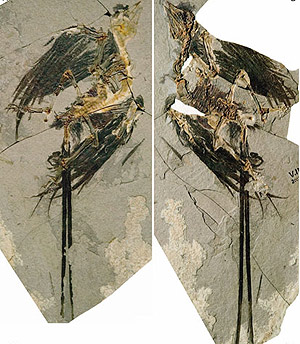
El fósil del 'Eoconfuciusornis zhengi' hallado en China se encuentra muy bien conservado. (Foto: Zhou Zhong-He | Instituto de Paleontología y Paleoantropología de Vertebrados en Beijing)
MADRID.- Paleontólogos chinos y británicos han descubierto el fósil de un ave llamada 'Eoconfuciusornis zhengi', también conocida como 'el alba del pájaro de Confucio', y que sólo es precedida por el 'Archaeopteryx', que vivió durante el período Jurásico.
Los restos, que se encuentran en buen estado, fueron hallados a la orilla de un lago durante una expedición en la provincia de Hebei al norte de China.
"El hallazgo de la 'Eoconfuciusornis' nos ofrece una nueva pieza para completar el rompecabezas de la evolución del 'Archaeopteryx' a las aves más actuales", explica Zhou Zhong-He, director ejecutivo del Instituto de Paleontología y Paleoantropología de Vertebrados en Beijing y coautor del estudio publicado en la revista 'Science in China'.
El espécimen, que está completamente desarrollado, posee alas de apariencia moderna y una cola simétricamente balanceada que quedaron grabadas como líneas curvas negras y marrones en la piedra.
"Estas líneas pueden ser un reflejo de los colores originales, pero éstos pudieron haber sido también los brillantes rojos, azules y amarillos que tienen las aves modernas" afirma Mike Benton, paleontólogo de la Universidad de Bristol en el Reino Unido y coautor del estudio.
"El estado de preservación en el que se encuentra el animal es extraordinario y nos ha dado muchos detalles", añade Zhang Fucheng, autor principal de la investigación y profesor del Instituto en Beijing.
Movimientos 'torpes'
El 'Archaeopteryx' era un aviador con movimientos 'torpes' y rasgos físicos de dinosaurio como sus dientes y su larga y huesuda cola. A pesar de esto el 'Eoconfuciusornis' y su antecesor compartían una capacidad limitada de ascender desde superficies planas y bajas, una desventaja anatómica que habría hecho que ambos pájaros fueran "vulnerables a atacar", explica Zhou.
El 'pájaro de Confucio' vivía probablemente entre los árboles y tenía garras y largas plumas en la cola que le ayudaban a "subir por los troncos y ramas, aclara el científico". "También es probable que el 'Eoconfuciusornis' se moviera por los lagos para rastrear y capturar pescados", añade.
"El descubrimiento del 'Eoconfuciusornis' es de gran importancia para el estudio de la diversidad de las especies capaces de volar y planear que se encontraban en esta parte del mundo hace 125 millones de años", comenta Xu Xing, un paleontólogo chino que en 2003 descubrió el extraño fósil de 128 millones de años del 'Microraptor gui', un dinosaurio de cuatro alas que aparentemente podía deslizarse de árbol en árbol.
Los científicos suponen que el fósil del pájaro se sumergió en el lago hace unos 131 millones de años, donde fue rápidamente cubierto por sedimento. Con el tiempo el animal quedó revestido en arenisca.

lunes, 5 de mayo de 2008

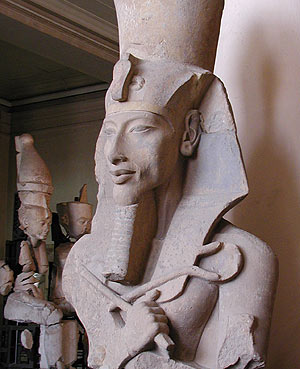
Revelan que el faraón egipcio Akenaton pudo haber sido hermafrodita


Fuente: Elmundo

MADRID.- A pesar de no haber sido el más varonil de los faraones, al poseer formas claramente femeninas, Akenaton tuvo al menos media docena de hijos. La combinación de rasgos masculinos y femeninos que aparecen en las estatuas y relieves de Akenaton, esposo de Nefertiti y padre de Tutankamon, revela que pudo haber sido hermafrodita, pues tenía curvas de mujer pese a que sus órganos reproductores eran los de un hombre. Así lo han afirmado un grupo de investigadores estadounidenses.
Irwin Braverman, investigador médico de la Universidad de Yale, ha defendido esta audaz tesis preparada para la conferencia anual sobre la muerte de personajes históricos que tiene lugar en la Escuela de Medicina de la Universidad de Maryland, tras haber analizado la morfología de las figuras del faraón.
Aunque el hermafroditismo es compatible con los rasgos físicos y faciales que se observan en las representaciones de Akenaton, Braverman y su equipo no tienen ninguna prueba directa que avale su teoría. Para ello necesitarían que las autoridades arqueológicas egipcias confirmaran cuál es la tumba del afeminado faraón y que les dejaran estudiar los restos de ADN que quedaran en ella.
Según los investigadores, la forma femenina de Akenaton se debía a una mutación genética que causó que su cuerpo convirtiera más hormonas masculinas de las necesarias en hormonas femeninas. Además, se supone que la cabeza del faraón era deforme por una enfermedad que produce que los huesos del cráneo culminan su desarrollo a temprana edad.
El faraón tenía "un aspecto andrógino. A pesar de poseer un físico femenino con amplias caderas y pechos, era hombre y era muy fértil, tanto que llegó a tener más de seis hijos, entre ellos Tutankamon" explica Braveman, quien utilizó estatuas y talladuras para completar sus estudios de Akenaton.
Braverman, especialista en estudiar la salud de los individuos a partir de sus retratos y representaciones, imparte clases en la facultad de Medicina de Yale utilizando pinturas del Centro para el Arte Británico, con las que enseña habilidades de observación a estudiantes de primer año.
Por su parte, el egiptólogo Donald B. Redford, ha afirmado que Akenaton pudo haber sufrido el síndrome de Marfan, un desorden genético que se caracteriza por producir formas alargadas, incluyendo en los dedos y en el rostro.
"Aunque esto es posible, aún es una teoría muy subjetiva" ha declarado afirma el profesor de estudios mediterráneos de la Universidad Penn State a la cadena Fox News.
Además de ser el esposo de Nefertiti y el posible padre de Tutankamon, Akenaton es conocido por introducir una innovadora forma de monoteísmo en el antiguo Egipto, donde reinó a mediados del 1.300 a.C.

viernes, 2 de mayo de 2008

Sacan a la luz templo funerario


El Universal
Luego de su tercera temporada de trabajo en la Tumba Tebana 39, en el Valle de los Nobles en Egipto, especialistas mexicanos identificaron que este monumento es en realidad un templo funerario, dedicado al segundo sacerdote del faraón Amon.
El equipo mexicano, encabezado por la egiptóloga Gabriela Arrache, confirmó que este descubrimiento resalta la importancia del estudio de campo que realizan desde 2005, porque si bien hay miles de tumbas en egipto, los templos funerarios se pueden contar con los dedos de la mano.
El equipo de la Universidad del Valle de México (UVM) ha logrado remover más de 600 toneladas de escombros de este monumento, con lo que ya pudo definir los límites exactos del templo.
Los investigadores mexicanos encontraron que el templo funerario consta de tres cámaras funerarias, un pasillo y un santuario central, además de dos pozos que van a las tumbas del sacerdote y sus familias.
Los 13 especialistas mexicanos lograron que durante la expedición realizada en marzo pasado, también comenzaran la consolidación y cimentación de las cámaras, las cuales estaban a punto de derrumbarse, dado que gran parte de los muros estaban sin ningún tipo de soporte.
“Igualmente se recolectaron diversos fragmentos de muro que esperamos el año próximo clasificar y colocar en el lugar original”, comentó Arrache.
A pesar de que en la entrada principal hay una maldición para todo aquel que ingrese en la tumba con el fin de saquearla o hacer daño, eso no detuvo a los ladrones. Durante los trabajos de restauración se hallaron dos pozos de saqueo que conducían a las cámaras funerarias, de donde fueron sustraídos lozas y pedazos de muro, que posteriormente eran vendidos en el mercado negro.
Los investigadores mexicanos incluso encontraron fragmentos de huesos humanos que se supone son los restos de los familiares del sacerdote al que le fue dedicado el templo, los cuales fueron recogidos y colocados en un solo sitio.
Uno de los grandes retos que se le presentará a los restauradores y arqueólogos mexicanos será el de limpiar las códices que se encuentran en las paredes, sumamente dañadas por el paso del tiempo.
Arrache expuso que a partir del Proyecto de la Tumba Tebana 39 se ha logrado intercambiar experiencias en cuanto a uso de materiales en el restauración en México con sus homólogos egipcios, además este estudio permitirá que por primera vez el país tenga una representación en el décimo Congreso Internacional de Egiptología, a efectuarse en mayo próximo en Rodas, Grecia.

jueves, 1 de mayo de 2008

Descubren en Argentina los restos de armadillos prehistóricos gigantes


TIENEN 800.000 AÑOS DE ANTIGÜEDAD

Descubren en Argentina los restos de armadillos prehistóricos gigantes

BUENOS AIRES.- El Museo Paleontológico de la ciudad argentina de San Pedro ha anunciado el hallazgo de restos óseos de tres ejemplares de una gran especie de armadillo prehistórico que murieron en un pantano hace unos 800.000 años.
El descubrimiento lo consiguió un equipo de trabajo del museo en una cantera de extracción de tosca a las afueras de San Pedro, a unos 170 kilómetros al norte de Buenos Aires

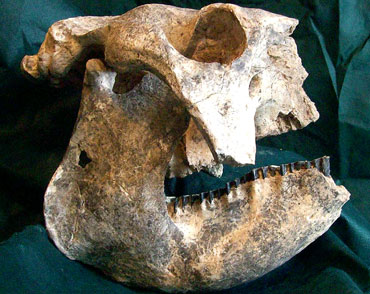
Se trata de "los primeros restos óseos conocidos hasta el momento de unos gigantescos armadillos fósiles correspondientes a la especie denominada 'Glyptodon munizi'", informaron los descubridores en un comunicado.
Los huesos fosilizados fueron extraídos de sedimentos finamente laminados que se habrían depositado en el fondo de un pantano que luego se secó.
Las piezas fueron recuperadas en un estrato situado a unos 15 metros bajo el nivel actual de suelo. Hasta este descubrimiento solo se tenía la certeza de la existencia de los 'Glyptodon munizi' por el hallazgo de partes de la coraza que los cubría.
Los paleontólogos lograron extraer en San Pedro un ejemplar con un 90 por ciento de su esqueleto en "óptimo estado de preservación". Asimismo, fueron descubiertos el cráneo, la mandíbula y fragmentos de costillas de un segundo ejemplar, y un húmero, una escápula y algunos huesos de las extremidades de un tercer individuo.
El esqueleto más completo "presenta detalles de gran valor científico que se desconocían en esta especie, como son un grupo de placas óseas que le protegían la zona del vientre y una gran cantidad de pequeños huesecillos que estaban incrustados en la piel de los pómulos cuando el animal vivía", destacó el museo.
Estos diminutos huesos dérmicos, llamados "osteodermos", cumplían la función de reforzar la piel ante el ataque de los depredadores, para evitar así que fuera desgarrada.

La especie 'Glyptodon munizi' estuvo representada por armadillos de talla gigantesca que superaban los 1.000 kilos de peso y medían unos tres metros de longitud.

YO BUSCO A CLEOPATRA


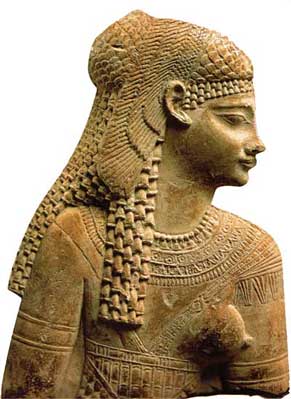
Cuando Kathleen Martínez aparece en el vestíbulo del lujoso hotel donde se hospeda en El Cairo, cuesta imaginar que esta dominicana se pase cuatro meses al año embadurnada de polvo hasta las cejas, cavando y cepillando en tenebrosas tumbas a 35 metros de profundidad. Se acerca encaramada a unas vertiginosas sandalias de tacón y perfectamente maquillada, tan coqueta como la reina a la que estudia desde hace quince años, la legendaria Cleopatra VII. «Ella inventó el maquillaje», afirma, fascinada por la figura de la primera reina que ocupó el poder en Egipto sin renunciar por ello a sentirse femenina. «Antes ya había reinado Hatshepsut, ¡pero se tenía que vestir de hombre! Cleopatra reinó como mujer».
Kathleen Martínez busca desde hace cuatro años la tumba donde descansan la extraordinaria reina y muy probablemente su amante, el general romano Marco Antonio. Bajo sus órdenes y pagados de su propio bolsillo, un equipo de 30 personas remueve la tierra del templo de Tabusiris Magna, cerca de Alejandría, en busca de lo que sería el mayor hallazgo arqueológico desde que se descubrió la tumba de Tuntankamón.
«Tenemos grandes expectativas», adelanta la arqueóloga, que no puede desvelar demasiado, aunque la sonrisa ilusionada la delata. Una palabra de más que no haya sido aprobada por el todopoderoso Zahi Hawass, secretario general del Consejo Superior de Antigüedades de Egipto, podría ser fatal para su misión. Martínez sí puede hablar de algunos de los hallazgos que se han encontrado en el templo. Bustos y monedas con el rostro de la reina que han permanecido enterrados durante siglos, y que han desatado las esperanzas de los arqueólogos, conscientes al fin de que siguen una pista fiable.
La egiptología dio durante mucho tiempo por sentado que su tumba yacía cerca del fastuoso palacio que la reina tuvo en Alejandría, sepultado ahora bajo las aguas debido a un terremoto. Pero Kathleen Martínez tenía otra teoría: Cleopatra tuvo que ser enterrada en un lugar apartado de Alejandría, para que su tumba y la de Marco Antonio no fueran profanadas y Octavio, su gran enemigo, no pudiera mostrar sus cuerpos como trofeos por las calles de Roma. «Señalé varios puntos posibles en un mapa de la antigua Alejandría y fui a convencer a Hawass», explica, consciente de que proceder de República Dominicana, un país sin tradición arqueológica, suponía una magra tarjeta de presentación. «Pero me escuchó». Cuatro años después, sueña con el día en que pueda verse cara a cara con la mítica reina, que, por cierto, «era muy guapa y tenía una nariz griega».