Crocs Uncover

Bizarre Species

lunes, 16 de junio de 2008

El Dorado Legend Snared Sir Walter Raleigh

Gold Muisca artwork in Colombian museum
Photograph by Mauricio Duenas/AFP/Getty Images


Through the centuries, this passion gave rise to the enduring tale of a city of gold. In the 16th and 17th centuries, Europeans believed that somewhere in the New World there was a place of immense wealth known as El Dorado. Their searches for this treasure wasted countless lives, drove at least one man to suicide, and put another man under the executioner's ax.
"El Dorado shifted geographical locations until finally it simply meant a source of untold riches somewhere in the Americas," says Jim Griffith, a folklorist in Tucson, Arizona.
But this place of immeasurable riches hasn't been found.
The origins of El Dorado lie deep in South America. And like all enduring legends, the tale of El Dorado contains some scraps of truth. When Spanish explorers reached South America in the early 16th century, they heard stories about a tribe of natives high in the Andes mountains in what is now Colombia. When a new chieftain rose to power, his rule began with a ceremony at Lake Guatavita. Accounts of the ceremony vary, but they consistently say the new ruler was covered with gold dust, and that gold and precious jewels were thrown into the lake to appease a god that lived underwater.
The Spaniards started calling this golden chief El Dorado, "the gilded one." The ceremony of the gilded man supposedly ended in the late 15th century when El Dorado and his subjects were conquered by another tribe. But the Spaniards and other Europeans had found so much gold among the natives along the continent's northern coast that they believed there had to be a place of great wealth somewhere in the interior. The Spaniards didn't find El Dorado, but they did find Lake Guatavita and tried to drain it in 1545. They lowered its level enough to find hundreds of pieces of gold along the lake's edge. But the presumed fabulous treasure in the deeper water was beyond their reach.
Raleigh's Quest
English courtier Sir Walter Raleigh made two trips to Guiana to search for El Dorado. During his second trip in 1617, he sent his son, Watt Raleigh, with an expedition up the Orinoco River. But Walter Raleigh, then an old man, stayed behind at a base camp on the island of Trinidad. The expedition was a disaster, and Watt Raleigh was killed in a battle with Spaniards. Eric Klingelhofer, an archaeologist at Mercer University in Macon, Georgia, says Walter Raleigh was furious at the survivor who informed him of Watt's death and accused the survivor of letting his son be killed. "The man goes into his cabin on the ship and kills himself," says Klingelhofer, who is trying to find the site of Raleigh's base camp on Trinidad.
Raleigh returned to England, where King James ordered him beheaded for, among other things, disobeying orders to avoid conflict with the Spanish.
The legend of El Dorado endures because "you want it to be true," says Jose Oliver, a lecturer at the Institute of Archaeology at University College London. "I don't think we've ever stopped seeking El Dorado."
So where is this lost city of gold? In his 1849 poem "El Dorado," writer Edgar Allan Poe offers an eerie and eloquent suggestion: "Over the Mountains of the Moon, down the Valley of the Shadow, ride, boldly ride…if you seek for El Dorado."

viernes, 13 de junio de 2008

Endangered sea dragon at Ga. aquarium pregnant


Endangered sea dragon at Ga. aquarium pregnant

ATLANTA - A weedy sea dragon at the Georgia Aquarium has something to celebrate this Father's Day. One of the rare creatures is pregnant for only the third time ever at a U.S. aquarium, aquarium officials said. But don't look for the expectant mom — dads carry the eggs in this family.
The aquarium's sea dragon has about 70 fertilized eggs — which look like small red grapes — attached to his tail. He is expected to give birth in early to mid-July, said Kerry Gladish, a biologist at the aquarium.
Sea dragons, sea horses and pipe fish are the only species where the male carries the eggs, Gladish said. Sea dragon pregnancies are rare because researchers don't know what gets them in the mood to mate.
"We know there's something biologically or environmentally that triggers them to want to reproduce, but in the aquarium world, we're not sure what that is," Gladish said.
The aquarium recently changed the lighting and thinned out the plants in the sea dragons' tank to give them room to court each other.
The aquarium has seven of the 18-inch sea dragons, which resemble Dr. Seuss characters with long aardvark-like snouts, colorful sea horse bodies and multiple paddle-like fins.
During mating, the female lays dozens of eggs and then transfers them to the male's tail.
In the wild, the survival rate for sea dragon babies is low, but in captivity it's about 60 percent, Gladish said. The fish is on the International Union for Conservation of Nature's list of threatened species, mostly because of pollution and population growth in its native Australia.
Only about 50 aquariums worldwide have sea dragons

jueves, 12 de junio de 2008

New Dinosaur May Link S. American, Aussie Dinos


James Owen
for NGN

A rare fossil found in Australia suggests dinosaurs were able to traverse the vast prehistoric continent of Gondwana, scientists report.

The hundred-million-year-old fossil belonged to a two-legged meat-eater, or theropod, that is closely related to Megaraptor namunhuaiquii, a giant, big-clawed carnivore from Argentina, says a team led by Nathan Smith of the University of Chicago's Field Museum.

Bizarre Dinosaurs Interactive

The discovery could help redraw the world map during the dinosaur era, researchers add.

That's because the newfound Australian dinosaur shows that animals could travel across Gondwana during the Cretaceous period, about 145 to 65 million years ago.

This in turn suggests that Gondwana's Southern Hemisphere landmasses broke up later than traditionally thought.

Strange Forearm

The study is based on the unidentified theropod's arm bone, which was discovered at Dinosaur Cove in southeastern Australia in 1989.

The fossil has unique features that solidly link it to the South American Megaraptor that was first described in 1998, Smith said.

"Megaraptor has a huge hand with a big [clublike] claw and a very strange forearm, so if you had to pick one bone to refer to, then the ulna [arm bone] might be that bone," Smith said.

The length of the fossil bone, 7.6 inches (19.3 centimeters), suggests the dinosaur was about half the size of Megaraptor.

This size difference could be because it is a smaller species or because it was a juvenile, Smith said.

The still-nameless Australian specimen is described this week in the journal Proceedings of the Royal Society B.

Animal Exchange

Previously scientists thought that Australian animals were isolated from life on other Gondwana landmasses during most of the Cretaceous because of geography and climate, the study authors said.

Bizarre Dinosaurs Interactive
"What we now have is demonstration that there must have been some kind of [animal] exchange between Australia prior to about a hundred million years ago," Smith said.

The new study also supports alternative models for the break up of Gondwana.

Traditionally it was thought that Africa and South America separated from eastern Gondwana—which included Antarctica, Australia, India, and Madagascar—some 138 million years ago.

The alternative models show Africa separating first.

The new study is not the final say on the matter, Smith emphasized.

But "I think in the future we are going to start seeing more [Australian fossils] that really demonstrate close affinities with other animals in South America."

Little Evidence

Yet the Australian husband-and-wife team who led the excavation of the theropod fossil aren't convinced by the findings.

Patricia Vickers-Rich, a paleontologist at Monash University in Victoria, said "too much is being interpreted based on a single bone."

The Australian dinosaur fossil record is "very scanty," she said, so "rather sweeping generalizations about biogeography are made based on very little evidence."

Tom Rich, curator of vertebrate paleontology at Museum Victoria, echoed his wife's comments.

He added that other Australian dinosaurs from the same period seem to be more closely allied with those from Asia than South America.

The reason for this is a "complete mystery to me," he wrote in an email, since a map of the world of that time would show "Australia was much further from Asia than it is today."

But, he said, "fossils should not be identified on the basis of geography if one is going to do meaningful paleobiogeographic reconstructions—otherwise one will be going around in a very tight logical circle."

The Riches said that more theropod bones from the Dinosaur Cove area are currently being studied. "There could be half a dozen different theropods," Tom Rich said, though the condition of the fossil bones may not allow individual species to be identified.

miércoles, 11 de junio de 2008

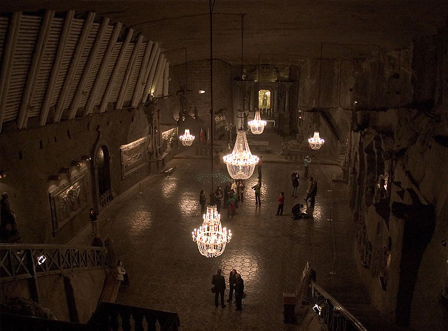
More Underground Wonders part 2

Pembrokeshire, Wales


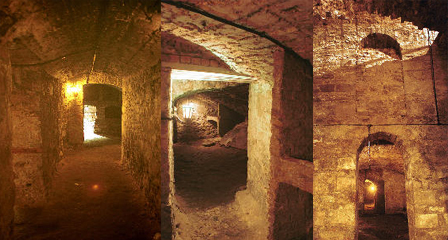
Edinburgh, Scotland has a long and strange history, though perhaps the oddest story of all is the tale of a bridge that was buried underground. After this bridge was built, superstition following a prominent death led to its disuse. As property values in the area grew, however, people first built under and then even on top of the bridge. Eventually leaks forced the abandonment of the spaces below, which were subsequently filled in. They were recently rediscovered and opened for tourists!


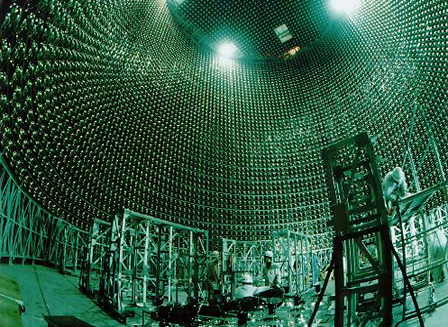
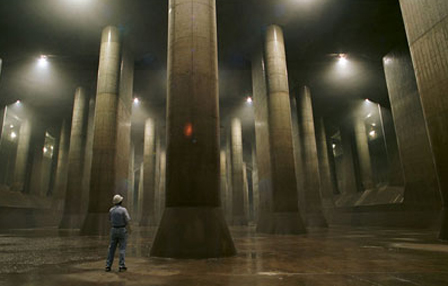
Tokyo, Japan is at the heart of a strange and gripping mystery involving seven riddles and a supposed secret underground city. It all began when Japanese researcher Shun Akiba found an old map of the Tokyo tunnel system that didn’t match current maps. Since then, he has found six other strange inconsistencies in historical maps and other records that suggest the existence hidden spaces. His claims have been vehemently denied by the Japanese government.


Seattle, Washington’s Pioneer Square district has a very peculiar historical quirk: a century ago, they raised the streets by an entire floor. People actually died falling off of the street to the lower sidewalks below before they managed to raise the sidewalks to the same level. Eventually, what was street level became completely unused and abandoned, though it was recently reopened for visitors.


7 (More!) Underground Wonders of the World: Lost Caverns and Buried Cities 1

The world is full of wonders, from abandoned towns and deserted settlements to underwater cities and underground architecture. Humans burrow into the Earth out of anything from necessity to superstition, driven by coincidence or coerced by circumstance. Without further ado, here are seven more underground wonders of the world.


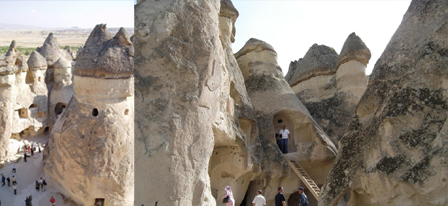
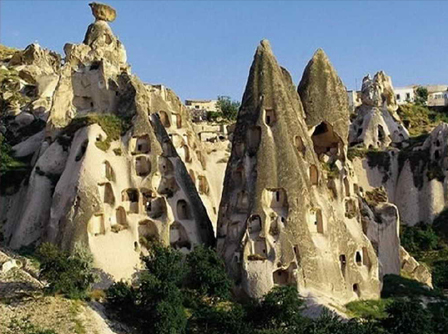
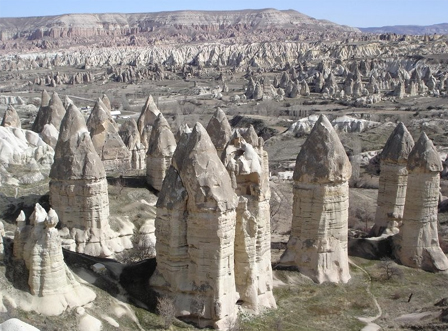
Kapadokya, Turkey is home to hundreds of linked rooms that, together, form an ancient system of underground cities over 2,500 years old. Areas are separated by narrow corridors lit once lit by oil lamps as well as other architectural devices for maximizing the defensibility of the spaces. Settlement initially started on the surface, then slowly moved underground over time.


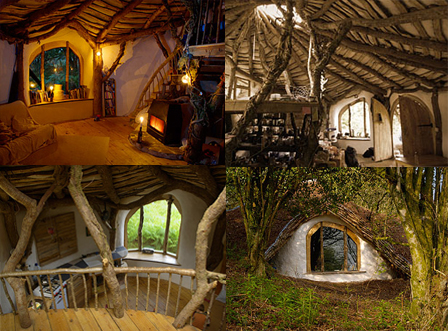
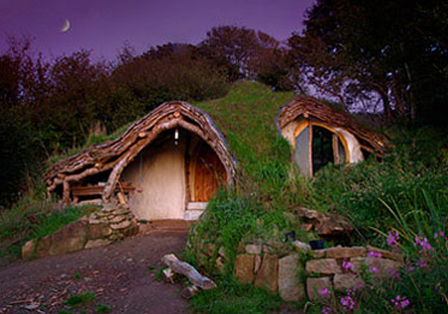
Pembrokeshire, Wales is home to a family with a house straight out of The Hobbit. This amazing architectural wonder is created virtually completely from the natural materials found around the residence. The walls are made out of stone and mud and water enters the house by gravity from a nearby spring. Non-natural materials, such as windows and plumbing, were recovered from trash.

martes, 10 de junio de 2008

Egypt Mummies Moved for DNA Tests; Pharaoh Among Them?


Andrew Bossone in Cairo
for NGN


Three mummies have been moved from the Valley of the Kings in Luxor to the Egyptian Museum in Cairo to begin extensive studies of their origins, Egyptian authorities recently announced.

Two female mummies found in a tomb known as KV21 and one male mummy found outside the tomb of Pharaoh Seti II, who ruled Egypt from 1200 to 1194 B.C., will undergo CAT scans and DNA analysis.

Such tests could tell researchers the mysterious mummies' ancestry and could even pinpoint their identities, although it may be years before scientists can say anything definitive.

Still, the females already show promise that they may be among several Egyptian queens that archaeologists have been searching for.

Both bodies were found in the Egyptian royal pose of women: the left arm bent at the elbow with the hand clenched diagonally across the chest, and the right arm laid straight alongside the body.

"We'll try to look at the two females in KV21, because we are now looking for the families of Tutankhamun through the Egyptian Mummy Project," said Zahi Hawass, secretary general of Egypt's Supreme Council of Antiquities.

The project is a five-year plan launched by Hawass to test and catalog the DNA of every mummy in the country.

"Maybe one of them could be Nefertiti or Tiye or Kiya, we do not know," said Hawass, who is also a National Geographic Explorer-in-Residence. (The National Geographic Society owns National Geographic News.)

DNA Trace

An Egyptian team will examine the mummies' genes in what Hawass describes as the only DNA lab in the world dedicated exclusively to the study of mummies.

The best way to study ancient genes is to examine mitochondrial DNA, said Angelique Corthals, a lecturer in biomedical and forensic studies at the University of Manchester in the United Kingdom, who trained the Egyptian team.

This type of DNA is passed on through the mother and contains thousands of copies of genetic information in each cell.

Comparing mitochondrial DNA from an unidentified mummy to the genetic code of an identified female mummy can establish a family relationship.

But the technique limits researchers to tracing a mummy's lineage through its female bloodline, which may not be available in many cases.

So instead the Egyptian team will examine the male mummy's nuclear DNA, which yields just one copy of the genetic code in each cell but can be traced from either parent.

This exhaustive testing process is made more difficult by contamination of the mummies' DNA over time and from chemicals used in the mummification process.

"[The DNA samples] are not just damaged because they are really old," Corthals said.

"They are also damaged because of the process of mummification. Ironically, what preserves the mummies best for their appearance destroys the DNA."

Several queens of the 18th dynasty, which lasted from 1550 to 1069 B.C. and preceded Tutankhamun's reign, have yet to be identified.

These include Kiya, who was likely Tut's mother and thus would share his mitochondrial DNA.

The queens Nefertiti, Tut's father's primary wife, and Tiye, Tut's paternal grandmother, have also not been found.

Mislabeled King

Scientists will study the male mummy on a hunch that it belongs to Thutmose I, who ruled from 1504 to 1492 B.C. and was the father of Queen Hatshepsut.

A mummy on display in the Egyptian Museum is labeled as Thutmose I, but recent tests revealed that the body is misidentified, Hawass noted.

"We found the mummy in the museum died at the age of 30, and Thutmose I died at the age of 50," he said. "He is not a royal mummy."

In 2007 Corthals and the Egyptian scientists conducted tests on a female mummy that is believed to be that of Hatshepsut.

The scientists will compare DNA from that mummy to the one recently found, but they note that making a connection will be hard because Thutmose I's family line is dubious.

His father is unknown and his mother was called Seniseneb, which was a common name during her time.

Inscriptions indicate that Thutmose I married his sister Ahmose, who was likely named after the first pharaoh of the 18th dynasty. But her exact parentage is also in doubt.

"It's not always clear who's in the family tree," Corthals said. "You may be testing who you think is the mother, but it might not be the mother at all."

In general, Corthals added, results from testing ancient DNA are not always certain.

"In the best of cases you can be only sure of a maximum … if you are really lucky of 90 percent [with mitochondrial DNA], but that's about it," Corthals said.

"There are to date no published studies that have successfully retrieved and compared ancient nuclear DNA from Egyptian mummies for the purpose of interfamily lineage."

lunes, 9 de junio de 2008

Martyrs or Imperial Guard?


Details of faces—7th century fresco devotional fresco (The Pontifical Commission of Sacred Archaeology)
Crypt of San Pietro e Marcellino (The Pontifical Commission of Sacred Archaeology)


New discoveries in the catacombs of San Pietro and Marcellinus

When a sinkhole opened up after a pipe broke underneath the convent and school of the Instituto Sacra Famiglia on Rome's Via Casilina, the sisters there received a surprise--about 1,200 surprises, in fact. The partial collapse of the building's foundation revealed five large chambers in which the remains of more than a thousand individuals had been interred almost simultaneously sometime at the beginning of the third century A.D.

Perhaps equally surprising is the location in which they were found. The convent under which the burial chambers are located sits atop the vast catacomb complex of San Pietro and Marcellinus. With three distinct gallery levels, the deepest of which is 36 feet (11m) below the surface, it is one of the largest such burial complexes in the city.

But the newly discovered burial chambers pre-date the extensive catacomb complex, which was believed to have been used by Christians from the mid-third century A.D. with permission from the emperor Gallienus who was anxious to make peace with them after the savage persecution they suffered at the hands his father, Valerian. And although the famed archaeologist Giovanni Battista de Rossi explored and recorded the catacomb at the end of the nineteenth century, there is no indication that he ever even knew of the presence of these chambers.

Given that these catacombs were thoroughly explored and mapped by De Rossi, how is it possible that these chambers were overlooked? "We're not entirely sure," says Raffaella Giuliani, an archaeologist and the Inspector of Catacombs for the Pontifical Commission for Sacred Archaeology in Rome, "but it is very likely that he and his team simply did not have the resources to shore up the site in order to prevent the collapse of the convent structure directly above it in order to pursue systematic excavation. The building's foundations come directly down into this area of the catacombs, and we had a great deal of work to do in order to reinforce the structure above us before we could excavate after the development of the sinkhole. It was a long and expensive process, even by today's standards."

It is not even certain that the newly discovered remains are of Christians, despite the fact that they are firmly ensconced within one of the most important Christian catacomb sites of ancient Rome. According to Giuliani, "there is at the moment no conclusive proof that can exclude the possibility that these may in fact be pagan burials." Which begs the question: What would pagan burials be doing in the middle of a Christian catacomb?

The answer may lie with the history of the land in which the catacombs are located. The property was originally the site of the barracks and training grounds of the equites singulares Augusti, a private corps of mounted Imperial bodyguards thought to have been formed by the emperor Trajan at the end of the first century A.D. At the beginning of the fourth century, they found themselves on the losing side of the war between Constantine and Maxentius, and were subsequently disbanded by the victorious Constantine after the battle of the Milvian Bridge in A.D. 312. At this point, the land--already in use by them underground--was turned over to the Christians. It was considered so sacred to the Christian community that the mausoleum of Constantine's mother, St. Helena, was constructed there.

During the period of use by the equites, however, this site was also used as a cemetery for the soldiers who served here. So the presence of pagan burials would not be as surprising as one might think. But more than a thousand of them interred almost at the same time? Giuliani explains that "it is very possible that what we are seeing here is the occurrence of some sort of plague or epidemic, perhaps a recurrence of the famous Antonine plague that took almost 1,200 lives a day during the reign of Antoninus Pius [A.D. 138-161]. The bodies are layered very carefully, one on top of the other, without lavish ceremony but nevertheless with great care. It seems as if these individuals were all interred within a short period--perhaps a few months at the most. Initially there was a great deal of excitement that these could perhaps represent martyrdoms [Christians executed for adhering to their faith], but this now appears unlikely as the Carbon 14 evidence and coins found among the remains date the burials to a period of relative peace between the Christian community and the Imperial government."

Stacked skeletons (The Pontifical Commission of Sacred Archaeology)
Further evidence that these may in fact be soldier burials is found in a close examination of the remains. Between the shrouds, a layer of gesso (a type of chalky plaster) covers each body. "This is a rather inexpensive and simple way to attempt to conserve the body, like a crude sort of mummification. We see this in soldier burials of the Roman period at times, particularly up in the northern parts of the Empire," says Giuliani, "and yet while we have found bits of amber and a limited amount of jewelry buried with the remains, we do not as yet have any conclusive proof one way or another as to whether or not these were Christian or pagan individuals. The fact that there are many women and several children present within these chambers does not necessarily preclude the fact that that these are the remains of the soldier of the equites it's possible and even probable that the soldiers would have had their families with them here on this property."

To date, approximately 100 skeletons have been excavated by a team of anthropologists from the University of Bordeaux whose specialty is the study of epidemic burials. They are currently studying the osteological remains for indications of trauma, which would perhaps point to a mass persecution rather than disease, but have found no such evidence. "So far,' explains Giuliani, "it would seem as if we are not dealing with victims of a persecution, but rather of a plague or epidemic of some sort. However, we still have a great deal more to excavate and study, for the moment we can make no conclusive statements as to who these individuals were or how they died." One thing that we can be certain of, however, is that the dark catacombs of Rome still have light to shed on our understanding of ancient history.

Sarah Yeomans is a journalist and archaeologist based in Rome and Washington, D.C. For more about Rome's catacombs, see Yeomans' "City of the Dead

viernes, 6 de junio de 2008

"Lost" Pyramid Found Buried in Egypt


Andrew Bossone in Cairo
for NGN

The pyramid of an ancient Egyptian pharaoh has been rediscovered after being buried for generations, archaeologists announced today.

The pyramid is thought to house the tomb of King Menkauhor, who is believed to have ruled in Egypt's 5th dynasty for eight years in the mid-2400s B.C.
Long since reduced to its foundations, the structure was previously known as Number 29 or the "Headless Pyramid." It was mentioned in the mid-19th century by German archaeologist Karl Richard Lepsius.

Then it disappeared in the sands of Saqqara, a sprawling royal burial complex near current-day Cairo.

It took Egyptian archaeologists about a year and a half just to remove all the sand above the pyramid.

"After Lepsius the location of the pyramid was lost and the substructure of [the] pyramid never known," said Zahi Hawass, secretary general of Egypt's Supreme Council of Antiquities.

"It was forgotten by people until we began to search this area and a hill of sand, maybe 25 feet [7.6 meters] high."

Hawass is a National Geographic explorer-in-residence. (The National Geographic Society owns National Geographic News.)

Old Kingdom Clues

Nothing on the pyramid specifically names its owner, and the majority of the structure has been destroyed, so Egyptian archaeologists had to put several clues together to identify it.

Past archaeologists have disputed the date of the pyramid, usually putting it in either the Old Kingdom, between 2575 and 2150 B.C., or the Middle Kingdom, between 1975 and 1640 B.C.

But the recent research determined that the pyramid lacked the winding mazes typical of a Middle Kingdom temple.

Instead, the lack of artwork and inscriptions, as well as the structure's red granite blocks, were typical of Old Kingdom pyramids, according to Hawass.

The burial chamber also contained the lid of a sarcophagus made of gray schist, a type of rock often used in the Old Kingdom.

What's more, the newfound pyramid resembles the pyramid next to it, which belongs to the first pharaoh of the 6th dynasty, Teti, who ruled from 2345 to 2181 B.C. That suggested the lost pyramid could also come from the 5th dynasty.

The neighboring pyramid also pointed to the owner of the pyramid as Menkauhor, since he was without a discovered burial tomb.

"There were missing pyramids of the kings, and this is one of them," Hawass said.


Sacred Road


Archaeologists also announced the discovery of new parts of a sacred road, dating to the Ptolemaic period, some 2,000 years after the Old Kingdom.

The discovery shows the sustained importance of Saqqara, which was located in the ancient capital of Memphis, the researchers added.

"During the whole history of Egypt, Memphis and Saqqara had remained very, very important," El Aguizy said.

"I am discovering tombs of people of the 26th dynasty [in Saqqara] that were reusing tombs of the 19th dynasty. It is a sacred place, and so many important people wanted to be buried there."

Another reason people wanted to be buried in Saqqara was the sacred road, which was used for the procession of mummified bulls of the god of the dead, Osiris.

"[Osiris] was enthroned like a king and when he died they made funerals like those of a king," El Aguizy said.

The bulls also had a historical significance: Their deaths were used to determine when a pharaoh reigned.

"It's a way of dating the pharaohs," El Aguizy said. "Sometimes we know how many bulls died during the reign of a king, or vice versa."

(See a photo of an underground tunnel for sacred bulls.)

More Discoveries Expected

The sacred path, first discovered by French archaeologist Auguste Mariette in 1850, is nicknamed the Way of the Sphinxes because of its long row of statues often found at the gates of Egyptian temples.

"The modern name of ancient Memphis is Mit Rahina … which means the way of the Sphinx," El Aguizy said.

"So [this path is] presumably the Way, with sphinxes [formerly] on the two sides."

Archaeologists hope the path will lead to more discoveries in the area. Plans are underway to relocate modern-day workers who live in a village beside the Menkauhor site to allow an expanded search for more temples.

"When I say we've discovered 30 percent of the Egyptian monuments, I take Saqarra as the first example," Hawass said.

"Saqqara is a virgin site," he added. "It's very important for us to do this excavation to understand more about the pyramids of the Old Kingdom."

Stingray


Stingrays are commonly found in the shallow coastal waters of temperate seas. They spend the majority of their time inactive, partially buried in sand, often moving only with the sway of the tide. The stingray's coloration commonly reflects the seafloor's shading, camouflaging it from predatory sharks and larger rays. Their flattened bodies are composed of pectoral fins joined to their head and trunk with an infamous tail trailing behind.

While the stingray's eyes peer out from its dorsal side, its mouth, nostrils, and gill slits are situated on its underbelly. Its eyes are therefore not thought by scientists to play a considerable role in hunting. Like its shark relatives, the stingray is outfitted with electrical sensors called ampullae of Lorenzini. Located around the stingray's mouth, these organs sense the natural electrical charges of potential prey. Many rays have jaw teeth to enable them to crush mollusks such as clams, oysters, and mussels.

When they are inclined to move, most stingrays swim by undulating their bodies like a wave; others flap their sides like wings. The tail may also be used to maneuver in the water, but its primary purpose is protection.

The stingray's spine, or barb, can be ominously fashioned with serrated edges and a sharp point. The underside may produce venom, which can be fatal to humans, and which can remain deadly even after the stingray's death. In Greek mythology, Odysseus, the great king of Ithaca, was killed when his son, Telegonus, struck him using a spear tipped with the spine of a stingray.

jueves, 5 de junio de 2008

Cleopatra Bust Among Treasures Found in Egypt Temple


Mati Milstein
for NGN

An alabaster bust of Cleopatra and a mask that might have belonged to her lover Marc Antony are part of a slew of treasures found north of Alexandria, Egypt's Supreme Council of Antiquities announced on Monday.

The artifacts were discovered inside the Taposiris Magna, a large temple in what is now Abusir that was built during the reign of Ptolemy II, which lasted from 282 to 246 B.C. Zahi Hawass, secretary general of the antiquities council, had been at the site leading a team searching for the lost tombs of Antony and Cleopatra.

According to legend, the famous couple committed suicide when Antony was defeated in 31 B.C. during a short series of land and sea battles that cemented Octavian's rule over Rome.

Hawass, who is also a National Geographic Explorer-in-Residence, said that in addition to the bust and mask, the team found 22 coins stamped with Cleopatra's face and a bronze statue of the Greek goddess Aphrodite.

While searching the site's network of underground shafts and tunnels, Hawass also stumbled across skeletons that he said were likely the remains of early Christians hiding from Roman authorities.

Though adamant that the most recent discoveries mean they are no closer to finding the tombs, the researchers think Taposiris is "a perfect place for us to look for Cleopatra and Marc Antony," Hawass said.

"It's just a theory—we are not 100 percent—that this was a typical place to hide the tombs away from Octavian."

Bigger Than Tut?

Cleopatra was the last ruler during Egypt's Greco-Roman Period, in which a Greek royal family governed from 323 to 30 B.C. She was arguably one of the most powerful and influential women in the ancient world.

In 48 B.C. she seduced Roman emperor Julius Caesar and bore him a son.

Years later she had three children with Marc Antony, then a key Roman political and military leader.

Their ill-fated love affair has been the subject of countless artworks, including paintings, movies, an opera, and a Shakespeare play.

One theory is that Taposiris Magna may have been chosen as the couple's burial site because of its temples to the Egyptian god Osiris and his wife, Isis.

"We hope Cleopatra's tomb is located in this site," Hawass said. "This could be an important discovery—bigger than that of King Tutankhamun's tomb."

John Baines is an Egyptologist at Oxford University's Oriental Institute who was not involved in the excavation.

"Aphrodite is not associated with indigenous Egyptian temples, so her presence may suggest a non-Egyptian, perhaps Ptolemaic connection," Baines said.

And masks similar to the one Hawass thinks might have belonged to Marc Antony were "normally part of a burial and are relatively common objects from Greco-Roman Egypt," he added.

Mary Beard, professor of classics at Cambridge University, said she is very doubtful that the site will contain the tomb of Cleopatra.

"I would have thought it very unlikely that Marc Antony was buried with her. Of course, if the title 'Tomb of Cleopatra' was pinned on [this site], it would be a huge tourist attraction," she said.

"I am not, needless to say, impugning the archaeological credentials of Mr. Hawass, but it's hard not to think that such factors play some part in the enthusiasm surrounding this discovery."

Hawass has been digging at Taposiris Magna for the past two years and has explored about 95 percent of the site.

Excavations are now on hold and will resume in November, when the team plans to use radar to further map buried features.

Missing Cape Cod lighthouse located in Calif.


WELLFLEET, Mass. - Local historians for decades thought the 30-foot tall lighthouse that once overlooked Wellfleet Harbor had been taken down and destroyed in 1925. Turns out, it had just been moved to the California coast.The fate of the cast-iron tower was uncovered last year by lighthouse researchers and reported by Colleen MacNeney in this month's edition of Lighthouse Digest.

MacNeney told the Cape Cod Times in Wednesday's edition it was her most exciting discovery.

Wellfleet historian Helen Purcell says the discovery of the lighthouse at Point Montara, 25 miles south of San Francisco, was a genuine shock.

MacNeney says she discovered correspondence that proved the lighthouse, first erected in 1881, had been moved by the Coast Guard from Wellfleet to Yerba Buena, Calif., and eventually to Point Montara.

There is no known documentation explaining how it was moved across the country, MacNeney said.

But Jim Walker, chairman of the Cape Cod Chapter of the American Lighthouse Foundation, speculates that because it is metal, it could have been disassembled bolt by bolt, with the pieces then transported by rail.

The lighthouse is still used as a navigational aid and a hostel.

miércoles, 4 de junio de 2008

Titanic Was Found During Secret Cold War Navy Mission


John Roach
NGN
June 2, 2008

The 1985 discovery of the Titanic stemmed from a secret United States Navy investigation of two wrecked nuclear submarines, according to the oceanographer who found the infamous ocean liner.

Pieces of this Cold War tale have been known since the mid-1990s, but more complete details are now coming to light, said Titanic's discoverer, Robert Ballard

"The Navy is finally discussing it," said Ballard, an oceanographer at the University of Rhode Island in Narragansett and the Mystic Aquarium and Institute for Exploration in Connecticut.

Ballard met with the Navy in 1982 to request funding to develop the robotic submersible technology he needed to find the Titanic. Ballard is also a National Geographic Society explorer-in-residence.

Surprise Find

Ronald Thunman, then the deputy chief of naval operations for submarine warfare, told Ballard the military was interested in the technology—but for the purpose of investigating the wreckage of the U.S.S. Thresher and U.S.S. Scorpion.

Since Ballard's technology would be able to reach the sunken subs and take pictures, the oceanographer agreed to help out.

He then asked the Navy if he could search for the Titanic, which was located between the two wrecks.

"I was a little short with him," said Thunman, who retired as a vice admiral and now lives in Springfield, Illinois. He emphasized that the mission was to study the sunken warships.

Once Ballard had completed his mission—if time was left—Thunman said, Ballard could do what he wanted, but never gave him explicit permission to search for the Titanic."But the Navy never expected me to find the Titanic, and so when that happened, they got really nervous because of the publicity," Ballard said.
"But people were so focused on the legend of the Titanic they never connected the dots."

http://ngm.nationalgeographic.com/ngm/0405/feature7/index.html
http://channel.nationalgeographic.com/series/finding-history/3570/Overview

Titanic: The Final Secret, a documentary on the discoveries, airs Monday, June 2, at 9 pm ET/PT on the National Geographic Channel.

Sunken Subs

The Thresher and Scorpion had sunk in the North Atlantic Ocean at depths of between 10,000 and 15,000 feet (3,000 and 4,600 meters).

The military wanted to know the fate of the nuclear reactors that powered the ships, Ballard said.

This knowledge was to help determine the environmental safety of disposing of additional nuclear materials in the oceans.

The Navy also wanted to find out if there was any evidence to support the theory that the Scorpion had been shot down by the Soviets.

Ballard's data showed that the nuclear reactors were safe on the ocean bottom and were having no impact on the environment, according to Thunman.

The data also confirmed that Thresher likely had sunk after a piping failure led to a nuclear power collapse, he added. Details surrounding the Scorpion are less certain.

A catastrophic mishap of some sort led to a flooding of the forward end of the submarine, Thunman said. The rear end remained sealed and imploded once the sub sank beneath a certain depth.

"We saw no indication of some sort of external weapon that caused the ship to go down," Thunman said—dismissing the theory that the Russians torpedoed the submarine in retaliation for spying.

Debris Trails

While searching for the sunken submarines, Ballard learned an invaluable lesson on the effects of ocean currents on sinking debris: The heaviest stuff sinks quickly.

The result is a debris trail laid out according to the physics of the currents.

With just 12 days left over in his mission, Ballard began searching for the Titanic, using this information to track down the ocean liner. He speculated that the ship had broken in half and left a debris trail as it sank.

"That's what saved our butts," Ballard said. "It turned out to be true."

The explorer has since used a similar technique to find other sunken ships and treasures, including his recent expeditions to the Black Sea.

Are these expeditions also part of top-secret missions? After all, the Black Sea is in the volatile Middle East.

"The Cold War is over," Ballard said. "I'm no longer in the Navy."

martes, 3 de junio de 2008

Bizarre but true facts about the Earth


Source: Thatsweird.net


In 1783 an Icelandic eruption threw up enough dust to temporarily block out the sun over Europe.

About 20 to 30 volcanoes erupt each year, mostly under the sea.

A huge underground river runs underneath the Nile, with six times more water than the river above.

Lake Bosumtwi in Ghana formed in a hollow made by a meteorite.

Beaver Lake, in Yellowstone Park, USA, was artificially created by beaver damming.

Off the coast of Florida there is an underwater hotel. Guests have to dive to the entrance.

Venice in Italy is built on 118 sea islets joined by 400 bridges. It is gradually sinking into the water.

The Ancient Egyptians worshipped a sky goddess called Nut.

The world's windiest place is Commonwealth Bay, Antartica.

In 1934, a gust of wind reached 371 km/h on Mount Washington in New Hampshire, USA.

American Roy Sullivan has been struck by lighting a record seven times.

The desert baobab tree can store up to 1000 litres of water in its trunk.

The oldest living tree is a California bristlecone pine name 'Methuselah'. It is about 4600 years old. The largest tree in the world is a giant sequoia growing in California. It is 84 meters tall and measures 29 meters round the trunk. The fastest growing tree is the eucalyptus. It can grow 10 meters a year.

The Antartic notothenia fish has a protein in its blood that acts like antifreeze and stops the fish freezing in icy sea.

The USA uses 29% of the world's petrol and 33% of the world's electricity.

The industrial complex of Cubatao in Brazil is known as the Valley of Death because its pollution has destroyed the trees and rivers nearby.

Tibet is the highest country in the world. Its average height above sea level is 4500 meters.

Some of the oldest mountains in the world are the Highlands in Scotland. They are estimated to be about 400 million years old.

Fresh water from the River Amazon can be found up to 180 km out to sea.

The White Sea, in Russia, has the lowest temperature, only -2 degrees centigrade. The Persian Gulf is the warmest sea. In the summer its temperature reaches 35.6 degrees centigrade.

There is no land at all at the North Pole, only ice on top of sea. The Arctic Ocean has about 12 million sq km of floating ice and has the coldest winter temperature of -34 degrees centigrade.

The Antarctic ice sheet is 3-4 km thick, covers 13 million sq km and has temperatures as low as -70 degrees centigrade.

Over 4 million cars in Brazil are now running on gasohol instead of petrol. Gasohol is a fuel made from sugar cane.

Ancient Roman Life Preserved at Pompeii

Cast of victim of the Vesuvius eruption in Pompeii, Italy
Photograph by Time & Life Pictures/Getty Images


By James Owens

On a fateful summer morning in A.D. 79 Mount Vesuvius buried the vibrant Roman city of Pompeii—and many of its citizens—beneath tons of volcanic ash and debris.

"Darkness fell, not the dark of a moonless or cloudy night, but as if the lamp had been put out in a dark room," wrote Pliny the Younger, who witnessed the cataclysm from across the Bay of Naples.

The darkness Pliny described drew the final curtain on an era in Pompeii. But the disaster also preserved a slice of Roman life. The buildings, art, artifacts, and bodies forever frozen offer a unique window on the ancient world.

Since its rediscovery in the mid-18th century the site has hosted a tireless succession of treasure hunters and archaeologists.

"Pompeii as an archaeological site is the longest continually excavated site in the world," says Steven Ellis, a classics professor at the University of Cincinnati and the co-director of the Pompeii Archaeological Research Project: Porta Stabia.

"Because of this, what we find in Pompeii is that every step in the development in the science of archaeology was tested out in Pompeii—with mixed results," he says.

For early archaeologists the disaster of the city's final days was the primary draw, unearthing buildings and streets as they stood at the time of the eruption.

"Today we are interested in the development of the city," Ellis explains. "What was there first and how did it get to the point it was when it was destroyed?"

The People's Pompeii

Ellis's team is particularly interested in a corner of the city near the Porta Stabia gate that is a bit off the beaten archaeological path.

"It's kind of a lost neighborhood of the city. When they first cleared it of debris in the 1870s they left this block for ruin (because it had no large villas) and it was covered over with a terrible jungle of vegetation," he says.

Much research has centered on public buildings and breathtaking villas that portray the artistic and opulent lifestyle enjoyed by the city's wealthy elite.

"We're trying to see how the other 98 percent of people lived in Pompeii," Ellis says. "It's a humble town block with houses, shops, and all the bits and pieces that make up the life of an ancient city."

But while his quest is knowledge of the living Pompeii, Stanford University's Gary Devore, the project's co-director, notes that the eruption still resonates because of the intimate connection it created between past and present.

"We're digging in an area where a lot of Pompeians died during the eruption," he says. "I remind myself all the time that I can investigate in such detail this ancient Roman culture as a direct result of a great human disaster.

"At the end of a day of intense mental processing and physical labor, when the tools are being packed up and put away for the night, I often take a moment to remind myself of that connection with the individuals whose homes and workshops we're digging up," he says.

Preserving Pompeii's Past for the Future

Even after hundreds of years of work, about a third of the city still lies buried. Yet there is no rush to unearth these hidden Pompeii neighborhoods.

Today's great challenge is preservation of what has been uncovered.

Volcanic ash long protected Pompeii, but much of it has now been exposed to the elements for many years. The combined wear of weather, pollution, and tourists has created a real danger of losing much of what was luckily found preserved.

Yet Devore is hopeful for Pompeii's future.

"The current administration of Pompeii [under Pietro Giovanni Guzzo] has been incredibly diligent in focusing on preservation," he says.

Over his 13 seasons at Pompeii, Devore has witnessed great improvements in conservation and preservation of the priceless site.

"As an archaeologist, I'm part of that process in the way that I document what gets dug out of the ground," he adds. "Since archaeology is destruction, we destroy bits of Pompeii as we go along. So it's incredibly important that we record in great detail, with the ability to recreate what we've taken away afterward. That's how we're part of the conservation of Pompeii."

lunes, 2 de junio de 2008

Machu-Pichu


The legendary Inca settlement of Machu Picchu has become one of the world's iconic areas. Its haunting aura is enhanced by the mystery surrounding its use and abandonment.