Crocs Uncover

Bizarre Species

lunes, 15 de diciembre de 2008

Confirmed: Scientists Understand Where Mass Comes From


The standard model of physics got it right when it predicted where the mass of ordinary matter comes from, according to a massive new computational effort. Particle physics explains that the bulk of atoms is made up of protons and neutrons, which are themselves composed of smaller particles known as quarks, which in turn are bound by gluons. The odd thing is this: the mass of gluons is zero and the mass of quarks [accounts for] only five percent. Where, therefore, is the missing 95 percent? [AFP]

The answer, according to theory, is that the energy from the interactions between quarks and gluons accounts for the excess mass (because as Einstein’s famous E=mc² equation proved, energy and mass are equivalent). Gluons are the carriers of the strong nuclear force that binds three quarks together to form one proton or neutron; these gluons are constantly popping into existence and disappearing again. The energy of these vacuum fluctuations has to be included in the total mass of the proton and neutron [New Scientist]. The new study finally crunched the numbers on how much energy is created in these fluctuations and confirmed the theory, but it took a supercomputer over a year to do so.

The theory that describes the interactions of quarks and gluons is known as quantum chromodynamics, or QCD. These exchanges bind quarks together by changing a quark property known as color charge. This charge is similar to electric charge but comes in three different types, whimsically referred to as red, green and blue. Six different types of quarks interact with eight varieties of gluons to create a panoply of elementary particles [Science News]. Calculating these interactions was a massive task, as researchers explain in an article in Science [subscription required]. The team used more than a year of time on the parallel computer network at Jülich, which can handle 200 teraflops - or 200 trillion arithmetical calculations per second [New Scientist].

But what, you may be saying, of the Higgs boson? The Higgs is often mentioned as an elusive particle that endows other particles with mass, and the Large Hadron Collider will search for it when it starts up again next year. But the Higgs is thought to explain only where the mass of the quarks themselves comes from. The new work confirms that the mass of the stuff around us is due only in very small part to the masses of quarks themselves. Most of it comes from the way they interact [Nature News].

Genghis Khan


Genghis Khan Mausoleum in Ordos


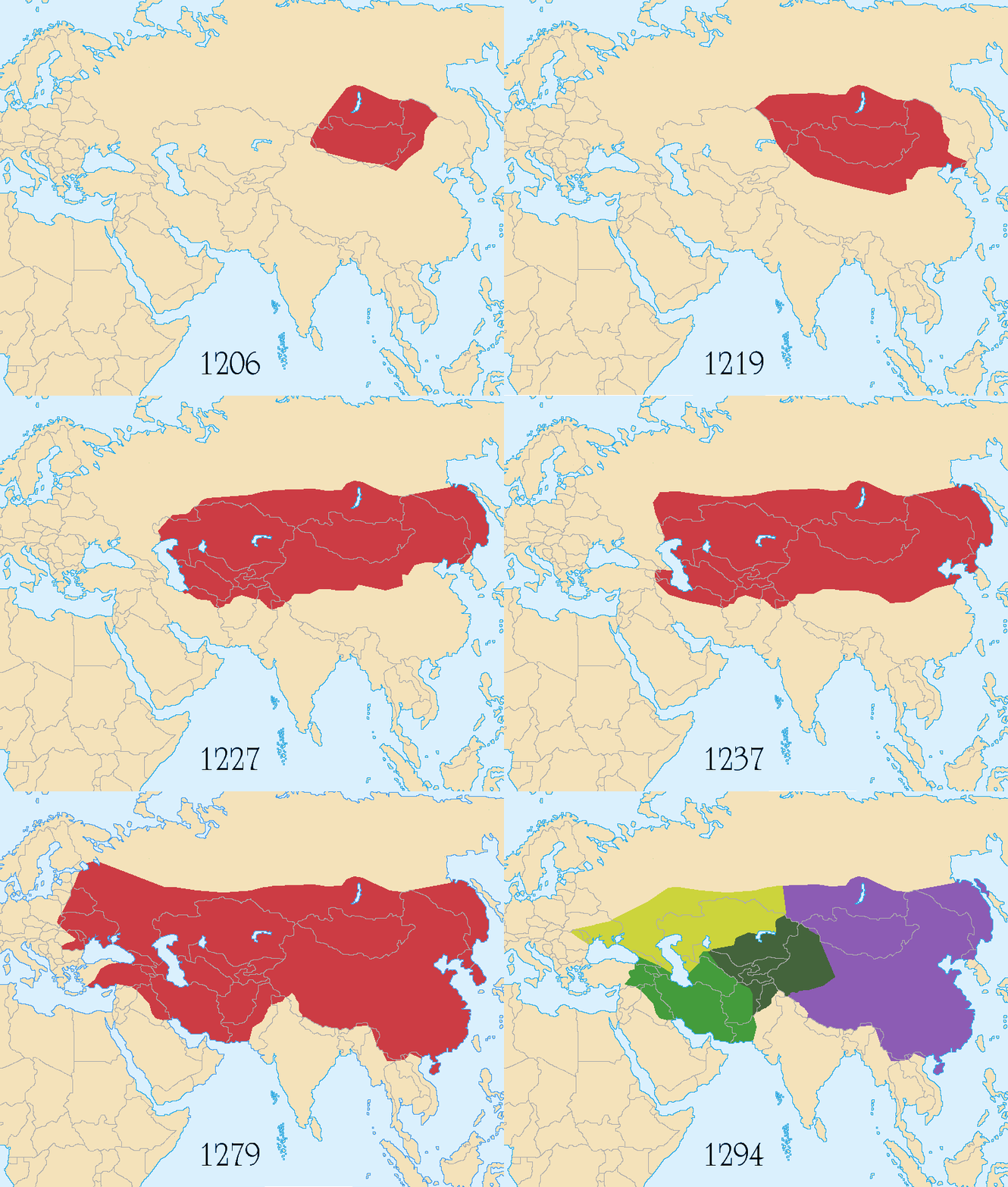
Genghis Khan ; Mongolian: Ч Chinggis Khaan, IPA: , Činggis Qaɣan; born Temüjin , was the Mongol founder, Khan (ruler) and posthumously declared Khagan (emperor) of the Mongol Empire, the largest contiguous empire in history.

He came to power by uniting many of the nomadic tribes of northeast Asia. After founding the Mongol Empire and being proclaimed "Genghis Khan", he started the Mongol invasions and raids of the Kara-Khitan Khanate, Caucasus, Khwarezmid Empire, Western Xia and Jin dynasties. During his life, the Mongol Empire eventually occupied a substantial portion of Central Asia.

Before Genghis Khan died, he assigned Ogedei Khan as his successor and split his empire into khanates among his sons and grandsons. He died in 1227 after defeating the Tanguts. He was buried in an unmarked grave somewhere in Mongolia at a location unknown. His descendants went on to stretch the Mongol Empire across most of Eurasia by conquering and/or creating vassal states out of all of modern-day China, Korea, the Caucasus, Central Asian countries, and substantial portions of modern Eastern Europe and the Middle East.

"The greatest happiness is to vanquish your enemies, to chase them before you, to rob them of their wealth, to see those dear to them bathed in tears, to clasp to your bosom their wives and daughters"

- Genghis Khan


Lineage

Temüjin was related on his father's side to Qabul Khan, Ambaghai and Qutula Khan who had headed the Mongol confederation. When the Jin Dynasty switched support from the Mongols to the Tatars in 1161, they destroyed Qabul Khan.[6] Genghis' father, Yesugei (leader of the Borjigin and nephew to Ambaghai and Qutula Khan), emerged as the head of the ruling clan of the Mongols, but this position was contested by the rival Tayichi’ud clan, who descended directly from Ambaghai. When the Tatars grew too powerful after 1161, the Jin switched their support from the Tatars to the Keraits.

Birth

The Onon River, Mongolia in autumn, a region where Temüjin was born and grew up.

Because of the lack of contemporary written records, there is very little factual information about the early life of Temüjin. The few sources that provide insight into this period are often conflicting.

Temüjin was born 1165 in a Mongol tribe near Burkhan Khaldun mountain and the Onon and Kherlen rivers in modern day Mongolia, not far from its current capital Ulaanbaatar. The Secret History of the Mongols purports that Temüjin was born with a blood clot grasped in his fist, a sign that he was destined to become a great leader. He was the third-oldest son of his father Yesükhei, a minor tribal chief of the Kiyad and an ally of Ong Khan of the Kerait tribe,[7] and the oldest son of his mother Hoelun. According to the Secret History, Temüjin was named after a Tatar chieftain that his father had just captured. The name also suggests that they may have been descended from a family of blacksmiths (see section Name and title below).

Yesükhei's clan was called Borjigin , and Hoelun was from the Olkhunut tribe. Like other tribes, they were nomads. Because his father was a chieftain, as were his predecessors, Temüjin was of a noble background. This relatively higher social standing made it easier to solicit help from and eventually consolidate the other Mongol tribes. No accurate portraits of Genghis exist today, and any surviving depictions are considered to be artistic interpretations. Persian historian Rashid al-Din recorded in his "Chronicles" that the legendary "glittering" ancestor of Genghis was tall, long-bearded, red-haired, and green-eyed. Rashid al-Din also described the first meeting of Genghis and Kublai Khan, when Genghis was shocked to find Kublai had not inherited his red hair.[8] Genghis's Borjigid clan, al-Din also revealed, had a legend involving their clan: it began as the result of an affair (technically a virgin birth) between Alan-ko and a stranger to her land, a glittering man who happened to have red hair and bluish-green eyes. Modern historian Paul Ratchnevsky has suggested in his Genghis biography that the "glittering man" may have been from the Kyrgyz people, who historically displayed these same characteristics. Controversies aside, the closest depiction generally accepted by most historians is the portrait currently in the National Palace Museum in Taipei, Taiwan

Early life and family

Temüjin had three brothers named Khasar (or Qasar), Khajiun, and Temüge, and one sister named Temülen (or Temülin), as well as two half-brothers named Bekhter and Belgutei. Like many of the nomads of Mongolia, Temüjin's early life was difficult. At nine years old, as part of the marriage arrangement, he was delivered by his father to the family of his future wife Börte, who was a member of the same tribe as his mother. He was to live there in service to Sansar, the head of the household, until he reached the marriageable age of 12. While heading home, his father was poisoned during a meal with the neighbouring Tatars, who had long been enemies of the Mongols. Temüjin returned home to claim the position of khan. However, his father's tribe refused to be led by a boy so young. They abandoned Hoelun and her children, leaving them without protection.

For the next several years, Hoelun and her children lived in poverty, surviving primarily on wild fruits, marmots, and other small game hunted by Temüjin and his brothers. It was during one hunting excursion that 13-year-old Temüjin killed his half-brother, Bekhter, during a fight which resulted from a dispute over hunting spoils.[9] This incident cemented his position as head of the household.

In another incident in 1182 he was captured in a raid and held prisoner by his father's former allies, the Bjartskular ("wolves"). The Bjartskular enslaved Temüjin (reportedly with a cangue), but with the help of a sympathetic watcher, the father of Chilaun (who would later become a general of Genghis Khan), he was able to escape from the ger by hiding in a river crevice. It was around this time that Jelme and Arslan, two of Genghis Khan's future generals, joined forces with him. Along with his brothers, they provided the manpower needed for early expansion. Temüjin's reputation also became relatively widespread after his escape from the Bjartskular.

At this time, none of the tribal confederations of Mongolia were united politically, and arranged marriages were often used to solidify temporary alliances. Temujin grew up observing the tough political climate of Mongolia, surrounded by tribal warfare, thievery, raids, corruption and continuing acts of revenge carried out between the various confederations, all compounded by interference from foreign forces such as the Chinese dynasties to the south. Temüjin's mother Ho'elun taught him many lessons about the unstable political climate of Mongolia, especially the need for alliances.

As previously arranged by his father, Temüjin married Börte of the Olkut'hun tribe when he was around 16 in order to cement alliances between their respective tribes. Börte had four sons, Jochi (1185–1226), Chagatai (1187—1241), Ögedei (1189—1241), and Tolui (1190–1232). Genghis Khan also had many other children with his other wives, but they were excluded from the succession, and records of daughters are nonexistent. Soon after Börte's marriage to Temüjin, she was kidnapped by the Tartars, and reportedly given away as a wife. Temüjin rescued her with the help of his friend and future rival, Jamuka, and his protector, Ong Khan of the Kerait tribe. She gave birth to a son, Jochi, nine months later, clouding the issue of his parentage. Despite speculation over Jochi, Börte would be his only empress, though Temüjin did follow tradition by taking several morganatic wives.[10]

Religion

Genghis Khan's religion is widely speculated to be Shamanism or Tengriism, which was very likely among nomadic Mongol-Turkic tribes of Central Asia. But he was very tolerant religiously, and interested to learn philosophical and moral lessons from other religions. To do so, he consulted among others with Christian missionaries, Muslim merchants, and the Taoist monk Qiu Chuji.

Uniting the confederations

The Central Asian plateau (north of China) around the time of Temüjin (the early 1200s) was divided into several tribes or confederations, among them Naimans, Merkits, Uyghurs, Tatars, Mongols, and Keraits, that were all prominent in their own right and often unfriendly toward each other as evidenced by random raids, revenges, and plundering.

Temüjin began his slow ascent to power by offering himself as an ally (or, according to others sources, a vassal) to his father's anda (sworn brother or blood brother) Toghrul, who was Khan of the Kerait, and is better known by the Chinese title Ong Khan (or "Wang Khan"), which the Jin Empire granted him in 1197. This relationship was first reinforced when Börte was captured by the Merkits; it was Toghrul to whom Temüjin turned for support. In response, Toghrul offered his vassal 20,000 of his Kerait warriors and suggested that he also involve his childhood friend Jamuka, who had himself become Khan (ruler) of his own tribe, the Jadaran.[11] Although the campaign was successful and led to the recapture of Börte and utter defeat of the Merkits, it also paved the way for the split between the childhood friends, Temüjin and Jamuka. Temüjin had became blood brother (anda) with Jamuka earlier, and they had vowed to remain eternally faithful.

The main opponents of the Mongol confederation (traditionally the "Mongols") around 1200 were the Naimans to the west, the Merkits to the north, Tanguts to the south, and the Jin and Tatars to the east. By 1190, Temüjin, his followers, and their advisors, had united the smaller Mongol confederation only. In his rule and his conquest of rival tribes, Temüjin broke with Mongol tradition in a few crucial ways. He delegated authority based on merit and loyalty, rather than family ties. As an incentive for absolute obedience and following his rule of law, the Yassa code, Temüjin promised civilians and soldiers wealth from future possible war spoils. As he defeated rival tribes, he didn't drive away enemy soldiers and abandon the rest. Instead, he took the conquered tribe under his protection and integrated its members into his own tribe. He would even have his mother adopt orphans from the conquered tribe, bringing them into his family. These political innovations inspired great loyalty among the conquered people, making Temüjin stronger with each victory.[12]

Toghrul's (Wang Khan) son Senggum was jealous of Temüjin's growing power, and his affinity with his father. He allegedly planned to assassinate Temüjin. Toghrul, though allegedly saved on multiple occasions by Temüjin, gave in to his son[13] and became uncooperative with Temüjin. Temüjin learned of Senggum's intentions and eventually defeated him and his loyalists. One of the later ruptures between Toghrul and Temüjin was Toghrul's refusal to give his daughter in marriage to Jochi, the eldest son of Temüjin, a sign of disrespect in the Mongolian culture. This act led to the split between both factions, and was a prelude to war. Toghrul allied himself with Jamuka, who already opposed Temüjin's forces; however the internal dispute between Toghrul and Jamuka, plus the desertion of a number of their allies to Temüjin, led to Toghrul's defeat. Jamuka escaped during the conflict. This defeat was a catalyst for the fall and eventual dissolution of the Kerait tribe.
Genghis Khan

The next direct threat to Temüjin was the Naimans (Naiman Mongols), with whom Jamuka and his followers took refuge. The Naimans did not surrender, although enough sectors again voluntarily sided with Temüjin. In 1201, a kurultai elected Jamuka as Gur Khan, "universal ruler", a title used by the rulers of the Kara-Khitan Khanate. Jamuka's assumption of this title was the final breach with Temüjin, and Jamuka formed a coalition of tribes to oppose him. Before the conflict, however, several generals abandoned Jamuka, including Subutai, Jelme's well-known younger brother. After several battles, Jamuka was finally turned over to Temüjin by his own men in 1206.

According to the Secret History, Temüjin again offered his friendship to Jamuka, asking him to return to his side. Temüjin had killed the men who betrayed Jamuka, stating that he did not want disloyal men in his army. Jamuka refused the offer of friendship and reunion, saying that there can only be one Sun in the sky, and he asked for a noble death. The custom is to die without spilling blood, which is granted by breaking the back. Jamuka requested this form of death, despite the fact that in the past Jamuka had been infamously known to have boiled his opponent's generals alive.

The rest of the Merkit clan that sided with the Naimans were defeated by Subutai, a member of Temüjin's personal guard who would later become one of the successful commanders of Genghis Khan. The Naimans' defeat left Genghis Khan as the sole ruler of the Mongol plains, which means all the prominent confederations fell and/or united under Temüjin's Mongol confederation. Accounts of Genghis Khan's life are marked by claims of a series of betrayals and conspiracies. These include rifts with his early allies such as Jamuka (who also wanted to be a ruler of Mongol tribes) and Wang Khan (his and his father's ally), his son Jochi, and problems with the most important Shaman who was allegedly trying to break him up with brother Qasar who was serving Genghis Khan loyally. Many modern scholars doubt that all of the conspiracies existed and suggest that Genghis Khan was probably inclined towards paranoia as a result of his experiences.[citation needed]

His military strategies showed a deep interest in gathering good intelligence and understanding the motivations of his rivals as exemplified by his extensive spy network and Yam route systems. He seemed to be a quick student, adopting new technologies and ideas that he encountered, such as siege warfare from the Chinese. Many legends claim that Genghis Khan always was at the front in battles, but these may not be historically accurate.

As a result by 1206 Temüjin had managed to unite or subdue the Merkits, Naimans, Mongols, Keraits, Tatars, Uyghurs and disparate other smaller tribes under his rule. It was a monumental feat for the "Mongols" (as they became known collectively). At a Kurultai, a council of Mongol chiefs, he was acknowledged as "Khan" of the consolidated tribes and took the new title "Genghis Khan". The title Khagan was not conferred on Genghis until after his death, when his son and successor, Ögedei took the title for himself and extended it posthumously to his father (as he was also to be posthumously declared the founder of the Yuan Dynasty). This unification of all confederations by Genghis Khan established peace between previously warring tribes and a single political and military force under Genghis Khan.

Death and burial

Mongol Empire in 1227 at Genghis Khan's death

In 1227, after defeating the Tangut people, Genghis Khan died (according to The Secret History of the Mongols). The reason for his death is uncertain and speculations abound. Some historians maintain that he fell off his horse during a horseback pursuit from the land of present day Egypt due to battle wounds and physical fatigue, ultimately dying of his injuries. Others contend that he was felled by a protracted illness such as pneumonia. The Galician-Volhynian Chronicle alleges he was killed by the Tanguts in battle. Later Mongol chronicles connect Genghis' death with a Tangut princess taken as war booty. One chronicle from the early 17th century even relates that the princess hid a small pair of pliers inside her vagina, and hurt the Great Khan so badly that he died. Some Mongol authors have doubted this version and suspected it to be an invention by the rival Oirads.[18]

Genghis Khan asked to be buried without markings, according to the customs of his tribe. After he died, his body was returned to Mongolia and presumably to his birthplace in Khentii Aimag, where many assume he is buried somewhere close to the Onon River and the Burkhan Khaldun mountain (part of the Kentii mountain range). According to legend, the funeral escort killed anyone and anything across their path to conceal where he was finally buried. The Genghis Khan Mausoleum, constructed many years after his death, is his memorial, but not his burial site.

On October 6, 2004, a joint Japanese-Mongolian archaeological dig uncovered what is believed to be Genghis Khan's palace in rural Mongolia, which raises the possibility of actually locating the ruler's long-lost burial site.Folklore says that a river was diverted over his grave to make it impossible to find (the same manner of burial of Sumerian King Gilgamesh of Uruk.) Other tales state that his grave was stampeded over by many horses, over which trees were then planted, and the permafrost also did its part in hiding the burial site.

Genghis Khan left behind an army of more than 129,000 men; 28,000 were given to his various brothers and his sons. Tolui, his youngest son, inherited more than 100,000 men. This force contained the bulk of the elite Mongolian cavalry. By tradition, the youngest son inherits his father's property. Jochi, Chagatai, Ögedei Khan, and Kulan's son Gelejian received armies of 4,000 men each. His mother and the descendants of his three brothers received 3,000 men each.

T. Rex, Other Dinosaurs Had Heads Full of Air


Ker Than

Dinosaurs were airheads—and that's not just because they had tiny brains, a new study says.

New 3-D scans of the skulls of Tyrannosaurus rex and other dinosaurs reveal the creatures had more empty space inside their heads than previously thought.

These air spaces made the skulls light but strong and could have helped dinosaurs breathe, communicate, and hunt.

The extra room may even have paved the way for flight in some species.

"Air is a neglected system that is actually an important contributor to what animals do," said study co-author Lawrence Witmer, a paleontologist at Ohio University in Athens.

The research is detailed in a recent issue of the journal The Anatomical Record.

Empty-Headed

Witmer and colleague Ryan Ridgely made detailed CT scans of air cavities in the skulls of two predators, T. rex and Majungasaurus; and two ankylosaurs, Panoplosaurus and Euoplocephalus, both plant-eaters with armored bodies and short snouts. (See an illustration of another ankylosaur species.)

The results mark the first time scientists were able to accurately estimate the weight of a dinosaur's head.

A T. rex head, for example, would have weighed more than 1,100 pounds (about 500 kilograms), close to the average weight of an adult cow, Witmer and colleagues found.

Until now, paleontologists had to make do with estimates for the weight of dinosaur heads, said Tom Holtz, a paleontologist at the University of Maryland who was not involved in the research.

"Larry's team is able to calculate a volume for the skull, so they can constrain the weight far more securely," Holtz said. "This is the next best thing to having a fleshy T. rex head to dissect."

Witmer estimates that T. rex's head would have been 18 percent heavier if not for the air spaces in its skull.

This savings may have allowed T. rex to pack more muscle onto its head, which possibly strengthened its bite and allowed it to tackle bigger prey.

"Crazy Straws"

The nasal airways in the ankylosaurs, however, were surprisingly convoluted. It was as if "crazy straws" had been rammed up the creatures' snouts, Witmer said.

These winding airways were often located next to large blood vessels.

"Whenever we see that, it raises the possibility that we're looking at heat transfer," Witmer said.

This setup would have allowed hot blood circulating through the creatures' heads to dump excess heat into the airways, helping to cool their brains and the rest of their bodies.

The transferred heat also could have warmed up air the dinosaurs breathed, making gas exchange in the lungs easier.

In addition, the twisty nasal passages may have acted as resonating chambers for sounds.

The two ankylosaur species examined had slightly different airways, so their voices would have been subtly different, Witmer said.

Hollow Bones

The research could provide new clues about how dinosaurs achieved flight.

Some of the new study's research subjects were theropods, the group of dinosaurs from which modern birds are descended.

(Related: "T. Rex Protein "Confirms" Bird-Dinosaur Link" [April 24, 2008].)

"Very often people have thought that birds have hollow bones because they fly, but it could be the other way around," Witmer said.

"They could have evolved hollow bones for other reasons, and that gave them the lower body mass necessary to take to the air."

Hans-Dieter Sues is a dinosaur expert at the Smithsonian National Museum of Natural History in Washington, D.C., who also did not participate in the research.

Witmer "certainly makes a strong case for paranasal sinuses [air-filled spaces within the skull] reducing the weight of the skull in certain dinosaurs," Sues said.

Sues cautioned, however, that "such functional hypotheses are difficult to test even in living species, including our own."

viernes, 12 de diciembre de 2008

It's Not the End of the World: What the Ancient Maya Tell Us About 2012


The Maya Cosmic Prophecy: From Sensation to Sensibility

Maya Scholars, in Mexico, Guatemala, Belize, Honduras, El Salvador and North America, have been watching with amusement and dismay as self-styled experts proclaim that ancient Maya prophets foretold an earth-shattering happening to occur December 21, 2012. This predicted phenomenon gets described in contradictory but often cataclysmic fashion--as an ecological collapse, a sunspot storm, a rare cosmic conjunction of the earth, sun, and the galactic center, a new and awesome stage of our evolution, and even a sudden reversal of the Earth's magnetic field which will erase all our computer drives. One even predicts the earth's initiation into a Galactic Federation, whose elders have been accelerating our evolution with a "galactic beam" for the last 5000 years. In sum, the world as we know it will suddenly come to a screeching halt.

These predictions are alleged to be prophecies by so-called "Ancient Mayans" whose "astronomically precise" calendar supposedly terminates on that date. According to such accounts, these mysterious Maya geniuses appeared suddenly, built an extraordinary civilization, designed in it clues for us, and then suddenly, inexplicably, vanished, as if they had completed their terrestrial mission. These same experts claim special credibility for the Maya prophecies by asserting that these historic sages, with their possible extraterrestrial origins, had tapped into an astonishing esoteric wisdom.

Could any of this be true?

The credibility of those claims deserves rational attention-which is what I intend to provide. Neither mystic nor prophet, I am a Mayanist. More specifically, I am a professional art historian and an epigrapher (less formally, a glypher), one who can read and write Maya hieroglyphs. For over a decade, I have focused my scholarly research specifically on Maya culture and writing, making some surprising discoveries that can present a more definitive perspective on the prophecies of the ancient Maya seers. As we approach the critical year, it is time to offer a more viable account of the Maya prophecy and expose both the fallacies and ethnocentricism tainting the current sensational accounts.

Here I intend to explain what we actually know about (1) Maya knowledge and attitudes, both ancient and modern, (2) the date 13.0.0.0.0. and (3) their many Creation stories and prophecies. I shall draw from recent decipherment, ethnography, interviews with Maya priests and knowledge-keepers, and especially from their surviving prophetic literature. That literature includes The Books of Chilam Balam, among others, the pre-Columbian Codices, and ancient inscriptions. The evidence is sometimes fragmentary and often puzzling to us moderns, at least at first. But I believe the effort will be worth it.

First, let me affirm that the year 2012 does hold particular significance in Mayan scholarship. Those of us who study the ancient and modern Maya — anthropologists, archaeologists, art historians, linguists, historians, amateurs, collectors — have been anticipating the end of the Maya Great Cycle for some time. We write it 13.0.0.0.0 4 Ajaw 3 K'ank'in. We have known for half a century that this date probably correlates to December 21 (or December 23) in the year 2012 in the Gregorian calendar.

jueves, 11 de diciembre de 2008

"Medusa" Worms Found in Mud Volcano


These new, undersea worms don't have eyes to turn you into stone.

But their resemblance to snake-haired Medusa (above) wasn't lost on discoverer Ana Hilário, who plans to name at least one after the mythological Greek monster.

Hilário, of Portugal's University of Aveiro, and colleagues recently found 20 species of the tiny worms, called frenulates, in mud volcanoes in the Gulf of Cádiz, an arm of the Atlantic Ocean southwest of Spain.

Mud volcanoes are places where methane-filled fluids seep from the seafloor, providing energy for "exceptionally rich ecosystems," Hilário said in an email.

(Related: "Giant Deep-Sea Volcano With 'Moat of Death' Found" [April 14, 2006].)

But scientists know little about the elusive frenulates, tube-dwelling worms that survive thanks to bacteria that live inside a special organ in their bodies.

The worms absorb chemicals such as methane from sediment and deliver the substances, via their blood, to the bacteria, which in turn produce organic carbon. The carbon nourishes both creatures.

Hilario has already named another genus from the expedition Bobmarleya—the worm's "dreadlocked" appearance reminded her of the Jamaican singer, she said.

miércoles, 10 de diciembre de 2008

First Exoplanet With CO2 Heats Up Hunt for Other Earths


Anne Minard

The recent discovery of carbon dioxide in the atmosphere of a Jupiter-like planet 63 light-years away has some researchers excited that we may soon find habitable exoplanets—worlds circling other stars.

According to lead author Mark Swain of NASA's Jet Propulsion Laboratory in Pasadena, California, carbon dioxide is a biomarker, a molecule associated with life as we know it.
This first discovery of the molecule on a far-flung planet, he said, is a step toward eventually finding biomarkers on smaller, more Earthlike worlds.

Last March, Swain and colleagues had announced the first detection of another biologically important chemical, methane, on the same exoplanet, as well as confirmation of water vapor.

"Methane is a potential marker [of life], as is water, as is carbon dioxide," Swain said. "So, three of the biggies we've already detected."

But not all planetary scientists are embracing the idea that finding chemicals such as carbon dioxide and methane on a distant planet is enough to say it is habitable.

On Earth, for example, carbon dioxide traps a certain amount of sunlight, keeping temperatures warm enough to support life. But on Venus, too much carbon dioxide creates a killing heat—average temperatures there reach 864 degrees Fahrenheit (462 degrees Celsius).

"To me, a CO2-dominated atmosphere says the planet would certainly be more like Venus than Earth," said Ellen Stofan, a planetary geologist for Proxemy Research in Maryland and a member of NASA's Cassini science team.

"To say it precludes life or guarantees life are both going out on a limb—we just don't know. But it is intriguing!"

Free Oxygen

Swain and colleagues made the CO2 discovery while studying radiation from an exoplanet dubbed HD 189733b.

The planet periodically transits—or passes in front of—its host star, giving observers a measurement of the star and planet's combined light. By subtracting the light from the star alone from the combined measurement, astronomers can "see" the planet's light.

Reading signatures from this light then told astronomers the chemical composition of the planet's atmosphere.
Swain acknowledges that HD 189733b is too big, gaseous, and hot to host life as we know it.

But the fact that we are now able to find biomarkers such as carbon dioxide on worlds so far away means that we'll know what to look for when reading light signatures from smaller, rocky planets like Earth.

So far, the most elusive biomarker on any exoplanet has been oxygen.

The only thing that drives the presence of free oxygen molecules on Earth is plants, points out Geoff Marcy, an astronomer at the University of California, Berkeley, who was not involved with the carbon dioxide study.

Without plants to generate O2, all the oxygen in the atmosphere would eventually react with other elements and be trapped.

"If you could detect free oxygen [on an exoplanet], then you'd have something. That would be remarkable," Marcy said.

Planet-Hunter's Toolkit

Astronomers searching for habitable exoplanets must first face the daunting challenge of finding distant Earthlike worlds.

Astronomers think at least half of the sunlike stars in our galaxy could host habitable terrestrial worlds.

But most of the more than 330 exoplanets found since the first discovery in 1995 have been large gaseous bodies that resemble Jupiter. Plenty have also been detected that are closer to the size of Saturn or Neptune, down to 17 times the mass of Earth.

Planets down to about five times the mass of Earth have been much rarer discoveries, and Berkeley's Marcy believes rocky planets—the holy grail, he calls them—are likely to be no more than three times the mass of Earth.

For now planetary detection methods are best suited to spotting larger bodies.

So far 270 of the known exoplanets have been detected using the so-called Doppler wobble, a shift in light from the parent star caused by a massive planet's gravitational tug.

About 50 or 60 exoplanets have been found because they transit their parent stars, and about 5 worlds have been spotted using a bizarre physical phenomenon predicted by Einstein's theory of relativity: gravitational lensing.

This is when light from other stars is bent by the gravitational tug of an object in the foreground that is orbiting a star too faint for us to see from Earth.

Marcy has high hopes that NASA's upcoming Kepler mission will bring the quest for rocky exoplanets closer to its goal.

"It's the hottest thing going, there's nothing even close to it," said Marcy, who is part of the Kepler science working group.

Set to launch on March 5, the space telescope is designed to find other Earths by staring at the constellation Cygnus and detecting stars that dim due to transiting planets.

Cygnus was chosen because it contains a large number of stars and won't be obscured by the sun at any time of the year.

The probe's photometers are sensitive enough to catch minute changes in light that result during a transit by a small planet, and its "eye" can see a hundred thousand stars at once.

"If Kepler finds that most stars have a terrestrial planet in the habitable zone, then there must be billions of such planets in our galaxy and life could be ubiquitous," said William Borucki, Kepler mission lead scientist at NASA.

"On the other hand, if Kepler finds no terrestrial planets or extremely few, then life of any type must be very rare. We could be the only sentient life."

Planet Trek

Even if Kepler proves there are scores of habitable worlds within Cygnus, the constellation contains stars that are a hundred to more than a thousand light-years away.

That means there won't be much to do but point radio telescopes toward them and scan for spillover from alien communication technologies.

(Related: "Are Neighborhood Aliens Listening to Earth Radio?" [September 7, 2006].)

That's because travel to any of its planets using current propulsion methods wouldn't be possible, at least not in a single generation, Marcy noted.

The idea requires acceptance of "having your great grandchildren be the ones who arrive at Alpha Centauri, not you."

Meanwhile, Notre Dame's Bennett points out that heavy elements—the main ingredients for planetary systems—are most common near the center of the galaxy, which is billions of years older than our solar system.

This ups the chances that any alien civilizations are much more advanced technologically than humans.

"If they're a few billion years ahead of us," Bennett said, "it's more of a question of them getting here than us getting there."

Pre-Columbian Tribes Had BBQs, Parties on Grave Sites


Alexis Okeowo
Some pre-Hispanic cultures in South America had elaborate celebrations at their cemeteries, complete with feasting and drinking grounds much like modern barbecue pits, according to a new archaeological study.

Excavations of 12th- and-13th-century burial mounds in the highlands of Brazil and Argentina revealed numerous earthen ovens. The finds suggest that the graves were also sites of regular festivals held to commemorate the death of the community's chief.

"After they buried an important person on the burial grounds, they feasted on meat that had been steamed in the earth ovens and drank maize beer," said archaeologist and study co-author José Iriarte.

Large rings of raised earth surround the mounds, with paths leading to their centers. The rings are composed of a series of the ovens, which were built up over generations.

"This monumental tradition spread across kilometers, from southern São Paulo state in Brazil to Río Grande del Sur in Argentina," added Iriarte, a professor of archaeology at the University of Exeter in the U.K.

The Jê people, who occupied the area Iriarte refers to during the 12th and 13th centuries, are recorded as having often consumed an alcoholic beverage of maize and honey."We think we are in the presence of a sizable, regionally organized population."

Along with the ovens, the team found big subterranean houses complete with roofs in a region rich with diverse plant and animal species, a desirable place to settle down, Iriarte added.
They were able to combine hunting and gathering, horticulture, fishing, and slash-and-burn agriculture to sustain large populations," said Iriarte, who has been conducting archaeological digs in the area for years and is considered an expert on Jê culture.

Michael Heckenberger, an archaeologist and anthropologist at the University of Florida who specializes in the Amazon, explained that the environment in southern Brazil was previously believed to be difficult for sustaining large populations.

"But I think it is very clear that [Iriarte and colleagues] have demonstrated that these were more than marginal tribes," Heckenberger said.

"This is part of a growing body of research that shows that groups of people in lowlands in Brazil had large, socially complex groupings, sociopolitical organization and social patterns including feasting," he added.

The new evidence also shows that, opposed to other peoples in the region, the Jê had settlements and celebrations that were more dynamic and permanent, Heckenberger added.

(See related: "Ancient Amazon Cities Found; Were Vast Urban Network" [August 28, 2008].)

Social Status

Other evidence has shown that the burial parties were reserved for renowned chiefs—who inherited their leadership positions—demonstrating "a moderate degree of political complexity," said Iriarte, whose work was funded in part by the National Geographic Society's Committee for Research and Exploration. (National Geographic News is owned by the National Geographic Society.)

The chief's son usually sponsored the festivities, Iriarte added. That way, "the relative reaffirmed ties to ancestors and to his position in society."

The Jê were also reaffirming their territory, according to Iriarte. Around A.D. 1000, several other groups of people were migrating around the Brazilian and Argentine highlands. The burial monuments, situated on hilltops or ridges, clearly outlined Jê communities, Iriarte said.

"They are really marking their land," he added.

"They carried out these festivities in a period of the year when pine nuts [eaten at celebrations] and maize were abundant," Iriarte added. "These were important resources to them."

Researchers found ceramic vessels such as bowls and small drinking cylinders that still contained residues of corn. Unidentifiable animal remains were also discovered.

The findings are published in the December issue of the journal Antiquity.

Complex Societies

Archaeologists traditionally viewed the Jeê people as small, nomadic groups. But these discoveries prove that theory wrong, Iriarte said.

"This is an unexpected development in this part of southern America," he said

martes, 9 de diciembre de 2008

"David and Goliath" City Found in Israel?


Mati Milstein in Tel Aviv


The remains of an ancient gate have pinpointed the location of the biblical city Sha'arayim, say archaeologists working in Israel.

In the Bible young David, a future king, is described as battling Goliath in the Elah Valley near Sha'arayim.

ancient biblical city and gate

The fortified gate at the Elah Fortress—the second to be found at the site—proves the existence of Sha'arayim, which means "two gates" in Hebrew, said Hebrew University archaeologist Yosef Garfinkel.

"All the sites from this period uncovered so far had only one gate. We have two gates and this is very unusual," Garfinkel said.

The gate, constructed of stones weighing up to ten tons, is located on the site's eastern side, facing Jerusalem.

Evidence of King David

The discovery is the second recent find to be made at the Elah Fortress—known as Khirbet Qeiyafa in Arabic—which is located near the present-day Israeli city of Bet Shemesh.

In October, Garfinkel revealed a 3,000-year-old pottery shard with text believed to be Hebrew—then hailed as the most important archaeological discovery in Israel since the Dead Sea Scrolls.

Initial carbon-14 dating of olive pits found at the site, as well as analysis of pottery remains, placed the text to between 1000 and 975 B.C.—the time King David would have lived.

Garfinkel believes the discovery provides further evidence that the fortified city or outpost was part of a centralized governmental system administered by King David, head of the Kingdom of Israel.

The fortress is the first site found from the Iron Age in what was once territory controlled by King David. Sha'arayim is also mentioned three times in the Bible and is twice linked to David.

"Everything comes together—the geography, the Bible, and the radiometric dating. It's no coincidence," Garfinkel said.

Judean City?

Other archaeologists received news of the second gate's discovery with interest, but they warned of jumping to conclusions.

Amos Kloner, an Israel studies professor at Bar Ilan University, once served as district archaeologist around the Elah site but is not involved in the current excavations.

"This is an initial idea, all aspects of which must be examined," he said. "[But] it doesn't matter if there is a second gate … This provides no indication of a Judean population there."

It's not known whether the Judeans or the Philistines controlled the strategic fortress overlooking the Elah Valley.

Team leader Garfinkel believes the site was most likely the westernmost outpost maintained by the Kingdom of Judea, which controlled land in southwest Asia and Palestine and was a predecessor to the Kingdom of Israel.

No Proof

Israel Knohl, also not involved in the Elah excavations, is a Biblical studies expert at Hebrew University of Jerusalem.

"The main problem with this site is that we still need unequivocal proof that it was a city of Judeans," Knohl said.

The discovery of the second gate "is of secondary importance … At the moment, we cannot determine with certainty this was Sha'arayim or that it was a Judean city."

Scholars know almost nothing of life in Sha'arayim.


"If you ask me what life was like even in Jerusalem during the time of King David, that we can't say," Knohl said. "When it comes to smaller [and less important] locations, we simply don't know."

Garfinkel said he will continue to explore the Elah site in search of further evidence.

"Maybe we'll find an inscription on the gate indicating who built the city: 'I David, son of Yishai, built this city,'" he said with a laugh.

lunes, 8 de diciembre de 2008

Humans 80,000 Years Older Than Previously Thought?


Tisisat Falls presents an idyllic scene. The Blue Nile crashes over the cataract in the lush forests of northwest Ethiopia.
Photograph by Diego Lezama Orezzoli/CORBIS


160,000-Year-Old Child Suggests Modern Humans Got Early Start


Kate Ravilious

Modern humans may have evolved more than 80,000 years earlier than previously thought, according to a new study of sophisticated stone tools found in Ethiopia.

The tools were uncovered in the 1970s at the archaeological site of Gademotta, in the Ethiopian Rift Valley. But it was not until this year that new dating techniques revealed the tools to be far older than the oldest known Homo sapien bones, which are around 195,000 years old.
Using argon-argon dating—a technique that compares different isotopes of the element argon—researchers determined that the volcanic ash layers entombing the tools at Gademotta date back at least 276,000 years.

Many of the tools found are small blades, made using a technique that is thought to require complex cognitive abilities and nimble fingers, according to study co-author and Berkeley Geochronology Center director Paul Renne.

Some archaeologists believe that these tools and similar ones found elsewhere are associated with the emergence of the modern human species, Homo sapiens.

"It seems that we were technologically more advanced at an earlier time that we had previously thought," said study co-author Leah Morgan, from the University of California, Berkeley.

The findings are published in the December issue of the journal Geology.

Desirable Location

Gademotta was an attractive place for people to settle, due to its close proximity to fresh water in Lake Ziway and access to a source of hard, black volcanic glass, known as obsidian.

"Due to its lack of crystalline structure, obsidian glass is one of the best raw materials to use for making tools," Morgan explained.

In many parts of the world, archaeologists see a leap around 300,000 years ago in Stone Age technology from the large and crude hand-axes and picks of the so-called Acheulean period to the more delicate and diverse points and blades of the Middle Stone Age.

At other sites in Ethiopia, such as Herto in the Afar region northeast of Gademotta, the transition does not occur until much later, around 160,000 years ago, according to argon dating. This variety in dates supports the idea of a gradual transition in technology.

A modern analogy might be the transition from ox-carts to automobiles, which is virtually complete in North America and northern Europe, but is still underway in the developing world," said study co-author Renne, who received funding for the Gadmotta analysis from the National Geographic Society's Committee for Research and Exploration. (The National Geographic Society owns National Geographic News.)

Morgan, of UC Berkeley, speculates that the readily available obsidian at Gademotta may explain why the technological revolution occurred so early there.

Complicated family tree

The lack of bones at Gademotta makes it difficult to determine who made these specialist tools. Some archaeologists believe it had to be Homo sapiens, while other experts think that other human species may have had the required mental capability and manual dexterity.

Regardless of who made the tools, the dates help to fill a key gap in the archaeological record, according to some experts.

"The new dates from Gademotta help us to understand the timing of an important behavioral change in human evolution," said Christian Tryon, a professor of anthropology from New York University, who wasn't involved in the study.

If anything, the story has now become more complex, added Laura Basell, an archaeologist at the University of Oxford in the U.K.

"The new date for Gademotta changes how we think about human evolution, because it shows how much more complicated the situation is than we previously thought," Basell said.

"It is not possible to simply associate specific species with particular technologies and plot them in a line from archaic to modern."

viernes, 5 de diciembre de 2008

"Screaming Mummy" Is Murderous Son of Ramses III?


Andrew Bossone in Cairo

ON TV Egypt Unwrapped: Mystery of the Screaming Man airs Friday, November 21, at 9 p.m. ET on the National Geographic Channel.

An Egyptian mummy who died wearing a pained facial expression could be Prince Pentewere, suspected of plotting the murder of his father, Pharaoh Ramses III, according to a new analysis.

Recent examinations of the mummy, found in 1886 and now located in the Egyptian Museum in Cairo, have helped archaeologists piece together a story of attempted murder, suicide, and conspiracy.

"Two forces were acting upon this mummy: one to get rid of him and the other to try to preserve him," said Bob Brier, an archaeologist at the University of Long Island in New York who examined the body this year.

Silent Scream

Called both "Unknown Man E" and the "Screaming Mummy" because of his open jaw and agonized expression, the mummy has baffled researchers since it was first uncovered.

Several archaeologists have proposed theories about the mummy's cause of death, saying he might have been buried alive or poisoned, or that he was a murdered Hittite prince during the reign of Tutankhamen.

Archaeologists now agree, however, that mummies are commonly found with their jaws open as a result of their heads falling back after death.

The Screaming Mummy was unlikely to have been a Hittite prince because that man probably would not have been mummified, according to those examining the corpse.

"They're not going to mummify this guy if they murdered him," Brier said. "They're going to get rid of the body."

The theory about poison, on the other hand, has not been totally ruled out.

Ignoble Death

Papyrus documents indicate a trial that took place in the 12th century B.C. for a wife of Pharaoh Ramses III. She was charged with conspiracy to murder the pharoah and put her son Pentewere in his place.

The mummy of Unknown Man E suggests an ignoble death, much like Pentewere would have received if this story were true, according to the archaeological team.

"We found this mummy is covered in sheepskin," said Zahi Hawass, secretary general of Egypt's Supreme Council of Antiquities and a National Geographic Explorer-in-Residence.

"In the mind of the ancient Egyptian. … To cover with sheepskin means he was not clean, he did something [bad] in his life," Hawass added.

Pentewere could have been sentenced to death by poison, after the murderous plans were revealed, according to Hawass and Brier.

The Unknown Man E was found without a grave marking, which would have prevented him from reaching the afterlife—a possible additional punishment for being part of a murder plot.

However, the denial of an afterlife contradicts careful mummification—something usually reserved for celebrated members of society, said Brier.

Desperate Attempt

Brier, a mummification expert, believes the Unknown Man E was mummified quickly because he did not have his brain or internal organs removed, nor was he completely dehydrated. Additionally, crude methods were used for his mummification.

"[Resin] is normally introduced into the cranium after removing the brain," he explained. But in the case of the Screaming Mummy, new research has shown that resin was poured down the corpse's throat.

"That's kind of a half-hearted or desperate attempt," Brier said.

So why wasn't the body simply disposed of without mummification? An influential person could have cared about the body and made sure it was at least hastily mummified, rather than thrown away.

"For some reason there was an attempt to make sure that he doesn't have an afterlife, and in another attempt somebody cares about him and tried to override that," Brier said.

Archaeologists insist the theory that the Screaming Mummy is Prince Pentewere is still only speculation, and so far have only conducted a CT scan of the mummy.

Hawass said he plans to conduct DNA testing to confirm the connection to Ramses III.

jueves, 4 de diciembre de 2008

Tundra


Tundra are among Earth's coldest, harshest biomes. Tundras ecosystems are treeless regions found in the Arctic and on the tops of mountains, where the climate is cold and windy and rainfall is scant. Tundra lands are snow-covered for much of the year, until summer brings a burst of wildflowers.

Mountain goats, sheep, marmots, and birds live in mountain, or alpine, tundra and feed on the low-lying plants and insects. Hardy flora like cushion plants survive on these mountain plains by growing in rock depressions where it is warmer and they are sheltered from the wind.

The Arctic tundra, where the average temperature is 10 to 20 degrees Fahrenheit (-12 to -6 degrees Celsius), supports a variety of animal species, including Arctic foxes, polar bears, gray wolves, caribou, snow geese and musk-oxen. The summer growing season is just 50 to 60 days, when the sun shines 24 hours a day.

The few plants and animals that live in the harsh conditions of the tundra are essentially clinging to life. They are highly vulnerable to environmental stresses like reduced snow cover and warmer temperatures brought on by global warming.

The Arctic tundra is changing dramatically due to global warming. Already, more southern animals like the red fox have moved onto the tundra. The red fox is now competing with the Arctic fox for food and territory, and the long-term impact on the sensitive Arctic fox is unknown.

It is the Arctic's permafrost that is the foundation for much of the region's unique ecosystem, and it is the permafrost that is deteriorating with the warmer global climate. Permafrost is a layer of frozen soil and dead plants that extends some 1,476 feet (450 meters) under the surface. In much of the Arctic it is frozen year round. In the southern regions of the Arctic, the surface layer above the permafrost melts during the summer and this forms bogs and shallow lakes that invite an explosion of animal life. Insects swarm around the bogs, and millions of migrating birds come to feed on them.

With global warming, the fall freeze comes later and more of the permafrost is melting in the southern Arctic. Shrubs and spruce that previously couldn't take root on the permafrost now dot the landscape, potentially altering the habitat of the native animals.

Another major concern is that the melting of the permafrost is contributing to global warming. Estimates suggest that about 14 percent of the Earth’s carbon is tied up in the permafrost. Until recently, the tundra acted as a carbon sink and captured huge amounts of carbon dioxide from the atmosphere as part of photosynthesis. This process helped keep the amount of this greenhouse gas from accumulating in the atmosphere.

Today, however, as the permafrost melts and dead plant material decomposes and releases CO2, the tundra has flipped from a carbon sink to a carbon contributor.

Venice Floods Reach Five Feet, But Life Goes On


December 2, 2008--Ignoring a mayoral request to stay indoors on Monday, Venetians and tourists wade and float through Venice's worst floods in 22 years.

The Italian island city saw waters as deep as 5 feet (155 centimeters)--the fourth deepest since the city began keeping flood records in 1872. The record, however, still stands: A 1966 flood put Venice under 76 sloshing inches (194 centimeters) of the wet stuff. "Venice is completely paralyzed," said a local official of the extreme floods that crested December 1, 2008, according to the Times of London.

Apparently these gondoliers didn't get the message. Shown breakfasting Monday, they exemplify the locals' rubber-booted fortitude in the face of floods, which occur several times a year. Outside the Doge's Palace (right), Venice's Piazza San Marco is hidden by floodwaters nearly as high as cafe tables on December 1, 2008.

The flood put nearly the entire city underwater.

Five years ago, the city began building a $5.5-billion system of offshore dams, expected to be completed in 2011. Such seawalls should prevent floods like this week's. The floods couldn't deter these shoppers, who donned tall boots and perused a pastry shop in Venice on December 1, 2008.

Mayor Massimo Cacciari urged residents to stay indoors and tourists to "think again" about visiting, the Scotsman reported.

"It all happened so quickly--within 20 minutes we were up to our waists in water," a shopkeeper told the newspaper

A woman waits for a boat amid floodwaters in Venice, Italy, on December 1, 2008.

Monday's extreme water levels led officials to suspend ferry and water taxi services in the city.

"We sent out another warning about very high tides this morning," said Leonardo Cossutta, who runs the Venice Tide Center's control room, on December 2, the New York Times reported.

He said transportation was returning to normal, although some canal ferries were forced to use alternative routes. Heightened canal water levels had made it impossible for the boats to fit under some bridges.
A woman crosses Venice's Piazza San Marco on an elevated walkway on December 2, 2008. The water had risen up to five feet (1.5 meters) high on Monday before beginning to recede on Tuesday.

The temporary walkway is designed to help visitors and residents navigate the city during flooding. Workers were unable to install most of the city's platforms, however, as the water rose too quickly

Alabama


The tranquil pace of life in Monroe County, Alabama, has nurtured some notable literary figures. Harper Lee and Truman Capote have called the county home.

Alabama Information and HistoryHome to five Native American tribes (Creek, Cherokee, Chickasaw, Choctaw, and Seminole), this area of fertile soils was the heart of the "cotton kingdom" before the Civil War.

Today Alabama lies at the center of a revitalized Deep South. Birmingham, the state's largest city, has become a focus for medical research, and is a major manufacturer of steel, iron, and coal. Leading industries include textiles and apparel, rubber and plastics, paper, chemicals, primary metals, and automobile manufacturing. The Alabama Research and Education Network, first state-funded computer network in the U.S., links universities and school systems across the state.

The Tennessee-Tombigbee Waterway, a transportation corridor for industry and agriculture, connects 16,000 miles of U.S. inland waterways to the Gulf of Mexico via Mobile's port.

ECONOMY

Industry: retail and wholesale trade, services, government, finance, insurance, real estate, transportation, construction, electrical equipment.
Agriculture: poultry, forest products, cattle, nursery stock, cotton, eggs, peanuts, soybeans.

martes, 2 de diciembre de 2008

Sources of Saturn Moon's Supersonic Water Jets Revealed


Richard A. Lovett

Jets of water vapor blasting out of Saturn's moon Enceladus at supersonic speeds are coming from vents each about the size of a professional sports stadium, a new study says.

Scientists first saw a plume of water vapor and dust shooting from the moon's south pole in 2005.
Research later determined that the water geysers are gushing out at about 1,000 miles (1,609 kilometers) an hour from a series of 100-mile-long (161-kilometer-long) fissures dubbed tiger stripes.

The new finding indicates that the gas and dust are escaping from relatively small vents along those fissures.

"We are making the distinction between the whole plume and individual jets in it, like streamers or searchlight beams," said team member Larry Esposito, of the University of Colorado in Boulder.

The researchers think the jets are formed when liquid water from pools not far beneath the icy moon's surface accelerates as vapor passes through a maze of nozzle-like channels before erupting into space.

"It's one more little piece of evidence that the source of the plume is liquid water," said lead study author Candice Hansen, a planetary scientist at NASA's Jet Propulsion Laboratory in Pasadena, California.

Swimming Pools and Ping Pong

The Cassini spacecraft observed the way the plume dimmed starlight shining from behind as the probe zipped past Enceladus in 2005 and 2007.

The data allowed scientists to determine the vapor jets' speed and density as low as 9 miles (15 kilometers) above the surface.

That, in turn, allowed them to calculate the likely size of the vents from which the vapor is emerging.

"It's certain the jets are not coming from the whole fissure," Esposito said.
Instead they are shooting out from regions that are no larger than 0.2 square miles (0.6 square kilometers), although the vents may be even smaller, depending on the temperature of the water vapor, the researchers note.

Overall, about 440 pounds (200 kilograms) of water are being blasted into space every second—roughly the equivalent of a residential swimming pool every few minutes.

But the amount observed in 2007 was less than that seen in 2005.

That was a surprise, the University of Colorado's Esposito said, because in 2007, Enceladus was at a point in its orbit where scientists had calculated that tidal forces from Saturn would stretch the vents wider, increasing their flow.

Instead, the opposite appears to have happened, the scientists report in this week's issue of the journal Nature.

"Sometimes you learn more by being wrong than by being right," study leader Hansen said.

She added that theoretical physicists are already looking at ways to refine their models of the moon to account for the new finding.

"It is the natural back-and-forth ping-pong [of science]," she said.

"You make observations. People have hypotheses and theories about what's going on. [We] take more observations and figure out where we're on the right track and where we probably are not."

The finding does, however, bolster the case for subterranean liquid water, strengthening the argument that Enceladus might be one of the better places in the solar system to look for extraterrestrial life.

In a March 2008 flyby, Cassini dipped into the plume and detected not only water vapor but also methane, carbon dioxide, and other organic molecules.

"We cannot say whether there is life or not," Hansen said. "But if we can conclude that there is liquid water, then we can say at least the ingredients are there.

lunes, 1 de diciembre de 2008

Oldest Turtle Found; May Crack Shell-Evolution Mystery


Brian Handwerk

Fossils of the oldest-known turtles, unearthed in southwestern China, may help answer an evolutionary enigma—how did the turtle get its shell?

The 220-million-year-old animals did not have full shells, or carapaces, on their backs, researchers found.

But the newfound creatures did sport fully developed plastrons—the flat part of a turtle shell that covers and protects the belly.

The discovery supports the theory that turtle shells formed from the underside—plastron first—and grew bony extensions of ribs and bone formation above backbones that eventually joined to form the classic shell that exists today.

Alternate Theory

An alternate theory of shell evolution suggests that turtle shells developed from the fusion of bony armor plates in the skin, known as osteoderms, seen in some dinosaurs and some modern-day reptiles, including crocodiles.

But the prehistoric turtle, dubbed Odontochelys semitestacea and described in a recent edition of the journal Nature, has no osteoderms.

"So far there is no direct evidence for the osteoderm theory," said study co-author Chun Li of the Institute of Vertebrate Paleontology and Paleoanthropology at the Chinese Academy of Sciences in Beijing.

"On the contrary, here, in our hands, there is an ideal missing link for turtle evolution. It has no osteoderms on its back, but only ossified neural [central] plates and expanded ribs."

The study also notes that embryonic evidence from modern turtles suggests that their shells begin to form in a similar manner.

If plastrons developed first, they may point to a marine lifestyle in which turtle bellies needed protection from predators," Li noted.

"We are not sure if the water [was] marine or [from other water bodies], so we presumed … that the animal inhabited marginal areas of the sea or deltas," he said.

Exciting Discovery

Scientists have waited a long time for a find like Odontochelys, Li said: The previously oldest known turtles featured fully formed shells.

"The new specimens are a very exciting discovery," agreed Robert Reisz of the University of Toronto, who was not involved in the research.

But Reisz suggests an alternate evolutionary interpretation for the intriguing fossils.

"Their argument is valid," he said of Li and colleagues.

"But we argue that it's equally possible that this could already be a [shell] reduction in an earlier turtle that we haven't found. Lots of marine turtles actually reduce their shell once they get into the water."

"Hopefully we'll find more," Reisz added. "We're closing the gap, but there is still a big morphological gap between this turtle and its non-turtle ancestors."

Odontochelys also boasts another feature seen in no other turtles so far—teeth, Reisz added.

"Basically if you look at all the turtles we know, other than this one, they all have a beak rather than teeth," he said.

"Turtles come from reptile ancestors with teeth so we expected this, but it's still a great thing to find."