Crocs Uncover

Bizarre Species

martes, 2 de junio de 2009

Gets Billion-Year Life Extension


The Earth could be habitable for another 2.3 billion years, extending previous estimates of life’s horizon by more than 1 billion years.

King Fai Li and his colleagues at Caltech hypothesize that Earth’s atmospheric pressure has always varied, and that it could fall in the distant future, keeping Earth from frying for far longer than previous research had shown.

If the new idea proves correct and can be extended to other planets with biospheres, it could increase the chances that earthly civilization finds extraterrestrial life by doubling the percentage of time that planets could be inhabited.

“[T]he Earth will be identifiable as an inhabited planet for nearly half the total lifetime of the Sun, an important point to consider in the search for life on extrasolar planets,” the authors write in the Proceedings of the National Academy of Sciences.

Over the next hundreds of millions of years, the sun will continue to get brighter until eventually, Earth becomes too hot to inhabit. Previous calculations had pegged that time at about a billion years from now, but the new paper argues that earlier models had neglected the role of atmospheric pressure in regulating the temperature of the planet on astronomical time scales.

Atmospheric pressure is a key variable in the overall greenhouse-gas effect because it determines how much infrared radiation greenhouse gases absorb. Higher pressures mean more absorption and consequently, more heat. Lower pressures have the opposite effect.

Life itself would be the mechanism for these temperature changes. By “fixing” nitrogen, pulling it out of the air and eventually into the Earth’s deep ocean, microbes could be making the atmosphere lighter one atom at a time.

“I am glad that Li and colleagues have raised the issue of how overall variation in atmospheric pressure may have affected past and may affect future climate,” ecologist Ken Caldeira of Stanford University said in an e-mail. “This could be relevant for understanding climate change on the billion-year time scale.”

Despite this potentially important role, atmospheric pressure in the distant past has gone uninvestigated.

“We have a lack of data about the past history of the atmospheric pressure,” said Li.

Admittedly, that means that there is a lot of uncertainty in their calculations.

“I think more work needs to be done before we can say with any confidence how the total mass of the atmosphere has varied in the past and how it might vary in the future,” Caldeira said.

While there are implications for very long time scales, Li said the work was unlikely to have an impact on the models of anthropogenic climate change.

“We all know that the human activity which is influencing the atmosphere has a time scale of hundreds of years or thousands of years,” Li said. “Even if the biosphere is really controlling the climate, it’s not on that time scale.”

Li said that an important next step in the research field would come from astrobiologist Roger Buick’s lab at the University of Washington, which is attempting to measure atmospheric pressures deep in the past.

“So, the assumption that we’ve always had an atmosphere of the same pressure as now is widespread but there’s no justification for it,” Buick said. “The reason that everyone just assumes an atmosphere of roughly current pressure is that it is exceedingly difficult to measure in the past. The weight of the atmosphere doesn’t leave much record in geology.”

But Buick found a set of basalt rocks from 2.7 billion years ago in Northwestern Australia that he thinks bear the marks of that pressure. Gas bubbles trapped in the rocks could provide the answer to whether or not the atmospheric pressure was different way back then.

Using the size of gas bubbles to establish the altitude of an eruption is a well-known scientific practice — smaller bubbles mean lower, larger ones mean higher. Buick, though, knows from other evidence that the rocks were formed at sea level, so variation in the bubble size will be an indication of atmospheric pressure, not elevation.

“If you know that your basalt erupted exactly at sea level, you can use it as a paleobarometer rather than a paleoaltimeter,” he said.

Buick’s “got an open mind” about what he might find, but no matter what the data shows, he’s not confident that it’ll be well-received by the scientific establishment.

“If the number is substantially different, either greater or lesser from today, we’ll have quite a bit of explaining to do and I expect people will not believe it anyway,” he said.

Li’s group, though, is waiting on Buick’s data to let them know whether they’re on the right track with their speculations that Earth’s biosphere can actually change the weight of the atmosphere.

“If the atmospheric pressure is changing, the only effective mechanism we can think of is by the biosphere itself,” Li said.

Earth Losing Atmosphere Faster than Venus, Mars


Earth's magnetic shield may be more of a security blanket than a protective screen when it comes to guarding the atmosphere from an assault from sun.

"We often tell ourselves that we are very fortunate living on this planet because we have this strong magnetic shield that protects us from all sorts of things that the cosmos throws at us -- cosmic rays, solar flares and the pesky solar wind.

"It certainly does help in some of those areas but we've come to the realization that in the case of the atmosphere, this may not be true," said Christopher Russell, a professor of geophysics and space physics at the University of California, Los Angeles.

Researchers at a comparative planetology conference last month were stunned to discover that Earth is losing more of its atmosphere than Venus and Mars, which have negligible magnetic fields.

"Three of us who work on Earth, Venus and Mars got together and compared notes," Russell told Discovery News. "We said, 'Oh my goodness -- what we've been telling people about the magnetic shield is not correct.'"

The perpetrators are streams of charged particles blasting off the sun in what is known as the solar wind.

"The interaction of solar wind with Venus and Mars is pretty simple," Russell said. "The wind comes in, carries a magnetic field, which wraps around the ionosphere of the planet. The ionosphere is basically dragged away."Earth's magnetic field interacts with the solar wind, drawing out energy that gets funneled into the planet's atmosphere along its magnetic field lines.

"The wind has to flow around this large magnetic obstacle in its path," Russell said. "The two are not friction free."

In addition to triggering aurora, the process causes Earth's atmosphere to heat up to the point where atmospheric gases can escape along the field lines, where they are then picked up by the solar wind.

"The visible manifestation of geomagnetic activity is the aurora -- the sun interacts with magnetosphere and causes it to glow -- but there are other things that go on when the particles interact with the atmosphere," said Scott Bailey, with the Center for Space Science and Engineering at Virginia Polytechnic Institute.Despite the rather mind-boggling rate at which Earth is losing atmosphere -- 5×1025 molecules per second -- scientists say there is no cause for alarm. If the loss rate stays the same, the planet's atmosphere will last for several more billion years.

"Ultimately we're trying to understand is why Venus, Mars and Earth atmospheres because so different when initially the planets were pretty much the same," Russell said.

Russell presented his research at the American Geophysical Union conference in Toronto last week. He and his colleagues are working on paper that details the comparative atmospheric losses of Earth, Venus and Mars.

lunes, 1 de junio de 2009

Ancient Volcanic Eruptions Caused Global Mass Extinction


A previously unknown giant volcanic eruption that led to global mass extinction 260 million years ago has been uncovered by scientists at the University of Leeds.
The eruption in the Emeishan province of south-west China unleashed around half a million cubic kilometres of lava, covering an area 5 times the size of Wales, and wiping out marine life around the world.

Unusually, scientists were able to pinpoint the exact timing of the eruption and directly link it to a mass extinction event in the study published in Science. This is because the eruptions occurred in a shallow sea – meaning that the lava appears today as a distinctive layer of igneous rock sandwiched between layers of sedimentary rock containing easily datable fossilised marine life.

The layer of fossilised rock directly after the eruption shows mass extinction of different life forms, clearly linking the onset of the eruptions with a major environmental catastrophe.

The global effect of the eruption is also due to the proximity of the volcano to a shallow sea. The collision of fast flowing lava with shallow sea water caused a violent explosion at the start of the eruptions – throwing huge quantities of sulphur dioxide into the stratosphere.

"When fast flowing, low viscosity magma meets shallow sea it's like throwing water into a chip pan – there's spectacular explosion producing gigantic clouds of steam," explains Professor Paul Wignall, a palaeontologist at the University of Leeds, and the lead author of the paper.

The injection of sulphur dioxide into the atmosphere would have lead to massive cloud formation spreading around the world - cooling the planet and ultimately resulting in a torrent of acid rain. Scientists estimate from the fossil record that the environmental disaster happened at the start of the eruption.

"The abrupt extinction of marine life we can clearly see in the fossil record firmly links giant volcanic eruptions with global environmental catastrophe, a correlation that has often been controversial," adds Professor Wignall.

Previous studies have linked increased carbon dioxide produced by volcanic eruptions with mass extinctions. However, because of the very long term warming effect that occurs with increased atmospheric carbon dioxide (as we see with current climate change) the causal link between global environmental changes and volcanic eruptions has been hard to confirm.

This work was done in collaboration with the Chinese University of Geosciences in Wuhan and funded by a grant from the Natural Environment Research Council, UK.

Breakthrough In Quantum Control Of Light: Implications For Banking, Drug Design, And More


This image represents a quantum state with zero, three and six photons simultaneously. The theory is on left and the experiment is on the right. (Credit: UCSB)

Researchers at UC Santa Barbara have recently demonstrated a breakthrough in the quantum control of photons, the energy quanta of light. This is a significant result in quantum computation, and could eventually have implications in banking, drug design, and other applications.
In a paper published in the journal Nature, UCSB physics researchers Max Hofheinz, John Martinis, and Andrew Cleland document how they used a superconducting electronic circuit known as a Josephson phase qubit to prepare highly unusual quantum states using microwave-frequency photons. The breakthrough is the result of four years of work in the laboratories of Cleland and Martinis.

The project is funded by the federal agency called the Intelligence Advanced Research Projects Activity, or IARPA. The government is particularly interested in quantum computing because of the way banking and other important communications are currently encrypted. Using large numbers, with hundreds of digits, encryption codes are changed daily and would take years of traditional computing to break. Quantum computing could potentially break those codes quickly, destroying current encryption schemes.

In the experiments, the photons were stored in a microwave cavity, a "light trap" in which the light bounces back and forth as if between two mirrors. In earlier work, these researchers showed they could create and store photons, one at a time, with up to 15 photons stored at one time in the light trap. The research shows that they can create states in which the light trap simultaneously has different numbers of photons stored in it. For example, it can simultaneously have zero, three, and six photons at the same time. Measuring the quantum state by counting how many photons are stored forces the trap to "decide" how many there are; but prior to counting, the light trap exists in a quantum superposition, with all three outcomes possible.

Explaining the paradoxical simultaneity of quantum states, Cleland said that it's like having your cake and eating it –– at the same time.

"These superposition states are a fundamental concept in quantum mechanics, but this is the first time they have been controllably created with light," Cleland said. Martinis added, "This experiment can be thought of as a quantum digital-to-analog converter." As digital-to-analog converters are key components in classical communication devices (for example, producing the sound waveforms in cell phones), this experiment might enable more advanced communication protocols for the transmission of quantum information.

First author Hofheinz designed and performed the measurements. He is a postdoctoral researcher from Germany who has been working at UCSB for the last two years on this project. The devices used to perform the experiment were made by Haohua Wang, a postdoctoral researcher from China, who is second author on the Nature publication.

The scientists said their research is leading to the construction of a quantum computer, which will have applications in information encryption and in solving or simulating problems that are not amenable to solution using standard computers

Cellular Circuits That Count Events


Researchers have designed cells that can count and "remember" cellular events, using simple circuits that mimic those found on computer chips (such as the one shown above). (Credit: iStockphoto)

MIT and Boston University engineers have designed cells that can count and "remember" cellular events, using simple circuits in which a series of genes are activated in a specific order.
Such circuits, which mimic those found on computer chips, could be used to count the number of times a cell divides, or to study a sequence of developmental stages. They could also serve as biosensors that count exposures to different toxins.

The team developed two types of cellular counters, both described in the May 29 issue of Science. Though the cellular circuits resemble computer circuits, the researchers are not trying to create tiny living computers.

"I don't think computational circuits in biology will ever match what we can do with a computer," said Timothy Lu, a graduate student in the Harvard-MIT Division of Health Sciences and Technology (HST) and one of two lead authors of the paper.

Performing very elaborate computing inside cells would be extremely difficult because living cells are much harder to control than silicon chips. Instead, the researchers are focusing on designing small circuit components to accomplish specific tasks.

"Our goal is to build simple design tools that perform some aspect of cellular function," said Lu.

Ari Friedland, a graduate student at Boston University, is also a lead author of the Science paper. Other authors are Xiao Wang, postdoctoral associate at BU; David Shi, BU undergraduate; George Church, faculty member at Harvard Medical School and HST; and James Collins, professor of biomedical engineering at BU.

Learning to count

To demonstrate their concept, the team built circuits that count up to three cellular events, but in theory, the counters could go much higher.

The first counter, dubbed the RTC (Riboregulated Transcriptional Cascade) Counter, consists of a series of genes, each of which produces a protein that activates the next gene in the sequence.

With the first stimulus — for example, an influx of sugar into the cell — the cell produces the first protein in the sequence, an RNA polymerase (an enzyme that controls transcription of another gene). During the second influx, the first RNA polymerase initiates production of the second protein, a different RNA polymerase.

The number of steps in the sequence is, in theory, limited only by the number of distinct bacterial RNA polymerases. "Our goal is to use a library of these genes to create larger and larger cascades," said Lu.

The counter's timescale is minutes or hours, making it suitable for keeping track of cell divisions. Such a counter would be potentially useful in studies of aging.

The RTC Counter can be "reset" to start counting the same series over again, but it has no way to "remember" what it has counted. The team's second counter, called the DIC (DNA Invertase Cascade) Counter, can encode digital memory, storing a series of "bits" of information.

The process relies on an enzyme known as invertase, which chops out a specific section of double-stranded DNA, flips it over and re-inserts it, altering the sequence in a predictable way.

The DIC Counter consists of a series of DNA sequences. Each sequence includes a gene for a different invertase enzyme. When the first activation occurs, the first invertase gene is transcribed and assembled. It then binds the DNA and flips it over, ending its own transcription and setting up the gene for the second invertase to be transcribed next.

When the second stimulus is received, the cycle repeats: The second invertase is produced, then flips the DNA, setting up the third invertase gene for transcription. The output of the system can be determined when an output gene, such as the gene for green fluorescent protein, is inserted into the cascade and is produced after a certain number of inputs or by sequencing the cell's DNA.

This circuit could in theory go up to 100 steps (the number of different invertases that have been identified). Because it tracks a specific sequence of stimuli, such a counter could be useful for studying the unfolding of events that occur during embryonic development, said Lu.

Other potential applications include programming cells to act as environmental sensors for pollutants such as arsenic. Engineers would also be able to specify the length of time an input needs to be present to be counted, and the length of time that can fall between two inputs so they are counted as two events instead of one.

They could also design the cells to die after a certain number of cell divisions or night-day cycles.

"There's a lot of concern about engineered organisms — if you put them in the environment, what will happen?" said Collins, who is also a Howard Hughes Medical Institute investigator. These counters "could serve as a programmed expiration date for engineered organisms."

The research was funded by the National Institute of Health Director's Pioneer Award Program, the National Science Foundation FIBR program, and the Howard Hughes Medical Institute.

Quicker, Cheaper SARS Virus Detector -- One Easily Customizable For Other Targets


Antibody mimic protein is tailored to attach to nanowire base at one end, leaving biologically active area open for detection. (Credit: University of Southern California)

Members of a USC-led research team say they've made a big improvement in a new breed of electronic detectors for viruses and other biological materials — one that may be a valuable addition to the battle against epidemics.
It consists of a piece of synthetic antibody attached to a nanowire that's attached to an electrical base, immersed in liquid.

If the protein the antibody binds to is present in the liquid, it will bind to these antibodies, immediately creating a sharply measurable jump in current through the nanowire.

The basic principle of nanotube and nanowire biosensors for protein detection was first demonstrated in 2001, but the new design by a team headed by Zhongwu Chou and Mark Thompson of the University of Southern California uses two new elements.

First, it takes advantage of bioengineered synthetic antibodies, much, much smaller versions of the natural substances that are designed to bind with a specific protein and only that protein.

Second, it uses indium oxide (In2O3) nanowires instead of silicon and other materials previously tried. Metal oxides, according to a new study published in ACS Nano, do not, unlike silicon, develop "an insulating native oxide layer that can reduce sensitivity."

The result, according to the paper, is a device that can detect its target molecules with a sensitivity as great as the best alternative modes, do so more rapidly and without use of chemical reagents.

It is also potentially considerably cheaper than alternatives.

"We believe," the authors write, "that nanowire bisensor devices functionalized with engineered proteins … can have important applications ranging from disease diagnosis to homeland security."

Additionally, the system can be useful in basis research, in helping to establish certain important parameters for two-part biological systems like the antibody/target protein pair.

The protein the prototype system detects is the SARS (severe acute respiratory syndrome) virus n-protein, which infected more than 8,000 people in 2002-2003, killing nearly 10 percent of them.

Commercial systems using enzyme-linked immunosorbent assay (ELISA) now exist to test for SARS, but the new system has advantages in time, cost and portability.

The first step was the creation, by Richard Roberts and Mark Thompson, chemists, and their team of the synthetic antibody, including both the active area, design to interact with the protein and, at the other end, a chemical "hook" that would bind it to nanowire at this point and only this point. "This … strategy allows every bound [detector molecule] to retain full activity, a clear advantage over antibodies, which [in earlier biosensor designs] are often bound to nanowire surface via amine containing residues randomly distributed over the antibody surface."

The Zhou lab, which has specialized in nanowire and nanotube technology for years, performed the complex set of procedures to synthesize the wires, attaching

In tests, the group performed if anything better than predictions, showing a standard and low level of activity when no SARS protein was present, leaping quickly to a higher level when the protein was introduced, in response patterns that varied consistently according to concentration of the SARS protein. Devices complete except for the detector molecule showed no response at all.

The response was complete in less than ten minutes, compared to hours needed for results from ELISA tests - which are basically present/not present tests with relatively little quantitative elements.

Next steps are to enable detection in more complex environment, such as Serum and whole blood, by integrating the nanobiosensor with micro systems such as microfluidics chips and micro filters.

The USC team believes their new system has potential to be cheaper and more portable than either.

In addition to Zhou (from the Viterbi School's Ming Hsieh Department of Electrical Engineering) and Thompson (of the USC College Department of Chemistry), the team included Fumiaki Ishikawa, Hsaio-Kang Chang, Po-Ching Chen from Electrical Engineering; Marco Curreli, Rui Zhang, Richard W. Roberts and C. Anders Olson from Chemistry, Richard J. Cote of the Keck School of Medicine at USC Department of Pathology, and Hsiang-I Liao and Ren Sun of the UCLA Department of Medical Pharmacology.

The Whittier Foundation and the National Institutes of Health funded the research.

Significant Gas Resource Discovered In Gulf Of Mexico


Gas hydrates are relatively abundant in sea-floor mounds on the Gulf of Mexico. Here methane is actively dissociating from a hydrate mound. (Credit: Courtesy of USGS)

The Gulf of Mexico contains very thick and concentrated gas-hydrate-bearing reservoir rocks which have the potential to produce gas using current technology.
Recent drilling by a government and industry consortium confirm that the Gulf of Mexico is the first offshore area in the United States with enough information to identify gas hydrate energy resource targets with potential for gas production.

Gas hydrate, a substance comprised of natural gas and water, is thought to exist in great abundance in nature and has the potential to be a significant new energy source to meet future energy needs. However, prior to this expedition, there was little documentation that gas hydrate occurred in resource-quality accumulations in the marine environment.

“This is an exciting discovery because for the first time in the U.S. Gulf of Mexico, we were able to predict hydrate accumulations before drilling, and we discovered thick, gas hydrate-saturated sands that actually represent energy targets,” said U.S. Geological Survey Energy Program Coordinator Brenda Pierce.

The U.S. Department of Energy (DOE), the U.S. Geological Survey (USGS), U.S. Minerals Management Service (MMS) and a group of U.S. and international energy industry companies under the management of Chevron were responsible for conducting this first ever drilling project with the goal to collect geologic data on gas-hydrate-bearing sand reservoirs in the Gulf of Mexico.

“We have also found gas hydrate in a range of settings, including sand reservoirs, thick sequences of fracture-filling gas hydrates in shales, and potential partially saturated gas hydrates in younger systems,” said USGS Scientist Timothy Collett. “These sites should provide a wealth of opportunities for further study and data collection that should provide significant advances in understanding the nature and development of gas hydrate systems.”

The most important technical accomplishments include:

The collection of a comprehensive set of logging-while-drilling (LWD) data through expected hydrate-bearing sand reservoirs in seven wells at three locations in the Gulf of Mexico.
LWD sensors provided unprecedented information on the nature of the sediments and the occurrence of gas hydrate.
The expedition discovered gas hydrate in both sand and fracture dominated reservoirs.
The discovery of thick gas-hydrate-bearing sands validates the pre-drilling integrated geological and geophysical approach used to identify the targets and provides increased confidence in assessing the energy resource potential of marine gas hydrates.
In the case of the Walker Ridge and Green Canyon drill sites gas-hydrate-bearing sand reservoirs between 50 and 100 ft thick were discovered.
The discovery of concentrated gas hydrates in sand reservoirs has made Walker Ridge and Green Canyon prime locations for future research drilling, coring, and production testing.


Field operations during this expedition were also supported by AOA Geophysics, the Borehole Research Group at Lamont-Doherty Earth Observatory of Columbia University, Schlumberger, and the crew of the Helix Q4000 drilling vessel.

Yangtze River


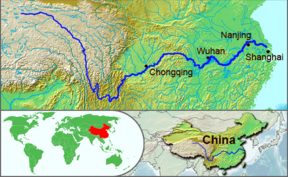
The Yangtze River, or Chang Jiang is the third-longest in the world, after the Amazon in South America and the Nile in Africa.

The river is about 6,385 km long (3915 mi) and flows from its source in Qinghai Province, eastwards into the East China Sea at Shanghai. It is considered by some[who?] as a dividing line between North and South China, although geographers generally consider the Qinling-Huai River line to be the official line of geographical division. As the largest river in the region, the Yangtze is historically, culturally, and economically important to China. One of the dams on the river, the Three Gorges Dam, is the largest hydro-electric power station in the world. The section of the river flowing through deep gorges in Yunnan province is part of the Three Parallel Rivers of Yunnan Protected Areas: a UNESCO World Heritage Site.


The name Yangtze River, as well as various similar names such as Yangtse River, Yangzi River, Yangtze Kiang, etc., is derived from Yangzi Jiang (which, beginning in the Sui Dynasty, was the Chinese name for the river in its lower reaches, specifically, the stretch between Yangzhou and Zhenjiang The name comes from the ancient ferry crossing Yangzi Jin From the Ming Dynasty, the name was sometimes written (yángzĭ). Because it was the name first heard by missionaries and traders, this name was applied in English to the whole river. In Chinese, Yangzi Jiang is considered a historical or poetic name for the river. The modern Chinese name, Chang Jiang literally means "long 'Jiang'" (Derived from Proto-Mon-Khmer languages, Jiang is the classical Chinese of Yangtze, but now it means river) and may sometimes also be used in English. It is also known to many as the 'Main Street' of China.

Like many rivers, the river is known by different names over its course. At its source, it is called in Chinese the Dangqu from the Tibetan for "marsh river"). Downstream, it is called the Tuotuo River and then the Tongtian River (, literally "river passing through heaven"). Where it runs through deep gorges parallel to the Mekong and the Salween before emerging onto the plains of Sichuan, it is known as the Jinsha River (Jīnshā Jiāng, literally "golden sands river").

The first turn of the Yangtze at Shigu, Yunnan Province, where the river turns 180 degrees from south- to north-bound.

Yangtze watershed

The Yangtze was earlier known to the Chinese as simply Jiang, which has become a generic name meaning "river", or the Da Jiang literally "great river"). The Tibetan name for the river is Drichu (Tibetan:. "river of the female yak"). The Yangtze is sometimes referred to as the Golden Waterway.

Central Africa

Brazil

More Artic Ocean


The Arctic Ocean, located in the Northern Hemisphere and mostly in the Arctic north polar region,[1] The International Hydrographic Organization (IHO) recognizes it as an ocean, although some oceanographers call it the Arctic Mediterranean Sea or simply the Arctic Sea, classifying it as one of the mediterranean seas of the Atlantic Ocean. Alternatively, the Arctic Ocean can be seen as the northernmost lobe of the all-encompassing World Ocean.

Almost completely surrounded by Eurasia and North America, the Arctic Ocean is partly covered by sea ice throughout the year (and almost completely in winter). The Arctic Ocean's temperature and salinity vary seasonally as the ice cover melts and freezes; its salinity is the lowest on average of the five major oceans, due to low evaporation, heavy freshwater inflow from rivers and streams, and limited connection and outflow to surrounding oceanic waters with higher salinities. The summer shrinking of the ice has been quoted at 50%. The National Snow and Ice Data Center (NSIDC) use satellite data to provide a daily record of Arctic sea ice cover and the rate of melting compared to an average period and specific past years.

Sun Stealing Earth's Atmosphere


Unlike, say, Mars's or Venus's, Earth's atmosphere was thought to be untouchable inside our protective magnetic field. But a new study says the sun is slowly "stealing" our atmosphere—and at a greater rate than on Mars or Venus.

Perhaps even more surprising, our planet's main solar defense may be a double agent, aiding and abetting the thievery.Mars, for example, probably started out with a thick atmosphere similar to Earth's. But without a magnetic field to protect the Martian atmosphere, the solar wind—actually a stream of charged particles from the sun—has been eroding it away.

Venus also lacks a magnetosphere and is being stripped of its atmospheric covering. Currently its rate of loss has outpaced that on Mars.

Typically hailed as a protective buffer from the sun's brute power, Earth's magnetosphere is actually helping the sun's energized particles strip away a tiny fraction of Earth's atmosphere, the new study says.

"We're, in fact, losing more oxygen and more hydrogen than even Venus is today," said Chris Russell, a professor of space physics at the University of California, Los Angeles.

"We often tell our colleagues and ourselves that we are fortunate living on this planet, because we have this magnetic shield that protects us," Russell said.

"It certainly does help, but we've come to the realization that, when it comes to the atmosphere, that's not true."

Don't Panic

An international team of researchers has been tracking planetary atmospheres using the European Space Agency's Mars Express mission for Venus and Mars and NASA's Small Explorer Mission (SMEX) for Earth.

SMEX also harbors an instrument for measuring magnetic activity on Earth.

"On Earth the magnetosphere acts like an energy collector that interacts with the material that's coming from the sun and can draw energy out of the solar wind," Russell said.

But then Earth's magnetic field funnels and guides that energy to the upper atmosphere, heating the atmosphere and allowing bits of it to escape along the very same funnels that guided the energy in.

The precise physics have yet to be worked out, but there's no cause for alarm, Russell said.

At the current rate, our present atmospheric inventory can last at least until the sun—midway through its life now—turns into a red giant and engulfs Earth, Russell said.

"At that point," he said, "the loss of atmosphere becomes moot."

Findings presented this week at a meeting of the American Geophysical Union in Toronto, Canada.

Space Torso Reveals Cancer Risk for Astronauts


Radiation detectors laced into dummy torsos that flew aboard the International Space Station bear sobering news for NASA and other agencies that want send humans to Mars: Houston, there is a problem.

Cancer and other health concerns skyrocket for astronauts living beyond the protective environment of Earth's magnetic shield for periods of six months or longer, say researchers looking into the effects of radiation on the human body.

Astronauts aboard the International Space Station, which orbits about 200 miles above the planet, are somewhat protected from harmful solar and cosmic radiation by Earth's magnetic field. Travelers to the moon, Mars and other destinations won't have this shielding.

"The radiation we see (on the station) is more benign that what they'll see going on a lunar or a Mars mission," said Kirk Shireman, NASA's deputy manager for the space station program.In addition to radiation studies under way at the Brookhaven National Laboratory, NASA and its partners on the station program have been flying torsos with embedded radiation sensors to gauge the potential damage to internal organs. Astronauts also wear dosimeters all the time and extra care is taken to monitor radiation levels while crewmembers are outside the station on spacewalks, Shireman said.

The information collected so far confirms that NASA's current guidelines for assessing radiation risks are pretty much on target, said Francis Cucinotta, a doctor and researcher who heads radiation studies at the Johnson Space Center in Houston.

NASA is planning to return astronauts to the moon by 2020 and establish a base, before moving on to human missions to Mars and other destinations under a new exploration initiative known as Constellation.

Cucinotta figures the agency has about five years to come up with some solutions to the radiation problem or find evidence that refutes current assessments of the risks.More shielding on moon and Mars ships probably isn't the answer, Cucinotta told Discovery News. The additional weight would make the spacecraft too heavy to launch with today's technologies.

Faster ships to Mars may be one answer -- the current round-trip time is about 18 months -- or perhaps some sort of magnetic shielding that repels space radiation, though neither technology exists today.

Another possibility is to select astronauts based on genetic factors that would make them more resilient to the effects of space radiation.

"NASA and the other agencies may have to do it, but it'd be kind of disappointing to have to have these additional qualifications to be an astronaut," Cucinotta said.

Pharmaceuticals that could repair cell damage and other harmful effects of spaceflight, unfortunately, do not seem to be an answer.

"We'd all be cured of cancer on Earth if we knew how to do this," Cucinotta said.

Synthetic Fibers to Reverse Blindness


June 1, 2009 -- Synthetic fibers can now be embedded with three, and possibly more, drugs or proteins. The new fibers could be woven into a variety of materials that have unique and novel properties -- such as reversing blindness.

"The ultimate idea is to implant this material into the eye," said Bin Dong, a scientist from Drexel University who, along with Gary Wnek and Meghan Smith of Case Western University, detailed their work in the journal Small.

"One protein will eat the scar tissue away, and the other will help induce the differentiation of retinal progenitor cells," said Dong.

Previously scientists were only able to include one drug or protein inside an electrospun fiber because the two would often interact with each other in ways that would negate or modify their effects.

To get around this limitation, the Drexel and Case Western scientists put the drugs and proteins inside tiny capsules, which stop the molecules from interacting with each other until they break apart.For their first tests, the scientists incorporated both bovine albumin serum (BAS) and epidermal growth factor (EGF) into the same electrospun fiber. Each molecule was also linked to a particular fluorescent dye that appears under special light. Red for BAS, green for EGF.

A fleece or nylon that glows different colors at different times is the beginning, though. Restoring vision to the blind could be the first use for these drug- and protein-containing fabrics.

Working with Michael Young, an ophthalmologist at the Schepens Eye Research Institute, the Drexel and Case Western University researchers are trying to create a biodegradable synthetic fabric that could return sight to blind people.

Surgically implanted onto the retina during a 45-minute operation, the protein-equipped fabric would do two things. First, proteins in the fabric would eat away at the scar tissue created by diseases like retinitis pigmentosa and macular degeneration.Once that's done, other capsules would break apart and release a growth factor that would encourage cultured retinal progenitor cells on top of the fabric to create new, light-detecting cells. The nanofiber material would then provide a place for these new cells attach to and grow on. Once the cells were established -- between 24 and 48 hours -- the material would naturally degrade.

"We've been able to show that in mice we can restore some kind of meaningful vision," said Young. "Pigs have compatible cells, and the next step is to restore vision for them as well."

If the animal trials go well, Young estimates that it will be a minimum of three years before any human trials of the material can be attempted.

"It sounds very exciting that they were able to incorporate multiple proteins," said Paula Hammond of the Massachusetts Institute of Technology, who works with electrospun materials.

"This could be especially interesting for tissue regeneration and wound healing applications," said Hammond.

Spot Other Worlds


A robotic probe sailing out in space to look for planets beyond the solar system has its first target in sight -- Earth.

The idea behind observing the home planet is to give scientists an understanding of how an alien Earth may look in the data collected by future telescopes, chemical-analyzing spectrographs and other instruments.

"It's basically an extra tool to have in our tool belt as we go looking for exoplanets," said Nicolas Cowan, with the University of Washington.

Cowen and colleagues have been using NASA's Deep Impact spacecraft to study Earth from millions of miles away. Originally dispatched to blast a hole into comet Tempel 1 so scientists could study the comet's interior, Deep Impact was given a follow-on assignment to visit comet Hartley 2 in November 2010 and search for extrasolar planets along the way.

Cowen focused on understanding how an ocean-bearing world like Earth, with continents interspersed with water, would impact the overall reflectivity of light in seven select wavelengths, particularly those in the near-infrared.They found that as Earth completed a 24-hour rotation, the change in brightness varied by about 30 percent up and down. The shift is caused by the planet's reflectivity as the sun alternatively shines on oceans and then continents.

"The key is to look at how the planet changes over time," Cowen told Discovery News.

Clouds were not found to be a significant contributor to the change in brightness because they typically do not completely dissipate or form within a 24-hour period.

"You could imagine some weird planet where the clouds change very quickly and then you wouldn't be able to use this technique. You'd be hosed," Cowen said.

Another show-stopper would be if a planet's water were in one hemisphere and its mass of land on the other, as the total amount of light reflected from its parent star would stay stable throughout a rotation.

Cowen says that variable brightness -- particularly in the wavelengths where light reflected off water and land show up most vividly -- might be an important clue that an alien planet shares Earth's proclivity for water, and perhaps life."The spectral resolution and coverage we used will be close to optimal for Earth-like planets," Drake Deming, the spacecraft's deputy principal scientist, wrote in an email to Discovery News.

Follow-up investigations to assess the chemical makeup of a target planet's atmosphere and its surface composition would be needed before any definitive claim could be made that an alien planet has oceans.

"There's going to be a lot of skeptics if you go and claim you found water on an extrasolar planet," Cowan said.

Scientists plan to use Deep Impact to get some polar views of Earth before the spacecraft heads out for its comet rendezvous.

"We imaged the Earth from above the north pole in March, and we are looking forward to a south pole view in September," said Deming.

Cowan's results will be published in the August issue of the Astrophysical Journal.