Mostrando entradas con la etiqueta most see. Mostrar todas las entradas
Mostrando entradas con la etiqueta most see. Mostrar todas las entradas
lunes, 16 de julio de 2012
Homes for extreme climates

domingo, 8 de julio de 2012
Shark devours another shark whole (Photo)
Report: Obama ordered wave of cyberattacks on Iran
lunes, 28 de mayo de 2012
5 real-life weapons straight out of a sci-fi movie
viernes, 9 de diciembre de 2011
Experts stumped by ancient Jerusalem markings AP In this photo taken on Dec. 1, 2011, Israel's Antiquities Authority archeologist Eli Shukron sweeps
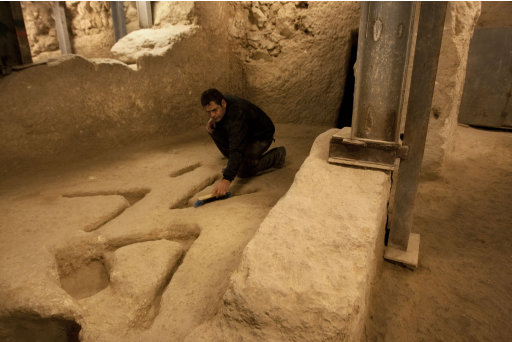
JERUSALEM (AP) — Mysterious stone carvings made thousands of years ago and recently uncovered in an excavation underneath Jerusalem have archaeologists stumped.
Israeli diggers who uncovered a complex of rooms carved into the bedrock in the oldest section of the city recently found the markings: Three "V'' shapes cut next to each other into the limestone floor of one of the rooms, about 2 inches (5 centimeters) deep and 20 inches (50 centimeters) long. There were no finds to offer any clues pointing to the identity of who made them or what purpose they served.
The archaeologists in charge of the dig know so little that they have been unable even to posit a theory about their nature, said Eli Shukron, one of the two directors of the dig.
"The markings are very strange, and very intriguing. I've never seen anything like them," Shukron said.
The shapes were found in a dig known as the City of David, a politically sensitive excavation conducted by Israeli government archaeologists and funded by a nationalist Jewish group under the Palestinian neighborhood of Silwan in east Jerusalem. The rooms were unearthed as part of the excavation of fortifications around the ancient city's only natural water source, the Gihon spring.
It is possible, the dig's archaeologists say, that when the markings were made at least 2,800 years ago the shapes might have accommodated some kind of wooden structure that stood inside them, or they might have served some other purpose on their own. They might have had a ritual function or one that was entirely mundane. Archaeologists faced by a curious artifact can usually at least venture a guess about its nature, but in this case no one, including outside experts consulted by Shukron and the dig's co-director, archaeologists with decades of experience between them, has any idea.
There appears to be at least one other ancient marking of the same type at the site. A century-old map of an expedition led by the British explorer Montague Parker, who searched for the lost treasures of the Jewish Temple in Jerusalem between 1909 and 1911, includes the shape of a "V'' drawn in an underground channel not far away. Modern archaeologists haven't excavated that area yet.
Ceramic shards found in the rooms indicate they were last used around 800 B.C., with Jerusalem under the rule of Judean kings, the dig's archaeologists say. At around that time, the rooms appear to have been filled with rubble to support the construction of a defensive wall.
It is unclear, however, whether they were built in the time of those kings or centuries earlier by the Canaanite residents who predated them.
The purpose of the complex is part of the riddle. The straight lines of its walls and level floors are evidence of careful engineering, and it was located close to the most important site in the city, the spring, suggesting it might have had an important function.
A unique find in a room beside the one with the markings — a stone like a modern grave marker, which was left upright when the room was filled in — might offer a clue. Such stones were used in the ancient Middle East as a focal point for ritual or a memorial for dead ancestors, the archaeologists say, and it is likely a remnant of the pagan religions which the city's Israelite prophets tried to eradicate. It is the first such stone to be found intact in Jerusalem excavations.
But the ritual stone does not necessarily mean the whole complex was a temple. It might simply have marked a corner devoted to religious practice in a building whose purpose was commonplace.
With the experts unable to come up with a theory about the markings, the City of David dig posted a photo on its Facebook page and solicited suggestions. The results ranged from the thought-provoking — "a system for wood panels that held some other item," or molds into which molten metal would could have been poured — to the fanciful: ancient Hebrew or Egyptian characters, or a "symbol for water, particularly as it was near a spring."
The City of David dig, where the carvings were found, is the most high-profile and politically contentious excavation in the Holy Land. Named for the biblical monarch thought to have ruled from the spot 3,000 years ago, the dig is located in what today is east Jerusalem, which was captured by Israel in 1967. Palestinians claim that part of the city as the capital of a future state.
The dig is funded by Elad, an organization affiliated with the Israeli settlement movement. The group also moves Jewish families into the neighborhood and elsewhere in east Jerusalem in an attempt to render impossible any division of the city in a future peace deal.
Palestinians and some Israeli archaeologists have criticized the dig for what they say is an excessive focus on Jewish remains. The dig's archaeologists, who work under the auspices of the government's Israel Antiquities Authority, deny that charge.
military drone was shot down over Iranian airspace,
On Wednesday November 30th an unmanned United States military drone was shot down over Iranian airspace, about 140 miles from the border of Afghanistan. The fallen drone, packed with guarded US military secrets, highlights the Obama administrations growing reliance on unmanned aircraft to fight its wars.
Unmanned drones have been a signature of the United States fight against terrorism; according to the Washington Post, U.S. drone strikes have killed twice as many suspected Al-Qaeda and Taliban members than were ever imprisoned in Guantanamo Bay. President Obama has found them particularly useful, authorizing more drone strikes in the first nine months in office than President George W. Bush did in his final three years in office.
If the recovered drone is in good shape it could provide Iran, and their allies including China and Russia, with highly guarded US military secrets, causing a fair amount of anxiety in Washington.
However, pursuing the enemy while keeping soldiers off the battle field is not a new strategy. The practice began in the 1940's when the U.S. started using unmanned rockets, and has evolved to the point where military drones are an integral part of any modern arsenal.
The United States has flown over 300 drone missions as of October of 2011, and while they're a crucial tool in modern warfare, the Bureau of Investigative Journalism believed they are to blame for hundreds of civilian casualties; a number the Pentagon denies.
Looking forward, what's the future of this joystick warfare, and is it legal? On Around the World, Christiane Amanpour is joined by Peter Singer, senior fellow at the Brookings Institute and author of Wired for War to talk about the future of drones.
martes, 12 de julio de 2011
8 Great Places to Retire Abroad
by Donna Fuscaldo, contributing writer
Great places to retire can be found outside of Florida and Arizona. In fact, many can be found outside of the U.S. entirely. Safe, attractive and affordable places to retire are scattered across the globe, from Latin America to Asia and even Europe. We've narrowed our list to eight overseas retirement hot spots.
Two factors critical to retirees (and their wallets) shaped our choices: cost of living and health care. To make our picks we consulted several experts on travel, tourism and overseas retirement, including Jennifer Stevens, executive editor of International Living, and Kathleen Peddicord, publisher of LiveandInvestOverseas.com. We also gave added weight to the cost of living, real estate and health care components of International Living's Global Retirement Index of the top 25 countries for retirees.
A note on cost of living: Monthly budgets for overseas retirees will vary widely, depending on country, lifestyle and housing type. There's no one-size-fits-all dollar amount. The estimates provided for each retirement hot spot offer a ballpark figure, including housing expenses, for how much a "typical" retired American couple would need to live comfortably.
Merida, Mexico
Population: 777,615
Climate: Tropical. Temperatures range from the low 80s to the mid 90s. Risk of hurricanes.
Proximity to major airport: Merida has an international airport with some nonstop flights to the U.S. Mexico City is less than two hours by plane.
Access to health care: There's a slew of quality medical facilities, including the highly regarded Clinica de Merida. Some retirees may qualify for Mexico's low-cost public health insurance program, known as IMSS. Mexico ranks 14th out of 25 countries on International Living's Global Retirement Index for health care.
Cost of living: Mexico tied for third (with Colombia and Thailand) on the Global Retirement Index for cost of living. A retired American couple can live comfortably in Merida on $1,700 a month.
The draw: City living meets colonial charm. Merida, the capital of the state of Yucatan, is a world away from Cancun, its touristy cousin across the peninsula. Sitting 22 miles inland, Merida has a European feel, thanks to its Old World architecture and abundant culture. There are opera houses and cathedrals to explore, and foodies rave about the dining scene. There's a growing population of retirees from the U.S., as evidenced by an English-language newspaper and library. Merida has escaped the violence that has plagued Mexico's border towns.
Lunigiana, Italy
Population: 130,000
Climate: Temperate. Summers can stretch from April to October, with temperatures from the mid 70s to low 90s. In winter, it's in the 50s and 60s.
Proximity to airport: Major airports in Pisa, Genoa and Parma are all about an hour's drive from the Lunigiana region. There's very limited nonstop service to the U.S. Expect to make a connection.
Access to health care: Italy ranks second (tied with Spain) out of 25 countries on International Living's Global Retirement Index for health care. Towns in the Lunigiana region with hospitals include Aulla, Fivizzano, La Spezia, Pontremoli and Sarzana. Pharmacists are found in most villages. Italy offers residents, including U.S. citizens legally residing in Italy, access to its national health plan, though many Americans opt instead to use private hospitals, which tend to provide better care than public ones.
Cost of living: Italy tied for 11th (with Uruguay) on the Global Retirement Index for cost of living, but 18th for real estate. A retired American couple can live comfortably on about $2,500 a month.
The draw: Tuscany on the cheap. The Lunigiana region of northern Tuscany is home to a network of villages connected by well-marked hiking paths. The Mediterranean coast is a short drive away, and Florence, Lucca and Pisa are all manageable day trips. Lunigiana isn't on the radar of too many retirees yet, which means the region is more affordable than areas farther south in the heart of Tuscany. Italy has a Social Security agreement with the U.S. that can benefit people who've worked in both countries.
Bocas del Toro, Panama
Population: 125,461
Climate: Warm and tropical, with temperatures ranging from the low 70s to high 80s. Rainy season can stretch from May to January.
Proximity to major airport: It's a one-hour flight to Panama City, where connections are available to the U.S.
Access to health care: There's a public hospital on Isla Colon, the main island in the Bocas del Toro archipelago. It's adequate and cheap, but most expats head to David or Panama City for checkups and planned treatments. Panama tied for 12th (with Portugal) out of 25 countries on International Living's Global Retirement Index for health care.
Cost of Living: Panama tied for 13th (with Costa Rica) on the Global Retirement Index for cost of living. A retired American couple can live comfortably in Bocas del Toro on $1,500 a month.
The draw: Laid-back island living. Bocas del Toro province, on the Caribbean in western Panama, boasts miles of sandy beaches, turquoise waters and sprawling rainforests. The currency is the U.S. dollar and, while Spanish is the country's official language, English is widely spoken. Panama has a "pensionado" program for retirees that provides discounts on public transportation, entertainment and health care.
Granada, Nicaragua
Population: 105,171
Climate: Hot and sticky. Temperatures span the 70s to the 90s, with humidity often high. The wettest months are May to October.
Proximity to airport: It's 45 minutes by car to Managua's international airport, where you can catch nonstop flights to the U.S.
Access to health care: Nicaragua tied for 22nd (with Honduras) out of 25 countries on International Living's Global Retirement Index for health care. In addition to local medical facilities, close proximity to Managua, the capital, gives retirees access to several specialized hospitals.
Cost of living: Nicaragua tied for sixth (with Brazil, Malta and Malaysia) on the Global Retirement Index for cost of living. It tied for second (with Colombia) for real estate. A retired American couple can live comfortably in Granada on $1,250 a month.
The draw: Rooms with a view. Granada, a picturesque colonial city that dates back to the 16th century, sits on the shores of Lake Nicaragua. Brightly painted buildings liven up the architecture, and volcanoes are visible in the distance. There are local restaurants, shops and access to freshwater activities. Nearby Managua has shopping malls, movie theaters and other entertainment options. Look into the government's incentive program for foreign retirees, which offers duty-free imports and other tax breaks.
Nha Trang, Vietnam
Population: 361,454
Climate: It's hot most of the year. Temperatures hover between the 80s and low 90s. The heart of the monsoon season is November and early December.
Proximity to airport: Cam Ranh International Airport is about 25 miles from downtown Nha Trang. There are no nonstop flights to the U.S.
Access to health care: The 1,000-bed Khanh Hoa General Hospital is located in Nha Trang. International Living didn't include Vietnam in its Global Retirement Index rankings.
Cost of living: A retired American couple can live comfortably in Nha Trang on $750 a month.
The draw: Live like a king for less. Located on the coast of South-Central Vietnam, Nha Trang is encased by miles of beaches and massive mountain ranges. An American couple can get by on less than $600 a month; $1,000 a month would land you in the lap of luxury. U.S. dollars, preferably crisp, clean ones, are widely accepted. There's a small population of foreigners in Nha Trang, as well as many restaurants and bars, a supermarket and a mall.
Roatan, Honduras
Population: approximately 70,000
Climate: The average temperature is 81 degrees. January is the coolest month; August, the hottest. Honduras lies in the hurricane belt.
Proximity to airport: There are nonstop flights to the U.S. from Roatan's international airport.
Access to health care: Roatan has several clinics and two hospitals on the island. Larger medical facilities are located on the mainland in San Pedro Sula and La Ceiba. Honduras tied for 22nd (with Nicaragua) on International Living's Global Retirement Index for health care.
Cost of living: Honduras ranks tenth on the Global Retirement Index for cost of living, but fourth for real estate. A retired American couple can live comfortably in Roatan on $1,200 a month.
The draw: Life's a beach. Located in the Bay Islands of Honduras, Roatan is home to the world's second longest coral reef, warm ocean waters and long strands of white sand. English is the primary language, the U.S. dollar is accepted, and real estate prices have come down in recent years. There's an established expat community. Retirees looking for a Caribbean experience for less probably won't be disappointed.
Bearn, France
Population: 350,000
Climate: Seasonal. Temperatures range from the 30s to 50s in the winter and the 70s to 80s in the summer.
Proximity to airport: The main airport is in Pau. No nonstop flights to the U.S., but easy connections via Paris, London and elsewhere.
Access to health care: France is tops on International Living's Global Retirement Index for health care. There are several hospitals in the Bearn region, including in the towns of Pau, Orthez, Oloron-Sainte-Marie, Mauleon, Tardets and Mourenx. Private medical insurance is required of non-E.U. residents. The Association of Americans Resident Overseas offers a group plan.
Cost of living: France ranks 18th on the Global Retirement Index for cost of living. A retired American couple can live comfortably on about $2,000 a month.
The draw: Basque in the moment. The Bearn area of southwestern France, near the border with Spain, is influenced by Basque culture from both sides of the Pyrenees (note the berets). The pastoral landscape is dotted with medieval towns, and hunting and fishing are favorite pastimes. There are loads of markets and vineyards to explore, not to mention a fair share of churches and castles. Living in Bearn is cheaper than in better-known parts of France such as Provence, a plus for retirees. France also has an agreement with the U.S. that provides Social Security advantages for people who've worked in both countries.
Corozal Town, Belize
Population: 9,901
Climate: Warm year-round, with temperatures mostly in the 80s. Mild rainy season starts in June. Risk of hurricanes.
Proximity to major airport: It's a short commuter flight via San Pedro -- each leg is less than half an hour -- to the country's main airport in Belize City, where connections are available to the U.S.
Access to health care: Corozal Town has its own hospital. More extensive medical options are available ten miles away in Chetumal, the capital of Mexico's state of Quintana Roo. Belize ranks 24th out of 25 countries on International Living's Global Retirement Index for health care.
Cost of living: Belize is second on the Global Retirement Index for cost of living, but 19th for real estate. A retired American couple can live comfortably in Corozal Town on $2,500 a month.
The draw: The best of both worlds. The town, located in northernmost Belize, offers retirees beaches and tranquility in Corozal, and big-city amenities such as malls and museums just across the border in Chetumal, Mexico. English is the official language, though Spanish is widely spoken. The government operates a "qualified retired persons" program that allows non-Belizeans to enjoy perks such as tax-free imports of household goods, cars and even airplanes. One-time application and program fees add up to $1,350, plus another $750 per dependent.
America's Most Beautiful Landmarks
From soaring man-made monuments to jaw-dropping natural landforms, the U.S. has a wealth of beautiful landmarks.
By Lyndsey Matthews
Courtesy of Niagara Tourism and Convention Corporation
While the Eiffel Tower, the Taj Mahal, and Mount Fuji may be the first images that come to mind when we picture beautiful landmarks, the truth is that there are numerous dazzling sights—both natural and man-made—right here in the United States.
The past century-and-a-half has seen the creation of two organizations that work together to protect America’s national treasures. After the first national park, Yellowstone, was established in 1872 to protect the natural beauty of its world-famous geyser basins and wildlife, the U.S. National Park Service was founded in 1916—and now oversees the preservation of 58 parks around the country. Later, the National Historic Preservation Act of 1966 created the National Register of Historic Places, to protect landmarks that specifically illustrate the heritage of the United States.
Not all of the landmarks on our list have been officially designated as state parks or National Historic Places. And, on their surface, many of them may seem dissimilar: one is an extraordinary (and still active) volcano, while another is a lighthouse; one is a mighty waterfall, while another is a centuries-old desert adobe settlement. But what’s amazing is that these landmarks, disparate though they are, share a home right here on U.S. soil. And all of them have played a part, however small, in our national history.
Niagara Falls, New York
More than 750,000 gallons of water per second thunder down this iconic 167-foot waterfall—the most powerful on the North American continent. The falls straddle the border between the U.S. and Canada, and though some argue that Horseshoe Falls—set on the Ontario side—is more spectacular than the smaller American Falls, the landmark has held a particular place in American history ever since 1901, when Michigan schoolteacher Annie Edson Taylor was the first person to go over the falls (and survive) in a barrel.
How to See It: Take a half-hour water tour on the Maid of the Mist ferry, which has boarding docks in both countries.
Mount Rushmore National Memorial, Keystone, SD
Courtesy of the National Park Service
Mount Rushmore National Memorial, Keystone, South Dakota
Carved into a granite mountain face in South Dakota’s southwesterly Black Hills, this sculpture of four of America’s most influential presidents (Washington, Jefferson, Lincoln, and Theodore Roosevelt) was considered an extraordinary feat of engineering when it was completed in 1941—and it’s still majestic today, bringing in more than two million visitors per year.
How to See It: If you visit in winter, you’ll be able to avoid the summer crowds and see the monument dusted with snow. In warmer months, though, try to catch the evening lighting ceremony (starting at 9 p.m.), where park rangers slowly illuminate the enormous granite faces above.
Golden Gate Bridge, San Francisco
Emrecan Dogan
Golden Gate Bridge, San Francisco
Stretching 1.7 miles high above the mist-enshrouded waters of San Francisco Bay, this peaked, vermilion-painted suspension bridge (the color is officially known as International Orange) is as striking today as it was when it was completed in 1937. The natural surroundings—including the coves and forested bluffs of Marin County; the island of Alcatraz; and numerous sailboats, barges, kite-surfers, and even frolicking seals—can all be seen from the bridge on a clear day.
How to See It: Walking at least partway along the bridge’s pedestrian path allows for the most dramatic views (and best photo ops).
The Wave, Coyote Buttes, AZ
Set in the remote Paria Canyon-Vermilion Cliffs Wilderness in northern Arizona, this dazzling rock formation, which looks like a cresting wave frozen in time, isn’t easy to access: you’ll need a permit from the Bureau of Land Management, which allows only 20 people per day to visit the delicate landform. But getting to see this fiery swirl of Jurassic-age sandstone, carved by the wind more than 190 million years ago, is well worth a little advance planning.
How to See It: From the Wire Pass Trailhead, it’s a three-mile hike out to the Wave over sandy terrain. Summer temperatures soar to more than 100 degrees, so bring plenty of water.
The Giant Forest, Sequoia and Kings Canyon National Park, CA
The Giant Forest, Sequoia and Kings Canyon National Park, CA
Located in the southern Sierra Nevada Mountains, this three-square-mile forest of massive giant sequoias is home to the General Sherman Tree, the world’s largest tree by volume (52,508 cubic feet). The other trees here are jaw-dropping, too—on average, they are as tall as 26-story buildings and have base diameters wider than many city streets. Equally awe-inspiring as these conifers’ grand size, though, is their age: most are between 1,800 and 2,700 years old.
How to See It: If you’re short on time, take a two-mile hike through the Giant Forest on the Congress Trail, which begins at the General Sherman Tree. With more time to explore, though, you’ll want to take the steep quarter-mile staircase to the top of Moro Rock, a granite dome that offers gorgeous views of the Great Western Divide and the forest below.
Kilauea Volcano, Hawai‘i Volcanoes National Park, HI
The legendary home of Pele, the Hawaiian volcano goddess, this 4,091-foot-high peak is located on the southeastern part of the Big Island of Hawaii. Appropriately named after the Hawaiian word for “spewing” or “much spreading,” this is one of the world’s most active and dangerous volcanoes. Continuous eruptive activity has occurred here since 1983, creating devastating-but-beautiful lava flows that have etched their way across the dramatic landscape.
How to See It: Take Crater Rim Drive, an 11-mile road that circles the summit of Kilauea, for panoramic views of the volcanic landscape. Since access roads often shut due to volcanic activity, though, be sure to check for closures before you visit.
Taos Pueblo, Taos, NM
Set at the base of the majestic Sangre de Cristo Mountains, this multistoried adobe compound is one of the country’s best-preserved Pueblo Indian settlements. The pueblo, which was built before 1400 and is one of the oldest continuously inhabited communities in the States, consists of ceremonial buildings and individual homes built from adobe—bricks made from earth mixed with straw and water—and decorated with bright turquoise doors. While visitors are welcome, approximately 150 people are lucky enough to call this UNESCO World Heritage Site and National Historic Landmark home.
How to See It: You’re welcome to wander around in the Pueblo as you like—but be respectful by only entering clearly marked shops, as most homes in the pueblo are privately occupied. (As a courtesy, you should also ask for permission before photographing Pueblo residents.)
Washington Monument, Washington, D.C.
This stately 555-foot monument, built in the bladelike shape of an Egyptian obelisk and completed in 1884, is the most prominent structure in the American capital city. Built in honor of the nation’s first president, the marble monument has served as a backdrop for some of the country’s most historic moments, including Martin Luther King, Jr.’s “I Have a Dream” speech and Barack Obama’s presidential inauguration. It’s at its most beautiful when mirrored in the Reflecting Pool at sunrise or sunset, and especially on the Fourth of July with evening fireworks bursting overhead.
How to See It: Though admission into the monument is free, tickets are required and long lines form to get inside every day. A better bet: enjoy the exterior of the monument from the steps of the Lincoln Monument, or from the tidal basin during the National Cherry Blossom Festival in April.
Portland Head Light, Cape Elizabeth, ME
Illuminated for the first time in 1791 by whale-oil lamps, this lighthouse is located within the beautifully landscaped grounds of Cape Elizabeth’s Fort Williams Park. Attached to a red-roofed Victorian keeper’s house, the 92-foot-tall white conical tower is often seen as a symbol of Maine’s beauty. From its location on a commanding point at the southwestern entrance to the harbor, you can take in crisp salt air as well as endless views of the ocean and rocky coastline for which the state is known.
How to See It: Fewer than 300 tickets are given out to climb the tower on Open Lighthouse Day, a September event put on by the Coast Guard, the State of Maine and the American Lighthouse Foundation. You can also enjoy the lighthouse in a more leisurely manner, by gazing up at it while picnicking in the park or visiting the museum.
The Half-There House
This 6,400-square foot home is half-buried in a grassy slope in East Hampton, NY.
Photo: Adam Friedberg
When Bob Stansel and Tammy Marek were planning their new luxury home here, they didn't want to overwhelm the neighbors. So they buried half of it.
Except for its arching corrugated metal roof, the unadorned modern structure built of concrete and glass barely rises higher than the grassy slope into which it's built. More than 3,200 of the four-bedroom home's roughly 6,400 square feet are located in a lower level, making the house appear more than twice as big from the side as it does from the front.
Using subterranean construction to avoid restrictive building codes is a popular option in places like California's Napa Valley, where home owners burrow underground for more space. But the couple here said their decision wasn't driven by regulations; instead it was their own desire for a pared-down aesthetic.
"I don't think I'd want people thinking that was my dream of retirement, to build some monster," said Mr. Stansel, a 65-year-old former mortgage banker who moved into the East Hampton home with his wife this winter. "We didn't want a bunch of expensive decorations on the outside."
On the property, Japanese maple and copper beech trees sit near a planted flat-roofed garage and grass driveway whose wide-set cobblestones look like part of the landscaping. Mr. Stansel took a 1,200-pound glacial rock, which he bought for $2,000 after becoming intrigued by its Alaska history, and trucked it from storage in Portland, Ore. to use outside as a garden feature.
The owners filled the home with pieces chosen by an interior decorator.
Photo: Adam Friedberg
The interior is simple, reflecting the desires of Ms. Marek, a 52-year-old day trader and horse lover—the couple has four horses that are boarded away from home in Connecticut and Holland. "It's more like a loft," she said. The front door leads to an open plan living area with flooring made of Oregon black walnut and white Bulgarian limestone. A concrete slab marks the staircase, which is held up with a harpsichord-like row of steel cables. Arched glass walls surround the modern living room and lacquered wood kitchen, hugging the curve of the roof.
Downstairs, a sitting area and den are lit by three pairs of 9-foot tall glass French doors around a lower courtyard. Mr. Stansel's study and a general storage area, however, are in rooms without any direct light.
Architects are seeing more houses with unassuming façades that explode in size when viewed from the back, or homes split into multiple buildings so they'll look less massive, or even homes that New York architect Lee Skolnick calls "McRanchions"—1950s ranch houses given luxury makeovers. "There's a trend we're seeing—it's called 'perceived thrift,'" said Chris Rose, an architect based in Charleston, S.C. "It's kind of like the ladies going to Bergdorf's and still buying stuff, but putting it in a brown bag."
Mr. Stansel had his fill when it came to towering properties: In 2009, he and Ms. Marek bought Canterbury Castle, a 1930s landmark in Portland, Ore. with a moat, drawbridge and turret, for about $290,000. They were already living in the house next door and bought the site as an investment. The city had deemed the crumbling edifice structurally unsound, clearing the way for the couple to raze it. Some locals were opposed, but the couple considered it unsafe and an eye sore.
At the same time, Mr. Stansel and Ms. Marek were beginning construction on the Long Island house. East Hampton-based architect Maziar Behrooz had come up with a design for the land's previous owner, who was inspired by a photo of an F-16 fighter jet nosing out of an airplane hangar for the building's shape. Mr. Behrooz dubbed it the Arc House, after the curve of the galvanized aluminum roof. Mr. Stansel was drawn to the home's low-slung profile.
The couple paid $1.25 million for the property down a long road lined with tall pines, and another $2.2 million for the building, Mr. Stansel said. Nearby, in a subdivision with meadows and fields for polo matches, a home is on the market for $2.9 million.
The couple moved to New York because they thought it would make it easier to travel to Europe in their retirement, though they are considering spending the winters in Portland if they don't find a buyer for their property there.
Outside their Long Island home, a memento from their Portland past is now set into the ground. Two heavy stones serve as steps to a soon-to-be-built Zen garden—pieces of the castle they once owned.
words largest bridge
1. A sign that reads: "Shandong Highway Corp. invests to operate Shandong Highway Jiaozhou Bay Bridge" is seen at Qingdao Jiaozhou Bay Bridge in Qingdao, Shandong province June 27, 2011. The world's longest sea bridge spanning Jiaozhou Bay of Qingdao City, Shandong Province, opened on Thursday, June 30, 2011. The bridge is 42 km (26 miles) long, Xinhua News Agency reported. Picture taken June 27, 2011. REUTERS/China Daily (CHINA - Tags: SOCIETY) CHINA OUT. NO COMMERCIAL OR EDITORIAL SALES IN CHINA less
2. A band plays during the opening ceremony of the Qingdao Jiaozhou Bay Bridge in Qingdao, Shandong province June 30, 2011. The world's longest sea bridge spanning Jiaozhou Bay of Qingdao City, Shandong Province, opened on Thursday. The bridge is 42 km (26 miles) long, Xinhua News Agency reported. REUTERS/China Daily (CHINA - Tags: SOCIETY) CHINA OUT. NO COMMERCIAL OR EDITORIAL SALES IN CHINA
3. Qingdao Jiaozhou Bay Bridge is seen in Qingdao, Shandong province, in this general view taken June 27, 2011. The world's longest sea bridge spanning Jiaozhou Bay of Qingdao City, Shandong Province, opened on Thursday, June 30. The bridge is 42 km (26 miles) long, Xinhua News Agency reported. Picture taken on June 27, 2011. REUTERS/China Daily (CHINA - Tags: SOCIETY IMAGES OF THE DAY) CHINA OUT. NO COMMERCIAL OR EDITORIAL SALES IN CHINA less
4. This photo taken Tuesday, June 21, 2011 released by China's Xinhua news agency shows the Jiaozhou Bay Bridge in Qingdao, east China's Shandong Province. China opened Thursday, June 30, 2011, the world's longest cross-sea bridge, which is 42 kilometers (26 miles) long and links China's eastern port city of Qingdao to an offshore island, Huangdao. (AP Photo/Xinhua, Yan Runbo) NO SALES
Suscribirse a:
Entradas (Atom)