
miércoles, 25 de enero de 2012

UK scientists find 'lost' Darwin fossils
LONDON (AP) — British scientists have found scores of fossils the great evolutionary theorist Charles Darwin and his peers collected but that had been lost for more than 150 years.
Dr. Howard Falcon-Lang, a paleontologist at Royal Holloway, University of London, said Tuesday that he stumbled upon the glass slides containing the fossils in an old wooden cabinet that had been shoved in a "gloomy corner" of the massive, drafty British Geological Survey.
Using a flashlight to peer into the drawers and hold up a slide, Falcon-Lang saw one of the first specimens he had picked up was labeled 'C. Darwin Esq."
"It took me a while just to convince myself that it was Darwin's signature on the slide," the paleontologist said, adding he soon realized it was a "quite important and overlooked" specimen.
He described the feeling of seeing that famous signature as "a heart in your mouth situation," saying he wondering "Goodness, what have I discovered!"
Falcon-Lang's find was a collection of 314 slides of specimens collected by Darwin and other members of his inner circle, including John Hooker — a botanist and dear friend of Darwin — and the Rev. John Henslow, Darwin's mentor at Cambridge, whose daughter later married Hooker.
The first slide pulled out of the dusty corner at the British Geological Survey turned out to be one of the specimens collected by Darwin during his famous expedition on the HMS Beagle, which changed the young Cambridge graduate's career and laid the foundation for his subsequent work on evolution.
Falcon-Lang said the unearthed fossils — lost for 165 years — show there is more to learn from a period of history scientists thought they knew well.
"To find a treasure trove of lost Darwin specimens from the Beagle voyage is just extraordinary," Falcon-Lang added. "We can see there's more to learn. There are a lot of very, very significant fossils in there that we didn't know existed."
He said one of the most "bizarre" slides came from Hooker's collection — a specimen of prototaxites, a 400 million-year-old tree-sized fungus.
Hooker had assembled the collection of slides while briefly working for the British Geological Survey in 1846, according to Royal Holloway, University of London.
The slides — "stunning works of art," according to Falcon-Lang — contain bits of fossil wood and plants ground into thin sheets and affixed to glass in order to be studied under microscopes. Some of the slides are half a foot long (15 centimeters), "great big chunks of glass," Falcon-Lang said.
"How these things got overlooked for so long is a bit of a mystery itself," he mused, speculating that perhaps it was because Darwin was not widely known in 1846 so the collection might not have been given "the proper curatorial care."
Royal Holloway, University of London said the fossils were 'lost' because Hooker failed to number them in the formal "specimen register" before setting out on an expedition to the Himalayas. In 1851, the "unregistered" fossils were moved to the Museum of Practical Geology in Piccadilly before being transferred to the South Kensington's Geological Museum in 1935 and then to the British Geological Survey's headquarters near Nottingham 50 years later, the university said.
The discovery was made in April, but it has taken "a long time" to figure out the provenance of the slides and photograph all of them, Falcon-Lang said. The slides have now been photographed and will be made available to the public through a new online museum exhibit opening Tuesday.
Falcon-Lang expects great scientific papers to emerge from the discovery.
"There are some real gems in this collection that are going to contribute to ongoing science."
Dr. John Ludden, executive director of the Geological Survey, called the find a "remarkable" discovery.
"It really makes one wonder what else might be hiding in our collections," he said.
Inside A $1.5 Million Cave House
Provided by:Forbes
http://l.yimg.com/d/lib/yre/mycs/d/img/3.14.5/forbes_new_120x40_logo-201010101057.gif
http://l.yimg.com/cv/ip/ap/default/120113/cave_entrance_main.jpg
The 37-acre Chulo Canyon Cave House was created by mining granite boulders and excavating blasted rocks.
Photo: Bisbee Realty
Locals refer to it as the Cave House and the nickname is apt. Sitting on 37 acres just outside of Bisbee, AZ, a mining town-turned-Baby Boomer retirement haven about 80 miles from Tucson, the Chulo Canyon Cave House is carved into an outcropping of granite boulder, extending more than 2,000-square feet into a desert grotto.
The strange and unusual dwelling is up for grabs and could be yours for $1.5 million. It occupies 2,890-square feet of living space and comes with a 890-square foot guest house, a subterranean game room underneath the guest house, a library building, a stand-alone workshop space, a separate home office, and a carport. The main house features rough petrous walls, rock and cement ceilings, and potable wall water seep that is collected from a natural spring. There’s a glass-walled sunroom, a commercial-grade kitchen with stained glass cabinets and mosaic tiling, an-eight person dining room, a sunken living room, two full bathrooms, a sleep loft with walk-in closet tucked below underneath the loft stairs, and a back room that is currently used as an exercise and yoga room.
The desert abode was built by the current owner, specifically the current owner’s late husband who recently passed away. “It’s technically a man made cave that was actually blasted out of the rock existing there,” explains Jean Noreen, a Realtor with Bisbee Realty and the listing agent for the Cave House. ”But it has all of the good qualities of a cave for living like it stays the same temperature all year round.” Maintaining a so-called ‘rock temperature,’ the house never slides below 66 degrees Fahrenheit or above 72 degrees.
The main house greets guest with a wall of windows before extending back into the cave.
Photo: Bisbee Realty
Creating this man-made cavern home meant recruiting a mining engineer who, using the Swedish straight wall mining technique, injected the ceilings with roof bolts and excavated blasted rock with ammonium nitrate.
But as attention-grabbing as the stone-forged main lair is, the property’s zaniness doesn’t end there. Starting with the pools, which are not your typical chlorinated in-grounds. Rather, the home’s natural pools are a short hike away, up the side of a nearby mountain and fed by a freshwater creek for six to eight months out of the year. The higher up the mountain you climb the more pools you have to choose from. The owners also installed a carefully camouflaged hot tub.
A perk of living in a cave is consistent temperature, which stays between 66 and 72 degrees.
Photo: Bisbee Realty
The other buildings on the premises peddle some secretive amenities, too. Lying below the two-story guest house is a game room with a separate entrance. The subterranean space is constructed of cement blocks and fluorescent lighting. The nearby library building, also constructed of cement blocks, doubles as a safe house, with a back room accessible through a roll-down metal security door hidden behind a sliding glass door. The back room is equipped with a Murphy bed, an air conditioner, an antique vault and a climate-controlled gun safe.
The Cave House has graced the Multiple Listing Services sporadically for years. "When we first put it on we did so for close to $3 million," says Noreen. The price bumped down to $1.5 million last year, when the owners decided they were truly serious about selling. But despite the 50% price chop, a buyer has yet to put up an accepted offer. Noreen believes it will be nontraditional home buyers that ultimately purchase this pad: "It would make a great retreat for something like a yoga retreat or as an alternative healing place. It’s very peaceful."
The real estate market in Bisbee has suffered its share of foreclosures in the past several years and prices plunged about 20% from their early 2008 highs, according to Zillow. Now home prices are cautiously inching back up. Noreen says homes are selling at prices that haven’t been seen since the late 1990s. “We’ve actually been really active…and we have a whole realm of people coming in to buy at these lower prices,” she remarks. Now to find a well-off a New Age nature-lover who wants to plunk down seven figures to live in a cave.
Researchers, tribes clash over Native bones
n this photo taken Dec. 8, 2011, Dr. Mari Lyn Salvador, Director of the Phoebe A. …
BERKELEY, Calif. (AP) — On a bluff overlooking a sweep of Southern California beach, scientists in 1976 unearthed what were among the oldest skeletal remains ever found in the Western Hemisphere.
Researchers would come to herald the bones — dating back nearly 10,000 years — as a potential treasure trove for understanding the earliest human history of the continental United States. But a local tribal group called the Kumeyaay Nation claimed that the bones, representing at least two people, were their ancestors and demanded them back several years ago.
For decades, fights like this over the provenance and treatment of human bones have played out across the nation. Yet new federal protections could mean that the vast majority of the remains of an estimated 160,000 Native Americans held by universities, museums and federal government agencies, including those sought by the Kumeyaay, may soon be transferred to tribes.
A recent federal regulation addresses what should happen to any remains that cannot be positively traced to the ancestors of modern-day tribes. Museums and agencies are required to notify tribes whose current or ancestral lands harbored the remains, then the tribe is entitled to have them back.
Prestigious institutions from Harvard to the University of California, Berkeley have already begun working through storehouses of remains uncovered by archeologists, highway and building contractors and others since the 19th Century. A few are surrendering bones to Native tribes, and others are evaluating whether to do so.
Tribes have hailed the rule, saying it will help close a long and painful chapter that saw native peoples' bones stolen by grave robbers, boxed up in dusty storerooms and disrespected by researchers.
"Darn it, these are people," said Louis Guassac, a member of the Kumeyaay Cultural Repatriation Committee. "This isn't stuff. You don't do this to people. I don't care how long they've been there. You respect them."
The Native American Graves Protection and Repatriation Act of 1990 provided for the return of remains connected to modern-day tribes. But it was not until 2010 that a rule on the disposition of so-called culturally unidentifiable remains was finalized by the Department of the Interior. Until then, more than 650 universities and other institutions had no clear guidance about how to return those remains, which account for the bones of about 116,000 people in their collections. That rule is still playing out, sometimes fractiously.
Universities find themselves tugged one way by the law's mandates, another by faculty research needs.
Some anthropologists say more remains will become off limits, imperiling study of the diets, health, migrations and other habits of ancient peoples without guaranteeing that the remains will wind up with their true descendants. "There really isn't any balance anymore," said Keith Kintigh, associate director of the School of Human Evolution and Social Change at Arizona State University. "The public and scientific interest in (the remains) no longer have any weight."
In recent months, Harvard's Peabody Museum has received requests for about 500 remains and hired additional staff as they respond to the 2010 rule, said Patricia Capone, the museum's repatriation coordinator.
At the University of Michigan, officials have decided to transfer the bulk of their 1,580 culturally unaffiliated remains to 13 Native American tribes who want them. In the meantime, they have been put off limits to researchers. "The law is very clear that they will be transferred," said school spokesman Rick Fitzgerald.
At UC-Berkeley, more than 6,000 of the roughly 10,000 remains that were deemed culturally unidentifiable are now subject to potential transfer to tribes. And the Phoebe A. Hearst Museum of Archaeology here has added four new staff members to help match remains to tribes if possible and notify tribes whose lands held the remains.
The small, eclectic museum recently celebrated the 100th anniversary of a recording made by Ishi — the last surviving member of the Yahi tribe who emerged from hiding in Northern California in 1911. The museum displays artifacts such as Pomo baskets, an Achumawi rabbit-skin blanket and arrowheads Ishi made out of obsidian and glass— but not the remains of native peoples.
The collection of bones —one of the country's largest — is in storage. Officials declined to show them to The Associated Press during a recent campus visit on grounds that that could be offensive to tribes.
The university currently has four pending requests for remains. And Museum Director Mari Lyn Salvador said the regulation change has caused concern among researchers.
"There are very important opportunities to understand contemporary medicine ... information that could be very useful to these (Native) communities themselves in terms of better understanding diabetes and other illnesses," she said.
The university presents such information to tribes, she said, but lets the tribes decide whether to allow researchers to work with the bones.
Tens of thousands of individual Native American remains have been collected since the mid-19th century. Some grave sites were looted or excavated to support scientific research, including a study of skulls purporting to show that Native Americans were inferior to Caucasians, according to Robert Bieder, an Indiana University professor who has written about the phenomenon.
The bones in dispute at UC San Diego have long since been out of the ground. They were excavated more than three decades ago from land around the university chancellor's house in La Jolla by a professor from another school. But a photo of the original discovery shows the outlines of two skeletons with skulls, buried head to toe.
Since their discovery in 1976, they have been studied at the Smithsonian and carbon dated at the University of Oxford, according to Margaret Schoeninger, a professor in the Department of Anthropology at UCSD and the university's representative on Indian burial issues.
When the Kumeyaay Nation — a dozen native bands with reservations in San Diego County — first demanded the remains, the university rejected its claim that they were the tribe's ancestors.
Researchers have said Kumeyaay remains were cremated early in the tribe's history, not buried. They have also questioned whether the remains are even Native American, given their age, although the university has concluded that they are.
"In terms of what the Kumeyaay have put forward, the only thing I've heard is their belief, their deep tie to the land and folklore," Schoeninger said. "We need empirical evidence."
Tribal representatives say they have an oral history that goes back thousands of years and connects them to the remains.
In light of the recent rule, university officials did a reevaluation, concluding that the skeletons came from the Kumeyaay's ancestral lands while still maintaining they were not the Kumeyaay's direct ancestors.
In a filing in December, the university said it would turn the remains over to the Kumeyaay although it gave other tribal groups until Jan. 4 to come forward and dispute the Kumeyaay's claim.
Kumeyaay repatriation officials say they will accept the remains.
"It's pleasing to know that these are going to finally be returned and properly taken care of," Guassac said. "They are going to be getting the respectful treatment they deserve."
One option, he said, is that the remains will be reburied.
New Mexico Is Stretching, Slowly but Surely
Time.com
The driving distance between Phoenix and Dallas is getting farther. It's a minuscule difference -- not even a millimeter a year -- but it's a tangible phenomenon, and you can blame on the middleman: New Mexico. The Rio Grande Rift, fault line that bisects the state, is bursting at the seams, pushing apart New Mexico's borders and stretching the land around it.
But don't expect to straddle the fault line and have your legs ripped out from under you, unless you have centuries to wait: the state is getting just one inch wider every 40 years. Scientists calculate the Rio Grande Rift's pace of expansion as approximately 1.2 nanostrains per year. So it's less an expanding waistline than a stretchmark. Still, it's having an effect on hundreds of miles of surrounding terrain. According to the group of seven scientists from New Mexico, Colorado and Utah, who studied the Rio Grande Rift for more than four years before releasing their findings in the January 2012 issue of Geology Magazine, the pull of the canyon isn't a localized problem. (PHOTOS: Along the Rio Grande, Scenes of a Tense Border.)
"We didn't expect it to be so spread out," University of Colorado geophysicist Anne Sheehan told the Albuquerque Journal. Indeed, the rift's movement hasn't been absorbed into the land directly around it, leading to a widespread stretching and rucking that has affected terrain in a radius of hundreds of miles -- and maybe even more, stretching not just New Mexico but Texas and Arizona as well. (LIST: Top 10 U.S. News Stories of 2011.)
The research team calls it a "distributed deformation," but we prefer to think of it as an America-shaped piece of taffy stretching endlessly, slowly but surely. And that should give you an idea of what will happen if this rifting phenomenon keeps occurring. It's hardly a visible effect, but it's an unexpected feature of the ever-changing landscape. The scientists plan to continue monitoring the 25 GPS units they've set up in the region to see if the pace keeps up. They're not yet sure if the rifting puts the geology of the region in peril. The stretching of the Earth's surface is easier to see at the edges of tectonic plates, where there are typically volcanoes or mountains, but movement on an continental rift is more mysterious. Fortunately, at the paltry rate it's happening, scientists will have centuries, if not millennia, to come up with a game plan for controlling it.
Strongest solar storm since 2005 hitting Earth
This handout image provided by NASA, taken Sunday night, Jan. 22, 2012, shows a solar …
WASHINGTON (AP) — The sun is bombarding Earth with radiation from the biggest solar storm in more than six years with more to come from the fast-moving eruption.
The solar flare occurred at about 11 p.m. EST Sunday and will hit Earth with three different effects at three different times. The biggest issue is radiation, according to the National Oceanic and Atmospheric Administration's Space Weather Prediction Center in Colorado.
The radiation is mostly a concern for satellite disruptions and astronauts in space. It can cause communication problems for polar-traveling airplanes, said space weather center physicist Doug Biesecker.
Radiation from Sunday's flare arrived at Earth an hour later and will likely continue through Wednesday. Levels are considered strong but other storms have been more severe. There are two higher levels of radiation on NOAA's storm scale — severe and extreme — Biesecker said. Still, this storm is the strongest for radiation since May 2005.
The radiation — in the form of protons — came flying out of the sun at 93 million miles per hour.
"The whole volume of space between here and Jupiter is just filled with protons and you just don't get rid of them like that," Biesecker said. That's why the effects will stick around for a couple days.
NASA's flight surgeons and solar experts examined the solar flare's expected effects and decided that the six astronauts on the International Space Station do not have to do anything to protect themselves from the radiation, spokesman Rob Navias said.
A solar eruption is followed by a one-two-three punch, said Antti Pulkkinen, a physicist at NASA's Goddard Space Flight Center in Maryland and Catholic University.
First comes electromagnetic radiation, followed by radiation in the form of protons.
Then, finally the coronal mass ejection — that's the plasma from the sun itself — hits. Usually that travels at about 1 or 2 million miles per hour, but this storm is particularly speedy and is shooting out at 4 million miles per hour, Biesecker said.
It's the plasma that causes much of the noticeable problems on Earth, such as electrical grid outages. In 1989, a solar storm caused a massive blackout in Quebec. It can also pull the northern lights further south.
But this coronal mass ejection seems likely to be only moderate, with a chance for becoming strong, Biesecker said. The worst of the storm is likely to go north of Earth.
And unlike last October, when a freak solar storm caused auroras to be seen as far south as Alabama, the northern lights aren't likely to dip too far south this time, Biesecker said. Parts of New England, upstate New York, northern Michigan, Montana and the Pacific Northwest could see an aurora but not until Tuesday evening, he said.
For the past several years the sun had been quiet, almost too quiet. Part of that was the normal calm part of the sun's 11-year cycle of activity. Last year, scientists started to speculate that the sun was going into an unusually quiet cycle that seems to happen maybe once a century or so.
Now that super-quiet cycle doesn't seem as likely, Biesecker said.
Scientists watching the sun with a new NASA satellite launched in 2010 — during the sun's quiet period — are excited.
"We haven't had anything like this for a number of years," Pulkkinen said. "It's kind of special."
Mysterious 'Winged' Structure from Ancient Rome Discovered
The archaeological team inside the postholes from the later Roman building. Decorated …
A recently discovered mysterious "winged" structure in England, which in the Roman period may have been used as a temple, presents a puzzle for archaeologists, who say the building has no known parallels.
Built around 1,800 years ago, the structure was discovered in Norfolk, in eastern England, just to the south of the ancient town of Venta Icenorum. The structure has two wings radiating out from a rectangular room that in turn leads to a central room.
"Generally speaking, [during] the Roman Empire people built within a fixed repertoire of architectural forms," said William Bowden, a professor at the University of Nottingham, who reported the find in the most recent edition of the Journal of Roman Archaeology. The investigation was carried out in conjunction with the Norfolk Archaeological and Historical Research Group.
The winged shape of the building appears to be unique in the Roman Empire, with no other example known. "It's very unusual to find a building like this where you have no known parallels for it," Bowden told LiveScience. "What they were trying to achieve by using this design is really very difficult to say."
The building appears to have been part of a complex that includes a villa to the north and at least two other structures to the northeast and northwest. An aerial photograph suggests the existence of an oval or polygonal building with an apse located to the east.
The winged building
The foundation of the two wings and the rectangular room was made of a thin layer of rammed clay and chalk. "This suggests that the superstructure of much of the building was quite light, probably timber and clay-lump walls with a thatched roof," writes Bowden. This raises the possibility that the building was not intended to be used long term. [Photos of Mysterious Stone Structures]
The central room, on the other hand, was made of stronger stuff, with its foundations crafted from lime mortar mixed with clay and small pieces of flint and brick. That section likely had a tiled roof. "Roman tiles are very large things, they’re very heavy," Bowden said.
Sometime after the demise of this wing-shaped structure, another building, this one decorated, was built over it. Archaeologists found post holes from it with painted wall plaster inside.
Bowden said few artifacts were found at the site and none that could be linked to the winged structure with certainty. A plough had ripped through the site at some point, scattering debris. Also, metal detecting is a major problem in the Norfolk area, with people using metal detectors to locate and confiscate materials, something that may have happened at this site.
Still, even when the team found undisturbed layers, there was little in the way of artifacts. "This could suggest that it [the winged building] wasn't used for a very particularly long time," Bowden said.
The land of the Iceni
Researchers are not certain what the building was used for. While its elevated position made it visible from the town of Venta Icenorum, the foundations of the radiating wings are weak. "It's possible that this was a temporary building constructed for a single event or ceremony, which might account for its insubstantial construction,' writes Bowden in the journal article.
"Alternatively the building may represent a shrine or temple on a hilltop close to a Roman road, visible from the road as well as from the town."
Adding another layer to this mystery is the ancient history of Norfolk, where the structure was found.
The local people in the area, who lived here before the Roman conquest, were known as the Iceni. It may have been their descendents who lived at the site and constructed the winged building.
Iceni architecture was quite simple and, as Bowden explained, not as elaborate as this. On the other hand, their religion was intertwined with nature, something which may help explain the wind-blown location of the site. "Iceni gods, pre-Roman gods, tend to be associated with the natural sites: the springs, trees, sacred groves, this kind of thing," said Bowden.
The history between the Iceni and the Romans is a violent one. In A.D. 43, when the Romans, under Emperor Claudius, invaded Britain, they encountered fierce resistance from them. After a failed revolt in A.D. 47 they became a client kingdom of the empire, with Prasutagus as their leader. When he died, around A.D. 60, the Romans tried to finish the subjugation, in brutal fashion.
"First, his [Prasutagus'] wife Boudicea was scourged, and his daughters outraged. All the chief men of the Iceni, as if Rome had received the whole country as a gift, were stripped of their ancestral possessions, and the king's relatives were made slaves," wrote Tacitus, a Roman writer in The Annals. (From the book, "Complete Works of Tacitus," 1942, edited for the Perseus Digital Library.)
This led Boudicea (more commonly spelled Boudicca) to form an army and lead a revolt against the Romans. At first she was successful, defeating Roman military units and even sacking Londinium. In the end the Romans rallied and defeated her at the Battle of Watling Street. With the Roman victory the rebellion came to an end, and a town named Venta Icenorumwas eventually set up on their land. [Top 12 Warrior Moms in History]
"The Iceni vanish from history effectively after the Boudicca revolt in [A.D.] 60-61," said Bowden.
But while they vanished from written history, archaeological clues hint that their spirit remained very much alive. Bowden and David Mattingly, an archaeologist at the University of Leicester, both point out that the area has a low number of villas compared with elsewhere in Britain, suggesting the people continued to resist Roman culture long after Boudicca's failed revolt.
This lack of villas, along with problems attracting people to Roman settlements in the area, "can be read as a transcript of resistant adaption and rejection of Roman norms," writes Mattingly in his book "An Imperial Possession: Britain in the Roman Empire" (Penguin Books, 2007).
There is "still a fairly strong local identity," said Bowden, who cautioned that while local people may have lived at the complex, the winged building is out of character for both Roman and Iceni architectural styles, a fact that leaves his team with a mystery.
Follow LiveScience for the latest in science news and discoveries on Twitter @livescience
viernes, 9 de diciembre de 2011
Pits add to Stonehenge mystery
Researchers say they've found two pits to the east and west of Stonehenge that may have played a role in an ancient midsummer ceremony. The discovery suggests that the 5,000-year-old circle of stones we see today may represent just a few of the pieces in a larger geographical, astronomical and cultural puzzle.
The previously undetected pits could provide clues for solving the puzzle.
"These exciting finds indicate that even though Stonehenge was ultimately the most important monument in the landscape, it may at times not have been the only, or most important ritual focus, and the area of Stonehenge may have become significant as a sacred site at a much earlier date," Vince Gaffney, an archaeology professor at the University of Birmingham, said in a news release issued over the weekend.
The pits, which measure about 16 feet (5 meters wide) and at least 3 feet (1 meter) deep, have been covered over for centuries and can't easily be spotted on the ground. But they showed up in a survey that was conducted using non-invasive mapping techniques such as ground-penetrating radar and magnetometry. The survey is part of the Stonehenge Hidden Landscape Project, which was initiated last year with backing from the University of Birmingham's IBM Visual and Spatial Technology Center and the Ludwig Boltzmann Institute for Archaeological Prospection and Virtual Archaeology in Vienna.
The placement of the pits is intriguing: They were found on the eastern and western sides of the Cursus, a racetrack-style enclosure north of Stonehenge itself that spans 1.5 miles (2.5 kilometers) from east to west and is up to 100 yards (meters) wide. From the perspective of an observer standing at the Heel Stone, a massive upright stone just outside Stonehenge's main circle, the sun would rise just above the eastern pit on the day of the summer solstice, which is the longest day of the year. The same observer would see the sun set that evening in line with the western pit.
National Geographic
A map of the Stonehenge area shows the placement of the stone circle and the Cursus, as well as another monument known as Woodhenge and a suggested ceremonial route between the monuments.
Archaeologists have previously noted that the Cursus was apparently created several hundred years before Stonehenge's 5,000-year-old stone circle was erected. The newly detected pits may have been part of a grand layout that guided the placement of the standing stones.
But to what end?
Gaffney, who led the survey project, speculated that the Cursus was the central stage for a midsummer ritual that was enacted long before Stonehenge's heyday. "The perimeter of the Cursus may well have defined a route guiding ceremonial processions which took place on the longest day of the year," he said.
In addition to the pits, Gaffney and his colleagues found a previously undetected gap in the middle of the northern side of the eroded earthwork that defines the sides of the Cursus. They propose that ceremonial leaders entered the Cursus through that gap, and then gathered at the eastern pit to conduct sunrise rituals. Over the course of the day, participants in the rituals might have made their way westward, ending up at the western pit at sunset.
"Observers of the ceremony would have been positioned at the Heel Stone, [with] which the two pits are aligned," Gaffney said.
Henry Chapman, another archaeologist at the University of Birmingham, said Stonehenge's position would have added to the symbolism. "If you measure the walking distance between the two pits, the procession would reach exactly halfway at midday, when the sun would be directly on top of Stonehenge," he said in the news release. "This is more than just coincidence, indicating that the exact length of the Cursus and the positioning of the pits are of significance."
The researchers suggested that the pits may have contained tall sighting stones, or wooden posts, or even fires to symbolize the sun. Just imagine how it would feel to watch the sun rise from a fire lit before dawn, follow its movement across the sky in time with a daylong procession, and then see it fall into the flames at sunset.
"Stonehenge may have been emerging as an important area for quite a long time, and sometimes you can't necessarily see that in the standing archaeology," Gaffney said in an MP3 podcast provided by the University of Birmingham. "The stones themselves, which are generally later, don't give you that information. You have to infer it from relationships between multiple monuments."
The researchers aren't anywhere close to finishing the puzzle: Gaffney figures there's at least another two years' worth of survey work to do. Even then, the full story of Stonehenge and its environs may remain wrapped in mystery. How much can stones and earth tell? Stay tuned ...
Tech Firm Implements Employee ‘Zero Email’ Policy
Tech Firm Implements Employee ‘Zero Email’ Policy (ABC News)
(Hannelore Foerster/Bloomberg/Getty Images)
You’ve got mail–not. Employees of tech company Atos will be banned from sending emails under the company’s new “zero email” policy.
CEO Thierry Breton of the French information technology company said only 10 percent of the 200 messages employees receive per day are useful and 18 percent is spam. That’s why he hopes the company can eradicate internal emails in 18 months, forcing the company’s 74,000 employees to communicate with each other via instant messaging and a Facebook-style interface.
Caroline Crouch, a spokeswoman for the company, told ABC News the goal is focused on internal emails rather than external emails with clients and partners. Atos has already reduced the number of internal emails by 20 percent in six months.
When asked how employees have responded to the policy, Crouch told ABC News the overall response “has been positive with strong take up of alternative tools.”
Breton, the French finance minister from 2005 to 2007, told the Wall Street Journal he has not sent an email in the three years since he became chairman and CEO of Atos in November 2008.
“We are producing data on a massive scale that is fast polluting our working environments and also encroaching into our personal lives,” he said in a statement when first announcing the policy in Feburary. “At [Atos] we are taking action now to reverse this trend, just as organizations took measures to reduce environmental pollution after the industrial revolution.”
Atos had revenue last year of of EUR 8.6 billion, or $11.5 billion, and has offices in 42 countries, according to the company website.
The company says by 2013, more than half of all new digital content will be the result of updates to, and editing of existing information. Middle managers spend more than 25 percent of their time searching for information, according to the company.
Crouch said Atos is evaluating a number of new tools to replace internal email including collaborative and social media tools. Those include the Atos Wiki, which allows all employees to communicate by contributing or modifying online content, and Office Communicator, the company’s online chat system which allows video conferencing, and file and application sharing.
A Smarter & Smoother Robot Arm
If someone tells you that you move l ike a robot it's not a compliment, unless you're doing the dan ce, just ask Al Gore. Robots have always been famous for making very rigid and stiff movements and there's a reason for that. While it's simple for a human to move their hand from the keyboard, pick up a cup of coffee, take a sip and put it back down, it's extremely difficult to come up with an equation for a robot to do the same thing.
The task of making a robot move more naturally may have scared away others in the past, but researchers at MIT's Computer Science and Artificial Intelligence Laboratory (CSAIL) and the Laboratory of Information and Decision Systems (LIDS) have attacked the dilemma head on. By combining two innovative Algorithms they have built a new robotic motion-planning system that calculates more efficient and human like paths for robot arms.
And what does all this mean? If robots are ever going to interact with humans it's critical that they're able to make efficient and predictable movements, which you can finally start to see with this system
Strange Security: Hackers Could Set Your Printer on Fire from a Distance
It takes a creative mind to turn an otherwise innocent gadget into a looming security threat, but what's a hacker if not exactly that? You might not be particularly concerned that your printer could spell your demise, but a research team at Columbia University has demonstrated that not only can vulnerable printers be hacked remotely to snag personal information like credit card and Social Security numbers - they could even be made to self destruct...literally.
The research team, helmed by Columbia Professor Salvatore Stolfo and student Ang Cui, demonstrated the design flaw in a number of models of LaserJet printer manufactured by Hewlett Packard. They showed how infiltrating a printer remotely and flooding it with commands could overheat the part of a printer that dries ink, causing it to smoke, melt down, and potentially even start a fire. In another test, the group swiped a Social Security number from a scanned document and auto-published it to a Twitter feed, all by controlling the compromised device remotely.
To show how real the threat is, the team reverse-engineered the printer software - essentially breaking it down and building it back up. They discovered that the automated firmware updates on some older models essentially left the devices wide open. Firmware is the software that controls the internal workings of an electronic device, and it needs to be updated occasionally. The printers in question scan for new firmware through an automated process known as a remote firmware update, but they aren't discerning about what they download. By skipping a critical step for security known as digital signing, the calling card of safe, manufacturer-approved software, any able hacker could push malicious software onto a device by disguising it as a firmware update attached to a print request.
After lacing a document with malicious code, a hacker could install a custom built version of operating software in roughly 30 seconds. And as printers operate on such remedial software (compared to a computer or a smartphone), the bait and switch would be impossible to detect without dismantling the infected device. Once compromised, there's no simple way to un-hack a printer.
The researchers briefed HP on the vulnerability last week, and the company is likely scrambling to come up with a fix that will address the exploit. HP claims that post-2009 models require the crucial digital signature step, and pointed out that since the hack applies to laser printers, which are more common in office settings for bulk black and white printing, many home users would be unaffected. The researchers are now looking into printer models made by other manufacturers, and expect to be able to replicate the hack well beyond HP's pre-2009 LaserJet line.
While the hack might be alarming, the security community has been well aware of firmware loopholes like this one for years now. According to Brandon Creighton, a security researcher at Veracode with over a decade of experience, "You can find published research going back at least ten years. At the same time, the study they're presenting is significant because they've done the work in building a proof-of-concept exploit that actually demonstrates the vulnerabilities. That's a fair amount of effort, and most people don't do that."
And printers aren't unique targets: home routers, Voice Over IP (VoIP) devices, and ISP cable and DSL boxes are among the gadgets potentially exposed to the same method. While nothing is failproof, keeping your devices up to date with software directly from the manufacturer's website is a good measure against clever exploits like this one
Expert: Mexico glyphs don't predict apocalypse
MEXICO CITY (AP) — The end is not near.
At least that's according to a German expert who says his decoding of a Mayan tablet with a reference to a 2012 date denotes a transition to a new era and not a possible end of the world as others have read it.
The interpretation of the hieroglyphs by Sven Gronemeyer of La Trobe University in Australia was presented for the first time Wednesday at the archaeological site of Palenque in southern Mexico.
His comments came less than a week after Mexico's archaeology institute acknowledged there was a second reference to the 2012 date in Mayan inscriptions, touching of another round of talk about whether it predicts the end of the world.
Gronemeyer has been studying the stone tablet found years ago at the archeological site of Tortuguero in Mexico's Gulf coast state of Tabasco.
He said the inscription describes the return of mysterious Mayan god Bolon Yokte at the end of a 13th period of 400 years, known as Baktuns, on the equivalent of Dec. 21, 2012. Mayans considered 13 a sacred number. There's nothing apocalyptic in the date, he said.
The text was carved about 1,300 years ago. The stone has cracked, which has made the end of the passage almost illegible.
Gronemeyer said the inscription refers to the end of a cycle of 5,125 years since the beginning of the Mayan Long Count calendar in 3113 B.C.
The fragment was a prophecy of then ruler Bahlam Ajaw, who wanted to plan the passage of the god, Gronemeyer said.
"For the elite of Tortuguero, it was clear they had to prepare the land for the return of the god and for Bahlam Ajaw to be the host of this initiation," he said.
Bolon Yokte, god of creation and war, was to prevail that day in a sanctuary of Tortuguero.
"The date acquired a symbolic value because it is seen as a reflection of the day of creation," Gronemeyer said. "It is the passage of a god and not necessarily a great leap for humanity."
Last week, Mexico's National Institute of Anthropology said a second inscription mentioning the 2012 date is on the carved or molded face of a brick found at the Comalcalco ruin, near the Tortuguero site. It is being kept at the institute and is not on display.
Many experts doubt the second inscription is a definite reference to the date cited as the possible end of the world, saying there is no future tense marking like there is in the Tortuguero tablet.
The institute has tried to dispel talk of a 2012 apocalypse, the subject of numerous postings and stories on the Internet. Its latest step was to arrange a special round table of Mayan experts this week at Palenque, which is where Gronemeyer made his comments.
Endangered crocodile finds new life at nuclear power plant

t sounds like the plot for a Syfy movie of the week, but the moral of the story is more heartwarming than terrifying: There's an unexpected newfound harmony between a nuclear power plant and a 15-foot-long endangered species of crocodile.
The Turkey Point Nuclear Power Plant in southeastern Florida has been so good to the American crocodile that the reptile was recently taken off the endangered species list. But the croc's newly thriving condition has nothing to do with nuclear power itself; rather the species has cottoned to the 168 miles of manmade cooling canals that surround the plant, adopting the system as a new natural breeding ground.
"The way the cooling canal system was designed actually turned out to be pretty good for crocodile nesting," said John Wrublik, a biologist with the U.S. Fish and Wildlife Service. "It wasn't designed for crocodiles, but they've done a very good job of maintaining that area."
The recirculating water system at Turkey Point works by pumping water from the canals through a condenser, somewhat like a car's cooling system. The canals and berms used in the process have unintentionally become a nesting habitat for the crocodiles, that has helped lower their risk status from "endangered" to "threatened."
Federal wildlife officials say the crocodiles have experienced a five-fold population increase since the late 70's. And the crocs living in the canals are doing even better than their counterparts at the state's other two official sanctuaries, which still classify the enormous reptile as threatened. In 1997, the American crocodile population was down to just 300, while today, it's estimated to be more than 1,500 and growing.
"We wouldn't advise people to normally make those types of impacts," Wrublik said of removing wetlands to make way for a nuclear power plant. "But this just so happens to have benefited the crocodile population."
What's more, it's not just the crocodiles that are thriving in the power plant canals; dozens of other protected species are booming there as well, including the manatee and loggerhead turtle.
Aside from the canals themselves, the plant's remote location has given the creatures a safety zone rarely found in the state after years of development destroyed most of their natural habitats. And even though humans regard the crocodiles are fierce creatures, they're actually very gentle and intelligent, according to researcher Mario Aldecoa.
"They are very misunderstood. All reptiles are," Aldecoa said. "They are a lot smarter than people think. And they just look like dinosaurs, and that's pretty neat."
Experts stumped by ancient Jerusalem markings AP In this photo taken on Dec. 1, 2011, Israel's Antiquities Authority archeologist Eli Shukron sweeps
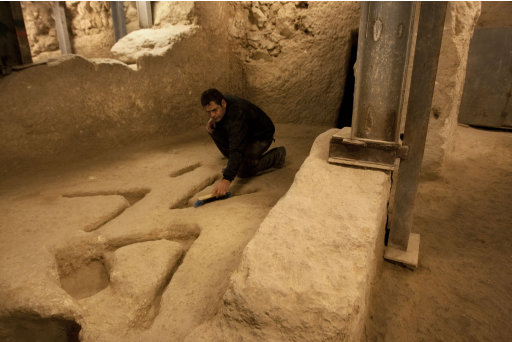
JERUSALEM (AP) — Mysterious stone carvings made thousands of years ago and recently uncovered in an excavation underneath Jerusalem have archaeologists stumped.
Israeli diggers who uncovered a complex of rooms carved into the bedrock in the oldest section of the city recently found the markings: Three "V'' shapes cut next to each other into the limestone floor of one of the rooms, about 2 inches (5 centimeters) deep and 20 inches (50 centimeters) long. There were no finds to offer any clues pointing to the identity of who made them or what purpose they served.
The archaeologists in charge of the dig know so little that they have been unable even to posit a theory about their nature, said Eli Shukron, one of the two directors of the dig.
"The markings are very strange, and very intriguing. I've never seen anything like them," Shukron said.
The shapes were found in a dig known as the City of David, a politically sensitive excavation conducted by Israeli government archaeologists and funded by a nationalist Jewish group under the Palestinian neighborhood of Silwan in east Jerusalem. The rooms were unearthed as part of the excavation of fortifications around the ancient city's only natural water source, the Gihon spring.
It is possible, the dig's archaeologists say, that when the markings were made at least 2,800 years ago the shapes might have accommodated some kind of wooden structure that stood inside them, or they might have served some other purpose on their own. They might have had a ritual function or one that was entirely mundane. Archaeologists faced by a curious artifact can usually at least venture a guess about its nature, but in this case no one, including outside experts consulted by Shukron and the dig's co-director, archaeologists with decades of experience between them, has any idea.
There appears to be at least one other ancient marking of the same type at the site. A century-old map of an expedition led by the British explorer Montague Parker, who searched for the lost treasures of the Jewish Temple in Jerusalem between 1909 and 1911, includes the shape of a "V'' drawn in an underground channel not far away. Modern archaeologists haven't excavated that area yet.
Ceramic shards found in the rooms indicate they were last used around 800 B.C., with Jerusalem under the rule of Judean kings, the dig's archaeologists say. At around that time, the rooms appear to have been filled with rubble to support the construction of a defensive wall.
It is unclear, however, whether they were built in the time of those kings or centuries earlier by the Canaanite residents who predated them.
The purpose of the complex is part of the riddle. The straight lines of its walls and level floors are evidence of careful engineering, and it was located close to the most important site in the city, the spring, suggesting it might have had an important function.
A unique find in a room beside the one with the markings — a stone like a modern grave marker, which was left upright when the room was filled in — might offer a clue. Such stones were used in the ancient Middle East as a focal point for ritual or a memorial for dead ancestors, the archaeologists say, and it is likely a remnant of the pagan religions which the city's Israelite prophets tried to eradicate. It is the first such stone to be found intact in Jerusalem excavations.
But the ritual stone does not necessarily mean the whole complex was a temple. It might simply have marked a corner devoted to religious practice in a building whose purpose was commonplace.
With the experts unable to come up with a theory about the markings, the City of David dig posted a photo on its Facebook page and solicited suggestions. The results ranged from the thought-provoking — "a system for wood panels that held some other item," or molds into which molten metal would could have been poured — to the fanciful: ancient Hebrew or Egyptian characters, or a "symbol for water, particularly as it was near a spring."
The City of David dig, where the carvings were found, is the most high-profile and politically contentious excavation in the Holy Land. Named for the biblical monarch thought to have ruled from the spot 3,000 years ago, the dig is located in what today is east Jerusalem, which was captured by Israel in 1967. Palestinians claim that part of the city as the capital of a future state.
The dig is funded by Elad, an organization affiliated with the Israeli settlement movement. The group also moves Jewish families into the neighborhood and elsewhere in east Jerusalem in an attempt to render impossible any division of the city in a future peace deal.
Palestinians and some Israeli archaeologists have criticized the dig for what they say is an excessive focus on Jewish remains. The dig's archaeologists, who work under the auspices of the government's Israel Antiquities Authority, deny that charge.
military drone was shot down over Iranian airspace,
On Wednesday November 30th an unmanned United States military drone was shot down over Iranian airspace, about 140 miles from the border of Afghanistan. The fallen drone, packed with guarded US military secrets, highlights the Obama administrations growing reliance on unmanned aircraft to fight its wars.
Unmanned drones have been a signature of the United States fight against terrorism; according to the Washington Post, U.S. drone strikes have killed twice as many suspected Al-Qaeda and Taliban members than were ever imprisoned in Guantanamo Bay. President Obama has found them particularly useful, authorizing more drone strikes in the first nine months in office than President George W. Bush did in his final three years in office.
If the recovered drone is in good shape it could provide Iran, and their allies including China and Russia, with highly guarded US military secrets, causing a fair amount of anxiety in Washington.
However, pursuing the enemy while keeping soldiers off the battle field is not a new strategy. The practice began in the 1940's when the U.S. started using unmanned rockets, and has evolved to the point where military drones are an integral part of any modern arsenal.
The United States has flown over 300 drone missions as of October of 2011, and while they're a crucial tool in modern warfare, the Bureau of Investigative Journalism believed they are to blame for hundreds of civilian casualties; a number the Pentagon denies.
Looking forward, what's the future of this joystick warfare, and is it legal? On Around the World, Christiane Amanpour is joined by Peter Singer, senior fellow at the Brookings Institute and author of Wired for War to talk about the future of drones.
Suscribirse a:
Entradas (Atom)