The research aims to produce valid information and must use reliable instruments that guarantee accurate and make it quantifiable and possible reproducibility. Allowing the exclusion or at least control prejudice of personal insights and trends that may distort the results.
Crocs Uncover
Bizarre Species
domingo, 16 de septiembre de 2012
Nanoengineers Can Print 3-D Microstructures in Mere Seconds
Nanoengineers at the University of California, San Diego have developed a novel technology that can fabricate, in mere seconds, microscale three dimensional (3D) structures out of soft, biocompatible hydrogels. Near term, the technology could lead to better systems for growing and studying cells, including stem cells, in the laboratory. Long-term, the goal is to be able to print biological tissues for regenerative medicine. For example, in the future, doctors may repair the damage caused by heart attack by replacing it with tissue that rolled off of a printer.
Human biology
Reported in the journal Advanced Materials, the biofabrication technology, called dynamic optical projection stereolithography (DOPsL), was developed in the laboratory of NanoEngineering Professor Shaochen Chen. Current fabrication techniques, such as photolithography and micro-contact printing, are limited to generating simple geometries or 2D patterns. Stereolithography is best known for its ability to print large objects such as tools and car parts. The difference, says Chen, is in the micro- and nanoscale resolution required to print tissues that mimic nature's fine-grained details, including blood vessels, which are essential for distributing nutrients and oxygen throughout the body. Without the ability to print vasculature, an engineered liver or kidney, for example, is useless in regenerative medicine. With DOPsL, Chen's team was able to achieve more complex geometries common in nature such as flowers, spirals and hemispheres. Other current 3D fabrication techniques, such as two-photon photopolymerization, can take hours to fabricate a 3D part.
The biofabrication technique uses a computer projection system and precisely controlled micromirrors to shine light on a selected area of a solution containing photo-sensitive biopolymers and cells. This photo-induced solidification process forms one layer of solid structure at a time, but in a continuous fashion. The technology is part of a new biofabrication technology that Chen is developing under a four-year, $1.5 million grant from the National Institutes of Health (R01EB012597). The Obama administration in March launched a $1 billion investment in advanced manufacturing technologies, including creating the National Additive Manufacturing Innovation Institute with $30 million in federal funding to focus on 3D printing. The term "additive manufacturing" refers to the way 3D structures are built layering very thin materials.
The Chen Research Group is focused on fabrication of nanostructured biomaterials and nanophotonics for biomedical engineering applications and recently moved into the new Structural and Materials Engineering Building, which is bringing nano and structural engineers, medical device labs and visual artists into a collaborative environment under one roof.
Computer Program Can Identify Rough Sketches
First they took over chess. Then Jeopardy. Soon, computers could make the ideal partner in a game of Draw Something (or its forebear, Pictionary).
Application software Graphical user interface
Researchers from Brown University and the Technical University of Berlin have developed a computer program that can recognize sketches as they're drawn in real time. It's the first computer application that enables "semantic understanding" of abstract sketches, the researchers say. The advance could clear the way for vastly improved sketch-based interface and search applications.
The research behind the program was presented last month at SIGGRAPH, the world's premier computer graphics conference. The paper is now available online (http://cybertron.cg.tu-berlin.de/eitz/projects/classifysketch/), together with a video, a library of sample sketches, and other materials.
Computers are already pretty good at matching sketches to objects as long as the sketches are accurate representations. For example, applications have been developed that can match police sketches to actual faces in mug shots. But iconic or abstract sketches -- the kind that most people are able to easily produce -- are another matter entirely.
For example, if you were asked to sketch a rabbit, you might draw a cartoony-looking thing with big ears, buckteeth, and a cotton tail. Another person probably wouldn't have much trouble recognizing your funny bunny as a rabbit -- despite the fact that it doesn't look all that much like a real rabbit.
"It might be that we only recognize it as a rabbit because we all grew up that way," said James Hays, assistant professor of computer science at Brown, who developed the new program with Mathias Eitz and Marc Alexa from the Technical University in Berlin. "Whoever got the ball rolling on caricaturing rabbits like that, that's just how we all draw them now."
Getting a computer to understand what we've come to understand through years of cartoons and coloring books is a monumentally difficult task. The key to making this new program work, Hays says, is a large database of sketches that could be used to teach a computer how humans sketch objects. "This is really the first time anybody has examined a large database of actual sketches," Hays said.
To put the database together, the researchers first came up with a list of everyday objects that people might be inclined to sketch. "We looked at an existing computer vision dataset called LabelMe, which has a lot of annotated photographs," Hays said. "We looked at the label frequency and we got the most popular objects in photographs. Then we added other things of interest that we thought might occur in sketches, like rainbows for example."
They ended up with a set of 250 object categories. Then the researchers used Mechanical Turk, a crowdsourcing marketplace run by Amazon, to hire people to sketch objects from each category -- 20,000 sketches in all. Those data were then fed into existing recognition and machine learning algorithms to teach the program which sketches belong to which categories. From there, the team developed an interface where users input new sketches, and the computer tries to identify them in real time, as quickly as the user draws them.
As it is now, the program successfully identifies sketches with around 56-percent accuracy, as long as the object is included in one of the 250 categories. That's not bad, considering that when the researchers asked actual humans to identify sketches in the database, they managed about 73-percent accuracy. "The gap between human and computational performance is not so big, not as big certainly as it is in other computer vision problems," Hays said.
The program isn't ready to rule Pictionary just yet, mainly because of its limited 250-category vocabulary. But expanding it to include more categories is a possibility, Hays says. One way to do that might be to turn the program into a game and collect the data that players input. The team has already made a free iPhone/iPad app that could be gamified.
"The game could ask you to sketch something and if another person is able to successfully recognize it, then we can say that must have been a decent enough sketch," he said. "You could collect all sorts of training data that way."
And that kind of crowdsourced data has been key to the project so far.
"It was the data gathering that had been holding this back, not the digital representation or the machine learning; those have been around for a decade," Hays said. "There's just no way to learn to recognize say, sketches of lions, based on just a clever algorithm. The algorithm really needs to see close to 100 instances of how people draw lions, and then it becomes possible to tell lions from potted plants."
Ultimately a program like this one could end up being much more than just fun and games. It could be used to develop better sketch-based interface and search applications. Despite the ubiquity of touch screens, sketch-based search still isn't widely used, but that's probably because it simply hasn't worked very well, Hays says.
A better sketch-based interface might improve computer accessibility. "Directly searching for some visual shape is probably easier in some domains," Hays said. "It avoids all language issues; that's certainly one thing."
Share this story on Facebook, Twitter, and Google:
NASA Mars Rover Opportunity Reveals Geological Mystery: Spherical Objects Unlike Previously Found 'Blueberries'
NASA's long-lived rover Opportunity has returned an image of the Martian surface that is puzzling researchers.
Exploration of Mars
Spherical objects concentrated at an outcrop Opportunity reached last week differ in several ways from iron-rich spherules nicknamed "blueberries" the rover found at its landing site in early 2004 and at many other locations to date.
Opportunity is investigating an outcrop called Kirkwood in the Cape York segment of the western rim of Endeavour Crater. The spheres measure as much as one-eighth of an inch (3 millimeters) in diameter. The analysis is still preliminary, but it indicates that these spheres do not have the high iron content of Martian blueberries.
"This is one of the most extraordinary pictures from the whole mission," said Opportunity's principal investigator, Steve Squyres of Cornell University in Ithaca, N.Y. "Kirkwood is chock full of a dense accumulation of these small spherical objects. Of course, we immediately thought of the blueberries, but this is something different. We never have seen such a dense accumulation of spherules in a rock outcrop on Mars."
The Martian blueberries found elsewhere by Opportunity are concretions formed by action of mineral-laden water inside rocks, evidence of a wet environment on early Mars. Concretions result when minerals precipitate out of water to become hard masses inside sedimentary rocks. Many of the Kirkwood spheres are broken and eroded by the wind. Where wind has partially etched them away, a concentric structure is evident.
Opportunity used the microscopic imager its arm to look closely at Kirkwood. Researchers checked the spheres' composition by using an instrument called the Alpha Particle X-Ray Spectrometer on Opportunity's arm.
"They seem to be crunchy on the outside, and softer in the middle," Squyres said. "They are different in concentration. They are different in structure. They are different in composition. They are different in distribution. So, we have a wonderful geological puzzle in front of us. We have multiple working hypotheses, and we have no favorite hypothesis at this time. It's going to take a while to work this out, so the thing to do now is keep an open mind and let the rocks do the talking."
Just past Kirkwood lies another science target area for Opportunity. The location is an extensive pale-toned outcrop in an area of Cape York where observations from orbit have detected signs of clay minerals. That may be the rover's next study site after Kirkwood. Four years ago, Opportunity departed Victoria Crater, which it had investigated for two years, to reach different types of geological evidence at the rim of the much larger Endeavour Crater.
The rover's energy levels are favorable for the investigations. Spring equinox comes this month to Mars' southern hemisphere, so the amount of sunshine for solar power will continue increasing for months.
"The rover is in very good health considering its 8-1/2 years of hard work on the surface of Mars," said Mars Exploration Rover Project Manager John Callas of NASA's Jet Propulsion Laboratory in Pasadena, Calif. "Energy production levels are comparable to what they were a full Martian year ago, and we are looking forward to productive spring and summer seasons of exploration."
NASA launched the Mars rovers Spirit and Opportunity in the summer of 2003, and both completed their three-month prime missions in April 2004. They continued bonus, extended missions for years. Spirit finished communicating with Earth in March 2010. The rovers have made important discoveries about wet environments on ancient Mars that may have been favorable for supporting microbial life.
JPL manages the Mars Exploration Rover Project for NASA's Science Mission Directorate in Washington.
To view the image of the area, visit: http://www.nasa.gov/mission_pages/mer/multimedia/pia16139.html
Scientists Differentiate Chemical Bonds in Individual Molecules for First Time Using Noncontact Atomic Force Microscopy
IBM scientists have been able to differentiate the chemical bonds in individual molecules for the first time using a technique known as noncontact atomic force microscopy (AFM).
Scanning tunneling microscope
The results push the exploration of using molecules and atoms at the smallest scale and could be important for studying graphene devices, which are currently being explored by both industry and academia for applications including high-bandwidth wireless communication and electronic displays.
"We found two different contrast mechanisms to distinguish bonds. The first one is based on small differences in the force measured above the bonds. We expected this kind of contrast but it was a challenge to resolve," said IBM scientist Leo Gross. "The second contrast mechanism really came as a surprise: Bonds appeared with different lengths in AFM measurements. With the help of ab initio calculations we found that the tilting of the carbon monoxide molecule at the tip apex is the cause of this contrast."
As reported in the cover story of the Sept. 14 issue of Science magazine, IBM Research scientists imaged the bond order and length of individual carbon-carbon bonds in C60, also known as a buckyball for its football shape and two planar polycyclic aromatic hydrocarbons (PAHs), which resemble small flakes of graphene. The PAHs were synthesized by Centro de Investigacion en Quimica Bioloxica e Materiais Moleculares (CIQUS) at the Universidade de Santiago de Compostela and Centre National de la Recherche Scientifique (CNRS) in Toulouse.
The individual bonds between carbon atoms in such molecules differ subtly in their length and strength. All the important chemical, electronic, and optical properties of such molecules are related to the differences of bonds in the polyaromatic systems. Now, for the first time, these differences were detected for both individual molecules and bonds. This can increase basic understanding at the level of individual molecules, important for research on novel electronic devices, organic solar cells, and organic light-emitting diodes (OLEDs). In particular, the relaxation of bonds around defects in graphene as well as the changing of bonds in chemical reactions and in excited states could potentially be studied.
As in their earlier research (Science 2009, 325, 1110) the IBM scientists used an atomic force microscope (AFM) with a tip that is terminated with a single carbon monoxide (CO) molecule. This tip oscillates with a tiny amplitude above the sample to measure the forces between the tip and the sample, such as a molecule, to create an image. The CO termination of the tip acts as a powerful magnifying glass to reveal the atomic structure of the molecule, including its bonds. This made it possible to distinguish individual bonds that differ only by 3 picometers or 3 × 10-12 meters, which is about one-hundredth of an atom's diameter.
In previous research the team succeeded in imaging the chemical structure of a molecule, but not the subtle differences of the bonds. Discriminating bond order is close to the current resolution limit of the technique and often other effects obscure the contrast related to bond order. Therefore the scientists had to select and synthesize molecules in which perturbing background effects could be ruled out.
To corroborate the experimental findings and gain further insight into the exact nature of the contrast mechanisms, the team performed first-principles density functional theory calculations. Thereby they calculated the tilting of the CO molecule at the tip apex that occurs during imaging. They found how this tilting yields a magnification and the very sharp images of the bonds.
This research was funded within the framework of several European projects including ARTIST, HERODOT, CEMAS, the Spanish Ministry of Economy and Competitiveness and the Regional Government of Galicia.
Share this story on Facebook, Twitter, and Google:
sábado, 25 de agosto de 2012
ONE GREEN THING BOTH PARTIES AGREE ON
If there's one thing Democrats and Republicans can agree on it's pedal-powered buses, seriously!
Humana, Inc. will provide 20 pedal-powered buses from Freewheelin for both parties National Conventions in Charlotte, N.C. and Tampa F.L., respectively, in the coming weeks.
What is a pedal-powered bus? Think Fred Flintstone's car, but bigger and green. The buses can hold eight people, along with a driver, that will pedal along the special trails at the conferences as well as popular areas in both cities.
The idea behind this was to provide a fun, environmentally friendly, and healthy way for visitors to get around. Humana's Chairman and CEO Mike McCalister said in a press release, "Whether it's a pedal bus, bicycle, hand-cycle or unicycle, pedaling is good for the body, the mind and the environment."
The shaded vehicles are estimated to save one pound of carbon dioxide from being emitted into the air and burn between 140 to 380 calories per rider. Freewheelin first started as a bike-sharing initiative on the health insurance company's Louisville K.Y., campus in 2007, which was then replicated at the 2008 political conventions.
The Republican National Convention starts next week on Aug. 27-30 in Tampa, Florida. The Democrats meet up in Charlotte, North Carolina Sept. 2-6. If you're planning to attend and want to catch a ride, find a representative on site to register.
VAPORIZING PLANETS IN THE NAME OF SCIENCE
One sure-fire way to grab an audience's attention is to vaporize a planet, amirite? We saw the destruction of Vulcan in Star Trek, the end of Krypton in the Christopher Reeves-era Superman, while the Death Star vaporized Alderaan in Star Wars: A New Hope.
As for Hitchhikers Guide to the Galaxy, Douglas Adams went all in, vaporizing the Earth right off the bat, all because an alien race known as the Vogons want to make way for a hyperspatial express route, leaving poor Arthur to roam about the Milky Way in his bathrobe.
But can you really vaporize a planet? According to the latest computer simulations by a couple of planetary scientists in St. Louis, you betcha! As outlined in their new paper in The Astrophysical Journal, Bruce Fegley and his colleagues (Katharina Lodders and Laura Schaefer) mathematically constructed a couple of model "Super-Earths" and put them through a series of atmospheric simulations.
The object wasn't really to study how to destroy the Earth. Fegley et al were trying to learn more about the kinds of atmospheres most likely to be found on Super-Earths -- i.e., exoplanets with masses that are more than that of Earth but less than that of Neptune, while still being rocky in nature, instead of, say, a gas giant.
Having detailed knowledge of likely chemical compositions could help astronomers who hunt for such planets find them. And one way of gaining that knowledge is to build computer models of Super-Earths and vaporize them.
Most exoplanets within that size range that have been found are gaseous in nature, because they orbit so close to their host stars that any rocky stuff gets melted. (How Stuff Works has an excellent summary of the various techniques astronomers use to hunt for exoplanets.)
For instance, using photometry, astronomers can detect an exoplanet as it transits the host star, because of predictable periodic dimming of a star's brightness as the planet momentarily blocks its light. Astronomers can also determine the chemical composition of said planet's atmosphere because the star's light gets filtered through that atmosphere -- think of it as stellar spectroscopy.
This, in turn, provides clues as to the planet's density, because the gases in the atmosphere likely came about because of vaporized rock. So it would be nice to have tidy simulated models to compare with the measured spectra of actual exoplanets.
One model Super-Earth had a continental crust just like our Earth, dominated by granite, while the other simulated Earth's composition before its crust formed, when it was mostly bulk silicate. (Water is the key ingredient in getting Earth today from that precursor Earth. Without it, our planet's crust would more closely resemble Venus.)
Then they plugged in the likely surface temperatures of observed Super-Earths, ranging from between 270 to 1700 degrees Celsius, just to see what would happen to the atmosphere. "The vapor pressure of the liquid rock increases as you heat it, just as the vapor pressure of water increases as you bring a pot to boil," Fegley explained via press release. "Ultimately this puts all the constituents of rick into the atmosphere."
In both models, the atmospheres would likely be mostly steam and carbon dioxide. Once the Super-Earths achieved temperatures above 760 degrees Celsius, there would also be sulfur dioxide. Think an especially steamy Venus.
And at temperatures higher than 1430 degrees Celsius, the uber-heated rock would produce silicon monoxide vapor. Even exoplanetary atmospheres have "weather," so should a "storm front" move through at those extreme temperatures, the simulations showed that the silicon monoxide could condense and produce "pebble rain."
Crank the temperature really, really, high, and you wouldn't just vaporize the Earth's crust and mantle. Theoretically, at least, you could destroy the entire planet. "You're left with a big ball of steaming gas that's knocking you on the head with pebbles and droplets of liquid iron," said Fegley. "But we didn't put that into the paper because the exoplanets the astronomers are finding are only partially vaporized."
Or maybe they just didn't want to give the Vogons any bright ideas.
lunes, 16 de julio de 2012
NASA's new Mars picture
The US space agency NASA has recently pieced together a panoramic view from the camera on NASA's Mars Exploration Rover Opportunity, calling it the "next best thing to being" on the Red Planet.
Here's The Most Stunning Photo of Mars The World Has Ever Seen
A TextureCam analysis of a Mars image is able to distinguish rocks from soil.
Future Planetary Rovers May Make Their Own Decisions In this undated image provided by NASA, Mars Rover Opportunity catches its own late-afternoon shadow in a view eastward across Endeavour Crater on Mars. The rover used a panoramic camera between about 4:30 and 5:00 p.m. local Mars time to record images taken through different filters and combined into this mosaic view. Most of the component images were recorded during the 2,888th Martian day, or sol, of Opportunity's work on Mars, which corresponds to March 9, 2012 on Earth. The view is presented in false color to make some differences between materials easier to see, such as the dark sandy ripples and dunes on the crater's distant floor. Opportunity has been studying the western rim of Endeavour Crater since arriving there in August 2011.
In this undated image provided by NASA, Mars Rover Opportunity catches its own late-afternoon shadow in a view eastward across Endeavour Crater on Mars. The rover used a panoramic camera between about
A close-up of the sunset on Sol 24 as seen by the Imager for Mars Pathfinder was released by the Jet Propulsion Labratory August 27. The red sky in the background and the blue around the Sun are approximately as they would appear to the human eye but the color of the Sun itself is not correct -- the Sun was overexposed in each of the 3 color images that were used to make the picture. The true color of the Sun itself may be near white or slightly bluish.
Mars Mars
A portion of the west rim of Endeavour crater sweeps southward in this color view from NASA's Mars Exploration Rover Opportunity released by NASA August 10, 2011. This crater has a diameter of about 14 miles (22 km). This view combines exposures taken by Opportunity's panoramic camera (Pancam) of the rover's work on Mars August 6, 2011. Opportunity arrived at the rim during its next drive on August 9, 2011. Endeavour crater has been the rover team's destination for Opportunity since the rover finished exploring Victoria crater in August 2008. Endeavour offers access to older geological deposits than any Opportunity has seen before. The lighter-toned rocks closer to the rover in this view are similar to the rocks Opportunity has driven over for most of the mission. However, the darker-toned and rougher rocks just beyond that might be a different type for Opportunity to investigate. The ground in the foreground is covered with iron-rich spherules, nicknamed "blueberries," which Opportunity has observed frequently since the first days after landing. They are about 0.2 inch (5 millimeters) or more in diameter. REUTERS/NASA/JPL-Caltech/Cornell/ASU/Handout (UNITED STATES - Tags: SCI TECH) FOR EDITORIAL USE ONLY. NOT FOR SALE FOR MARKETING OR ADVERTISING CAMPAIGNS. THIS IMAGE HAS BEEN SUPPLIED BY A THIRD PARTY. IT IS DISTRIBUTED, EXACTLY AS RECEIVED BY REUTERS, AS A SERVICE TO CLIENTS
Homes for extreme climates
Unrelenting winter nights and endless summer days. Temperatures that can plummet to 120 below or more. Snow, ice, and rock. There are few environments on earth more hostile than the frozen Antarctic wastelands. But even with winds of up to nearly 200 mph, it’s not impossible for people to survive in the coldest place on the planet.
In fact, humans are able to live in almost every world climate, driest deserts and densest jungles included—and it helps if you’ve got the right kind of shelter.
With permanent bases from countries all over the world, there are a number of approaches to building design in the harsh Antarctic region. Construction company Misawa Homes, which built most of the Antarctic facilities for the Japanese government’s Showa Station, opted for single-shell housing technology — useful when trying to keep out some of the coldest temperatures on earth.
On the other end of the climate spectrum, rainforests demand a much different approach to adaptive construction. One house in the outskirts of São Paulo, Brazil, is specially built to its jungle environment. The Iporanga “tree house” stands three stories tall, is partially wrapped in glass walls, and is tightly nestled into the forest, with the trees all but scraping the windows. The house, with its modest use of concrete and steel, plays chameleon by blending into the leaves which surround it.
Frozen Wasteland Cocoons
East Ongul Island, Antarctica
Outdoors, the thermometer reads 80 below and the winds whirl at 120 mph. Indoors, it’s toasty warm. The ultimate in form following way behind function, these Antarctic boxes are also wrapped in a “single shell,” with features to withstand the most unforgiving climactic conditions on the planet. With a design based on the company’s wooden-panel adhesion system, the polar dwellings are built to take an estimated 100 years of Antarctic punishment.
Iporanga Jungle Tree House
Near São Paulo, Brazil
Chimps have got it figured out: if you’re going to live in a rainforest, it’s better to be perched up in the trees. Brazilian architecture company Nitsche Arquitetos Associados designed this home in the thick forest outside São Paulo in 2006.
Five bedrooms on the top level of this three-story home provide both a high lookout from which to survey the surrounding jungle and privacy due to the height. But the main level is unquestionably the main attraction of the home, with a hyper-modern living room, dining room and kitchen. Structural elements, such as I-beams, are as exposed as the residents within. Though much of the home is made of steel, glass and concrete, the house never feels out of place, thanks to the way in which outside foliage plays a central role in the design scheme.
Rondolino Residence
Near Scotty's Junction, Nevada
Nottoscale, a San Francisco-based architectural company, used its own prefab building system to put together this one-bedroom, 1,200-square-foot desert house. Situated on a 40-acre lot, the home is completely dwarfed by its surroundings and looks every bit like the prefab home (with a modern sensibility) that it is. But the home isn’t the point – the location is.
“Isolation is much of the beauty of the property,” says the firm’s website. Another beautiful aspect? Its environmental efficiency. The desert dwelling is heated with a hydronic radiant system and features high-performance insulation. The home’s minimalist approach includes a simple 900-square-foot deck.
Hof House
Skakafjördur Fjord, Iceland
Located 60 miles south of the Arctic Circle, this sturdy home efficiently protects its residents from outside elements. Built on an estate that includes a church, barn and a cowshed, the home is built with natural and recycled construction materials such as cedar and concrete walls designed to visibly age according to the weather.
Geothermal and solar sources heat the entirety of the home. The grass turf on the roof, which was salvaged from some of the ground on which the home was built, isn’t the only material the architects reused: stone from the old house was cut to pave ground surfaces outside the new one, and old telegraph poles were used for building windows. The home was designed by Icelandic architectural firm Studio Granda.
domingo, 8 de julio de 2012
The BlackBerry, Trying to Avoid the Hall of Fallen Giants
FORGET the Union — what’s the state of the BlackBerry?
Research in Motion, maker of BlackBerry smartphones and tablets, sent its co-chief executives packing last week and replaced them with Thorsten Heins, who had been RIM’s chief operating officer. How would he characterize his employer?
“We make the best communications devices in the world,” said Mr. Heins, who met with editors and reporters from The New York Times on Friday.
Not everyone feels the same way. Over the last year, RIM’s share price has plunged 75 percent. The company once commanded more than half of the American smartphone market. Today it has 10 percent.
RIM has two, maybe three ways forward.
The first — the one that Mr. Heins is clearly aiming for — is a triumphant comeback after a near-death experience. Think Apple and its iMac. RIM is on the verge of upgrading its PlayBook operating system — now with, among other things, e-mail, a feature that the original PlayBook bafflingly lacked — and will release the BlackBerry 10 OS this year.
Behind Door No. 2 is a gradual decline and diminution as rivals like Apple, Google and Microsoft devour most of the market; to some degree, they already have. BlackBerry would keep the scraps — a small but dedicated following of corporate and government customers who want its proprietary messaging and security features.
Then there is the third option: oblivion. The road of progress is littered with the corpses of fallen titans. Objects that once seemed as indispensable as the companies that made them have been mercilessly superseded — as seen below. And RIM ought to know: with mobile devices like the BlackBerry 957, it helped to extinguish the pager era.
SONY WALKMAN (1979-2010) Before the Walkman, “personal audio” meant holding a transistor radio to your ear. Sony’s invention created an entire category of devices and helped make the company the technology leader of the 1980s. New models (Thinner! Auto-reverse!) were eagerly anticipated, the LP was relegated to the attic and tender moments spent listening to mix tapes from that certain someone proliferated across teenage bedrooms. Sony seemed incapable of putting a foot wrong. It successfully moved the brand into compact discs with the Discman, then bought record labels and movie studios to bring about that illusory marriage of technology and content. When the digital revolution hit, Sony was too beholden to its proprietary formats, as well as to the inertia inside its media companies. Enter Apple and the iPod.
PAGERS (BORN 1951) At first, pagers were attached to people who worked in fields where lives were on the line. That usually meant doctors, though the group expanded in the late 1980s to include drug dealers. Early beepers displayed only numbers, giving rise to a numerical lexicon that included codes like 911 (call me back immediately) and 07734, which resembles “hello” when read upside down. Pagers briefly gained fame in early 1990s hip-hop, showing up in songs like “Skypager,” by a Tribe Called Quest. The pager’s fall was attributable to the disruptive and destructive powers of another technology: the mobile phone. Why beep when you can talk? And a pager message is so tiny that it makes a tweet look like “The Iliad.” The beeper does live on, in limited circles: its network remains more reliable than cell networks, making it useful to E.M.S. and other rescue workers.
PALM PILOT (1997-2007) Filofax brought personal organizers to their analog apogee in the early ’90s, but Palm brought them into the digital age. Palm Pilots were dazzling when they first appeared: all of your contacts, calendars and notes in one slim, pocket-size device. A touch screen, which required a stylus, made navigation easy. And you could add software, bought through an online store. Want a Zagat guide to go along with your personal data? No problem. In later years, Palm even added telephone features, creating a compelling, all-in-one gadget. Despite boardroom dramas that affected the company’s name and its ownership, Palm’s reputation as a source of innovative hardware and software endured until Jan. 9, 2007. Why that date? That’s when Apple introduced the iPhone.
POLAROID INSTANT CAMERAS (1948-2008) Edwin Land’s invention of instant-developing film in 1948 put a darkroom inside a handheld camera. That achievement gave his Polaroid Corporation a distinct advantage over traditional film cameras. By 1980, Polaroid was selling 7.8 million cameras a year in the United States — more than half of all the 15 million cameras, instant and traditional, sold that year. In 1985, it won a major patent-infringement suit, forcing Kodak to abandon its own instant-camera efforts. The victory was short-lived. The late ’80s brought the rise of the digital camera. By 2000, digital cameras began appearing on cellphones, placing cameras in millions of pockets. Polaroid declared bankruptcy for the first time in 2001 and stopped making instant film in 2008. Kodak declared bankruptcy on Jan. 19.
ATARI 2600 (1977-c.1984) It wasn’t the first game console, but the Atari 2600 brought video games into the home and popular culture. Over its life span, more than 30 million were sold. Pong, Combat, Pitfall and Frogger soaked up children’s afternoons. Then came the PC, which could play games and do much more. Atari rushed out games, assuming that its customers would play whatever it released. They didn’t. Millions of unsold games and consoles were buried in a New Mexico landfill in 1983. Warner Communications, which bought Atari in 1976 for $28 million, sold it in 1984 for no cash.
New York Times
Egypt begins restoring ancient boat near pyramids
In this Thursday, June 23, 2011 file photo, an Egyptian and Japanese team of scientists …
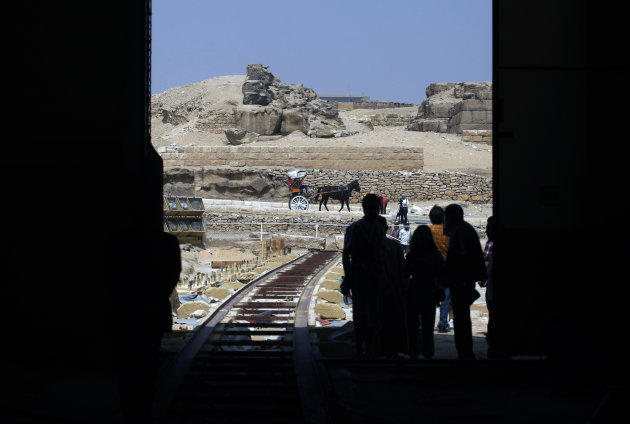
CAIRO (AP) — Archaeologists on Monday began restoration on a 4,500-year-old wooden boat found next to the pyramids, one of Egypt's main tourist attractions.
The boat is one of two that were buried next to the Pharaoh Khufu, spokesmen for a joint Egyptian-Japanese team of archeologists said. The boats are believed to have been intended to carry pharaohs into the afterlife.
Khufu, also known as Cheops, is credited with building the Great Pyramid of Giza, the largest of the pyramids. Khufu, son of Snefru, was the second ruler of the 4th Dynasty around 2680 B.C. and ruled Egypt for 23 years.
Both boats, made from Lebanese cedar and Egyptian acacia trees, were originally discovered in 1954. One of the boats is on display at a museum near the pyramids.
The second boat, which is now undergoing the restoration, remained buried. It is thought to be smaller than its sister ship, which is about 140 feet (43 meters) long.
The head of Egypt's Supreme Council of Antiquities, Mustafa Amin, said Egyptologists began taking samples of the wood for restoration on Monday.
"The boat was found in a complete shape, intact and in place," he said, adding that the focus now is on taking samples of the wood.
He said Egyptologists are studying "the different components and fungus in the wood in order to find the most sufficient and advanced way to work on the wood."
Last year in June, a team of scientists lifted the first of 41 limestone slabs each weighing about 16 tons to uncover the pit in which the ancient ship was buried, said Sakuji Yoshimura, professor from Japan's Waseda University.
At the time, experts said restoration would likely take about four years and that at its completion, the boat would be placed on display at the Solar Boat Museum near the pyramids, which routinely attract millions of tourists and boost one of Egypt's most important industries.
The team had initially thought the vessel would be safer left underground than exposed to pollution, but evidence showed that pollution, water and insects had invaded the boat's chamber.
A $10 million grant from Waseda University has helped in preparing the ship's excavation process.
Suscribirse a:
Entradas (Atom)